What is Chatbot AI? Complete Guide to AI Chatbots in 2026

What is Chatbot AI? Complete Guide to AI Chatbots in 2026
Table of Contents
- 1. What is Chatbot AI? (Understanding the Basics)
- 2. How Does Chatbot AI Work? (The Technology Behind)
- 3. Top AI Chatbots in 2026 (Chatbot Examples)
- 4. Practical Applications of Chatbot AI
- 5. Advantages of Using Chatbot AI
- 6. Limitations and Challenges of Chatbot AI
- 7. How to Effectively Use Chatbot AI
- 8. The Future of Chatbot AI
- 9. Frequently Asked Questions (FAQ)
1. What is a Chatbot AI? (Understanding the Basics)
A chatbot AI is a software application powered by artificial intelligence that simulates human conversation. These intelligent programs use natural language processing (NLP) and machine learning to understand user queries and provide relevant, contextual responses without human intervention.
Unlike traditional rule-based chatbots that rely on pre-programmed responses, modern AI chatbots leverage advanced language models to understand context, nuance, and intent. They can engage in meaningful dialogues, answer complex questions, and even learn from interactions.
1.1 Key Components of AI Chatbots
Modern chatbot AI systems comprise several essential components that work together seamlessly:
- Natural Language Processing (NLP): Enables the chatbot to understand human language in all its complexity, including slang, context, and linguistic variations
- Machine Learning Models: Allow the chatbot to improve and learn from every interaction, becoming smarter over time
- Language Models: Large pre-trained models like GPT that generate contextual, relevant responses
- Intent Recognition: Identifies what the user actually wants to accomplish beyond their literal words
- Knowledge Base: A repository of information the chatbot can reference to provide accurate answers
- Response Generation: Creates human-like responses based on the user’s input and context
1.2 Types of Chatbots
| Type | Description | Best Use Case | Examples |
|---|---|---|---|
| Rule-Based Chatbots | Follow pre-programmed rules and decision trees | FAQ automation, simple inquiries | Basic customer service bots |
| Retrieval-Based | Select responses from predefined database | Q&A systems, knowledge bases | Support center chatbots |
| Generative AI Chatbots | Generate original responses using language models | Complex conversations, creative tasks | ChatGPT, Google Bard, Claude |
| Hybrid Chatbots | Combine rule-based and generative approaches | Enterprise solutions needing both accuracy and flexibility | Advanced enterprise solutions |
2. How Does Chatbot AI Work? (The Technology Behind)
Understanding how chatbot AI works requires knowledge of several interconnected technologies. Let’s break down the process step by step.
2.1 The Conversation Flow
When you type a message to a chatbot, it doesn’t immediately respond. Instead, it goes through a sophisticated multi-step process:
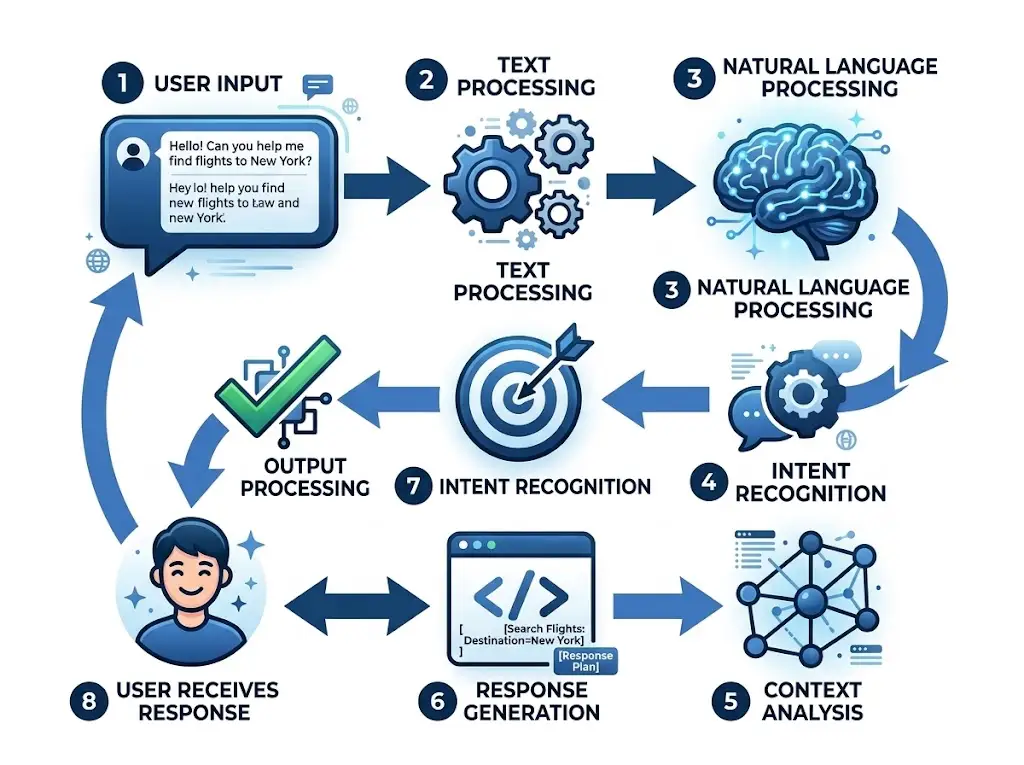
- Input Reception: The chatbot receives your text message through its interface
- Text Preprocessing: The input is cleaned and standardized (removing unnecessary characters, converting to lowercase)
- Tokenization: The text is broken into smaller units (tokens) that the model can process
- Intent Recognition: The system identifies what you’re trying to accomplish
- Entity Extraction: Relevant information (names, dates, numbers) is extracted from your message
- Context Analysis: The chatbot considers previous messages in the conversation for context
- Response Generation: Using language models, the chatbot generates an appropriate response
- Output Delivery: The response is formatted and displayed to you
2.2 Natural Language Processing (NLP) Explained
NLP is the technological heart of modern chatbots. It’s the field of artificial intelligence that focuses on enabling computers to understand, interpret, and generate human language in a meaningful and useful way.
There are two main approaches in NLP:
2.3 Large Language Models (LLMs)
The most advanced chatbots today are powered by Large Language Models (LLMs). These are artificial neural networks trained on vast amounts of text data from the internet, books, and other sources.
LLMs like GPT-4, Claude, and Google’s Gemini are pre-trained on hundreds of billions of text samples, enabling them to understand patterns in language and generate coherent, contextually relevant responses for virtually any topic.
The key advantage of LLMs is their ability to:
- Understand complex context and nuance in human language
- Generate human-like responses that are grammatically correct and semantically meaningful
- Adapt to different communication styles and preferences
- Handle ambiguous queries by asking clarifying questions
- Provide detailed explanations and reasoning for their responses
3. Top AI Chatbots in 2026 (Chatbot Examples)
Several prominent AI chatbots are leading the market in 2026. Let’s examine the characteristics and capabilities of the most popular ones.
3.1 ChatGPT
Developed by OpenAI, ChatGPT is one of the most popular and accessible AI chatbots available today. It’s built on the GPT-4 architecture and can engage in complex conversations across virtually any topic.
Key Features:
- Conversational and user-friendly interface
- Capable of writing, coding, analysis, and creative tasks
- Available through web, mobile app, and API integration
- Free version with Plus subscription for advanced features
- Multi-modal capabilities including image and file analysis
Best For: Content creation, coding assistance, learning, brainstorming, and general question-answering
3.2 Google Bard (Gemini)
Google’s entry into the generative AI chatbot space, Bard (now integrated into Google’s Gemini ecosystem), leverages Google’s cutting-edge AI research and massive knowledge base.
Key Features:
- Integration with Google services and real-time information
- Advanced reasoning and multi-step problem solving
- Access to current information without knowledge cutoff
- Free access through Google’s interface
- Strong performance in factual accuracy and citations
Best For: Research, fact-checking, real-time information retrieval, and integration with Google Workspace
3.3 Claude (Anthropic)
Claude, developed by Anthropic, is known for its alignment with human values, extensive context window, and nuanced understanding of complex topics.
Key Features:
- Very large context window (200,000+ tokens)
- Strong performance on reasoning and analysis tasks
- Emphasis on safety and alignment with human values
- Document and code analysis capabilities
- Available through web interface and API
Best For: Long-form content analysis, detailed research, complex reasoning, and professional applications
3.4 Microsoft Copilot
Microsoft’s integration of AI chatbot capabilities across their product ecosystem, including Office, Windows, and Azure, making AI assistance readily available to enterprise users.
Key Features:
- Deep integration with Microsoft Office and Windows
- Enterprise-ready with security and compliance features
- Real-time web search capabilities
- Multimodal capabilities (text, images, code)
- Available across devices and platforms
Best For: Enterprise environments, Office productivity, coding assistance, and business applications
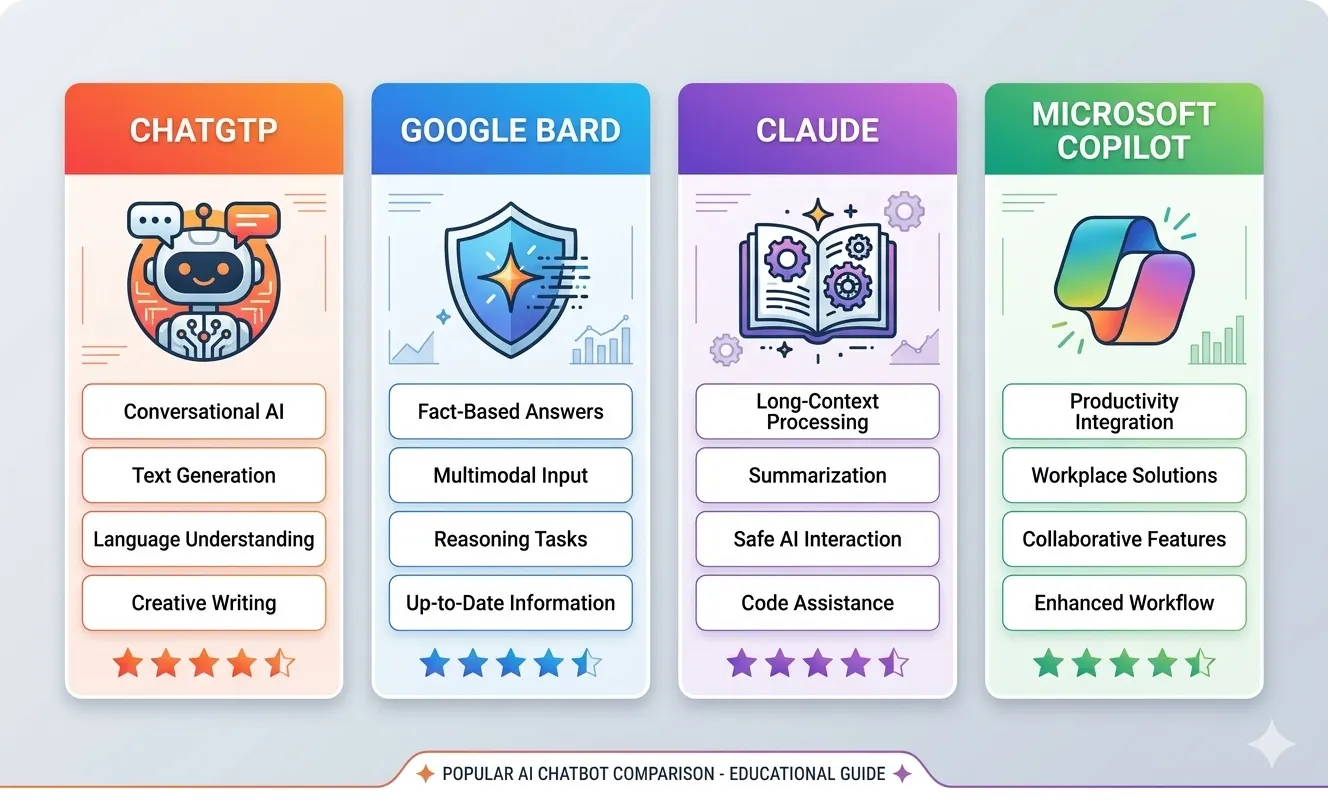
| Chatbot | Creator | Strengths | Best For | Pricing |
|---|---|---|---|---|
| ChatGPT | OpenAI | Versatile, user-friendly, creative tasks | Content, coding, learning | Free/Paid |
| Google Bard | Real-time info, factual accuracy | Research, fact-checking | Free | |
| Claude | Anthropic | Reasoning, large context, alignment | Analysis, long content | Free/Paid |
| Copilot | Microsoft | Enterprise integration, security | Business, Office apps | Enterprise |
4. Practical Applications of Chatbot AI
4.1 Customer Service and Support
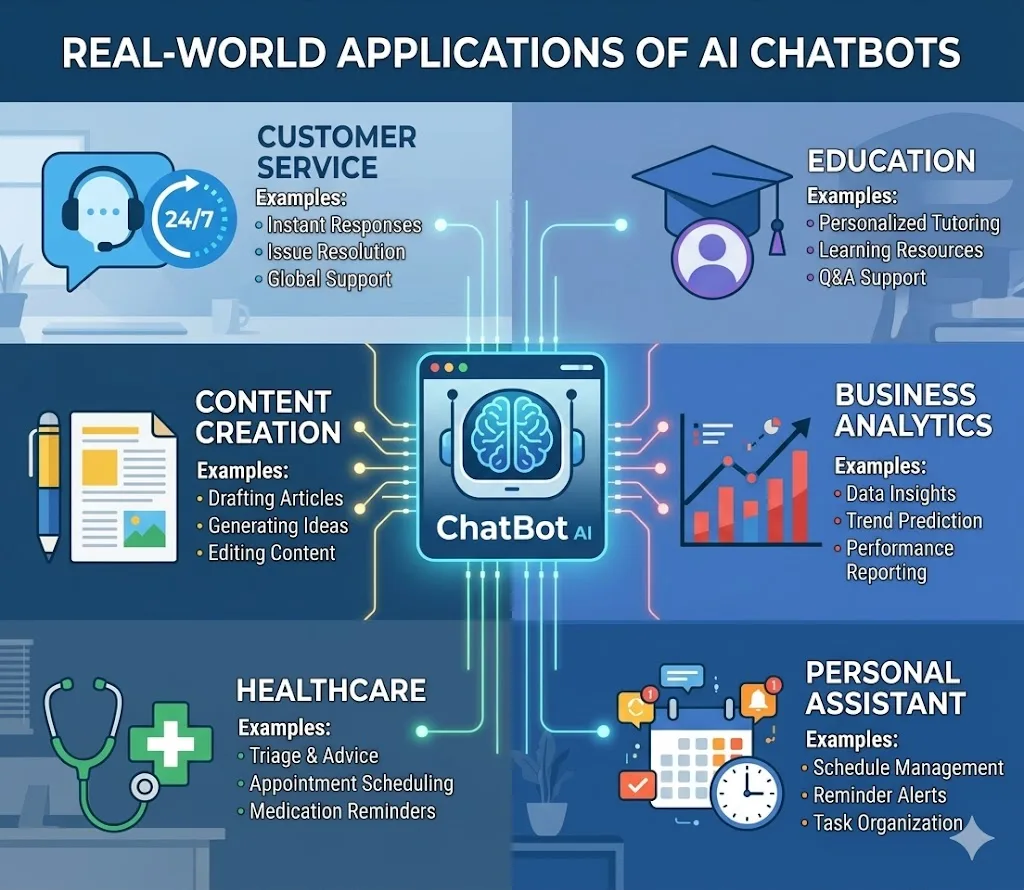
One of the most widespread applications of chatbot AI is in customer service. AI chatbots handle inquiries 24/7, reducing response times and improving customer satisfaction.
Case Study: Enterprise Customer Support
A major e-commerce company implemented an AI chatbot to handle customer inquiries. Within six months, the chatbot resolved 85% of customer queries without human intervention, reduced average response time from 4 hours to 2 minutes, and improved customer satisfaction scores by 23%. This resulted in $2.1 million in annual savings while maintaining or exceeding service quality standards.
4.2 Content Creation and Writing Assistance
Chatbot AI has become an invaluable tool for writers, marketers, and content creators. These tools assist with brainstorming, drafting, editing, and optimizing content for various platforms and audiences.
Professionals use chatbot AI to:
- Generate article outlines and structure
- Create compelling headlines and meta descriptions
- Draft social media posts and email campaigns
- Improve grammar, clarity, and tone
- Conduct research and gather information on topics
4.3 Education and Learning
AI chatbots are transforming educational experiences by providing personalized tutoring, answering student questions, and adapting to individual learning styles.
Case Study: AI-Powered Learning Assistant
An educational technology company deployed an AI chatbot as a learning assistant for high school students. The chatbot provided 24/7 homework help, explained complex concepts, and adapted explanations based on student comprehension levels. Students using the chatbot improved their test scores by an average of 15%, and engagement metrics increased by 40%.
4.4 Business Intelligence and Data Analysis
Advanced chatbots help businesses extract insights from data, generate reports, and make informed decisions through natural language interfaces.
4.5 Personal Productivity and Organization
AI chatbots assist users in managing calendars, setting reminders, taking notes, and organizing information through conversational interfaces.
5. Advantages of Using Chatbot AI
The adoption of chatbot AI continues to grow due to numerous compelling benefits:
Primary Advantages:
- 24/7 Availability: Chatbots provide instant responses at any time, eliminating wait times
- Cost Efficiency: Automating routine inquiries reduces operational costs significantly
- Scalability: Handle unlimited simultaneous conversations without quality degradation
- Consistency: Provide uniform responses and information quality across all interactions
- Data Collection: Gather valuable insights about user needs, preferences, and behavior patterns
- Personalization: Learn user preferences and tailor responses accordingly
- Reduced Human Error: Eliminate mistakes common in manual processes
- Improved User Experience: Natural conversations feel more intuitive and helpful
6. Limitations and Challenges of Chatbot AI
Despite their advantages, current chatbot AI systems have notable limitations that users should understand:
6.1 Knowledge Cutoff
Most AI chatbots are trained on data up to a specific date and lack real-time information. This means they cannot provide current news, stock prices, or recent events beyond their training data.
6.2 Hallucination and Inaccuracy
AI chatbots sometimes generate plausible-sounding but completely false information, a phenomenon called “hallucination.” While improving, this remains a significant limitation for factual queries.
6.3 Limited Contextual Understanding
Despite advances, chatbots still struggle with deeply sarcastic, culturally nuanced, or highly ambiguous queries that humans easily understand.
6.4 Privacy and Data Security Concerns
Users must be cautious about sharing sensitive information with chatbots, as conversations may be stored and analyzed.
6.5 Dependence and Over-Reliance
Over-reliance on chatbots for decision-making without critical evaluation can lead to poor outcomes.
7. How to Effectively Use Chatbot AI
To maximize the benefits of chatbot AI, follow these best practices:
7.1 Craft Clear and Specific Prompts
The quality of chatbot responses depends heavily on the quality of your input. Instead of vague questions, provide context and specific details.
Example:
- ❌ Weak: “Write about AI”
- ✅ Strong: “Write a 500-word article about the impact of AI chatbots on customer service in 2026, including specific examples and statistics”
7.2 Iterate and Refine
Don’t accept the first response. Ask follow-up questions to refine, expand, or adjust the output to better match your needs.
7.3 Verify Information
Always fact-check important information provided by chatbots, especially for factual claims, statistics, and citations.
7.4 Use It as a Starting Point
Treat chatbot output as a foundation that requires human review, editing, and refinement rather than final, ready-to-use content.
7.5 Provide Feedback
Many platforms allow you to rate responses. Providing feedback helps improve future responses and the overall system.
8. The Future of Chatbot AI
The chatbot AI landscape continues to evolve rapidly. Several trends are shaping the future:
8.1 Multimodal Capabilities
Future chatbots will seamlessly handle text, images, video, and audio, providing more comprehensive assistance across different content types.
8.2 Enhanced Reasoning Abilities
Next-generation models will demonstrate superior logical reasoning, mathematical problem-solving, and scientific thinking comparable to human experts.
8.3 Better Grounding in Reality
Chatbots will have improved access to real-time information and better mechanisms to distinguish between knowledge and speculation.
8.4 Personalization and Memory
Advanced chatbots will maintain long-term user contexts and develop truly personalized interactions based on extended conversation history.
8.5 Integration with Physical World
AI assistants will increasingly control smart devices, manage physical tasks, and interact with the real world through robotic interfaces.
9. Frequently Asked Questions (FAQ)
Conclusion: The Chatbot AI Revolution
Chatbot AI has transitioned from experimental technology to essential tools in business, education, and personal productivity. Understanding what chatbots are, how they work, and how to use them effectively positions you to leverage these powerful tools in 2026 and beyond.
Whether you’re using ChatGPT for content creation, Google Bard for research, Claude for complex analysis, or Copilot for business tasks, the key is approaching these tools with clear objectives, realistic expectations, and a critical mindset.
As chatbot AI technology continues evolving with improved accuracy, real-time capabilities, and multimodal features, those who master these tools will gain significant advantages in productivity, learning, and innovation.
Ready to explore chatbot AI yourself? Start with a free account on ChatGPT or Google Bard, experiment with different prompts, and discover how this technology can enhance your daily tasks and creative projects.
Share this article