Using AI for Creative Ideas: Complete Guide for Creators & Entrepreneurs

Using AI for Creative Ideas: Complete Guide for Creators & Entrepreneurs
Creativity doesn’t flow the same way for everyone. Some days inspiration strikes like lightning. Other days, you’re staring at a blank screen wondering where your brilliant ideas went. This is where artificial intelligence transforms your creative process.
In 2026, artificial intelligence has evolved from a futuristic concept to an essential creative partner for thousands of content creators, entrepreneurs, and designers worldwide. The question isn’t whether AI can help you be more creative anymore. The real question is: how can you leverage AI tools to unlock your fullest creative potential?
This comprehensive guide walks you through everything you need to know about using AI for creative ideas, from brainstorming techniques to practical implementation strategies backed by real case studies.
📑 Table of Contents
What Is AI for Creativity? Understanding the Fundamentals
Artificial intelligence for creativity represents a paradigm shift in how creators approach their work. Rather than replacing human creativity, AI serves as a powerful amplifier, accelerating ideation, reducing creative blocks, and expanding the boundaries of what’s possible in content creation and business development.
Think of AI as your digital brainstorming partner. When you interact with advanced language models like ChatGPT, Claude, or Gemini, you’re not just getting random suggestions. You’re tapping into patterns learned from billions of examples, allowing these systems to generate novel combinations and perspectives you might never have considered alone.
How AI Understands Creativity
Modern AI systems don’t understand creativity the way humans do emotionally. However, they excel at recognizing patterns in creative expression. They can analyze thousands of successful marketing campaigns, viral content pieces, and innovative product concepts to identify what makes ideas resonate with audiences. This pattern recognition becomes invaluable for generating fresh, engaging concepts.
The Psychology Behind AI-Assisted Creativity
Research shows that humans are most creative when they’re not overthinking. Paradoxically, working with AI actually frees your mind from the pressure of coming up with perfect ideas instantly. By having AI generate numerous options rapidly, you shift from “must be perfect” to “let me choose the best from many possibilities.” This psychological shift alone can dramatically increase your creative output quality.
Why AI Brainstorming Matters More Than Ever
The modern creative landscape demands constant innovation. Content creators face unprecedented competition. Entrepreneurs must launch dozens of campaigns to find winning ideas. Designers need fresh concepts weekly. The traditional brainstorming approach—sitting alone hoping for inspiration—simply doesn’t scale anymore.
The Brainstorming Speed Advantage
Without AI, generating 50 quality ideas takes hours or even days. With AI brainstorming tools, you can generate 50 ideas in 10 minutes. This isn’t about quantity for quantity’s sake. More ideas mean better odds of finding truly exceptional ones. According to creative industry research, the 50th idea often surpasses the first 20 in originality and effectiveness.
Breaking Through Creative Blocks
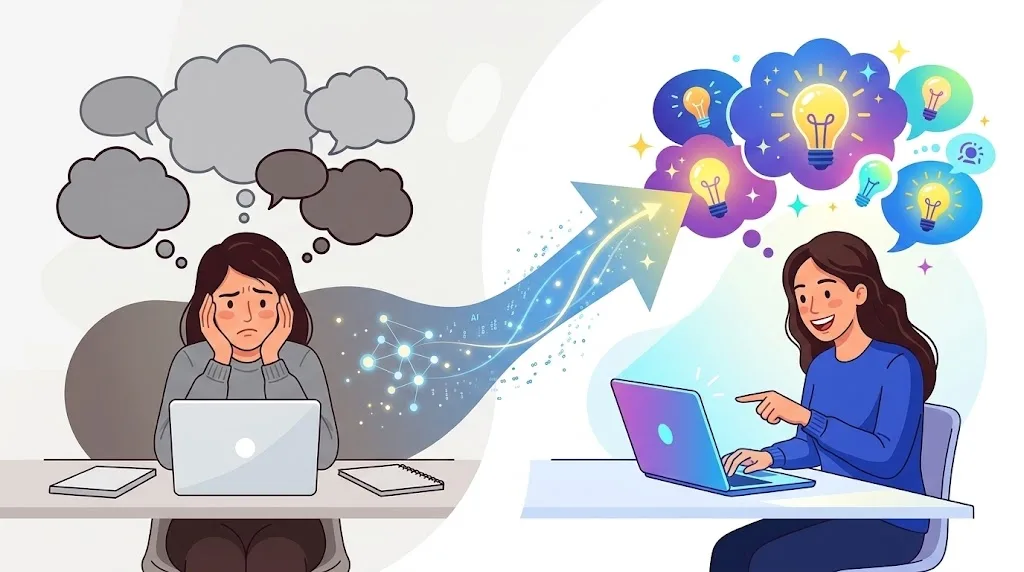
Creative block is one of the most frustrating challenges professionals face. AI offers a practical solution. By asking your AI partner to approach your topic from completely different angles—historical perspective, psychological angle, contrarian view, humor-based approach—you can bypass mental blocks that normally trap you in familiar thinking patterns.
Scalability Without Burnout
Many creators and entrepreneurs struggle with scaling content production. You want to create more, but your creative energy is finite. AI allows you to maintain consistent output without the mental exhaustion that normally accompanies high-volume creative work. You’re directing and refining rather than starting from scratch every time.
“The most innovative companies today aren’t using AI to replace creativity. They’re using it to democratize creativity—giving every team member the ability to generate ideas at the level previously reserved for their most creative minds.”
— Dr. Marcus Chen, Director of Innovation at Creative Tech Institute
Top AI Tools for Creative Ideas in 2026
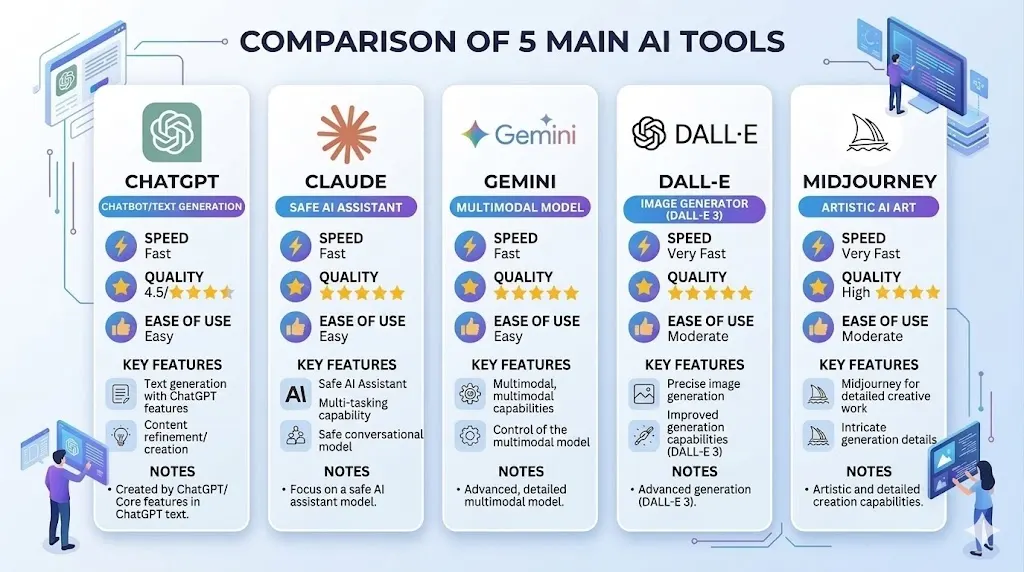
The AI tool landscape evolves rapidly, but several platforms have established themselves as industry leaders for creative work. Let’s examine the most effective tools and what makes each valuable for different creative applications.
Language Models: The Foundation of AI Creativity
Large language models form the backbone of most AI creative tools. These systems analyze patterns in language to generate human-like responses, making them perfect for brainstorming, copywriting, and content ideation.
| AI Tool | Best For | Key Features | Price |
|---|---|---|---|
| ChatGPT 4.5 | General brainstorming, content ideas, copywriting | Fast responses, multimodal, web browsing, file handling | $20/month or free |
| Claude 3.5 | Deep analysis, complex ideation, writing quality | Long context window, excellent reasoning, nuanced output | Free or subscription |
| Google Gemini | Multimodal creativity, image analysis for ideas | Integration with Google workspace, advanced vision capabilities | Free or $20/month |
| Perplexity AI | Research-backed brainstorming, trend analysis | Real-time web search, source citations, research optimization | Free or $20/month |
| Midjourney/DALL-E 3 | Visual creative concepts, design ideation | High-quality image generation, style consistency, editing | $10-30/month |
Specialized AI Creative Platforms
Beyond general language models, numerous specialized platforms focus on specific creative domains. These tools often integrate AI with domain-specific features that enhance particular types of creative work.
For Content Creators: Tools like Copy.ai, Jasper, and Writesonic focus specifically on content creation, offering templates for blog posts, social media, email campaigns, and advertising copy. These platforms pre-structure prompts for creativity, making it easier for non-technical users to generate quality output.
For Marketers: Platforms including HubSpot’s AI, Marketo, and Hootsuite Intelligence provide AI brainstorming within marketing workflows. They suggest campaign angles, content themes, and optimization strategies based on historical performance data.
For Designers: Tools like Figma AI, Adobe Firefly, and Canva’s Magic Generate visual design ideas from text descriptions. These are revolutionary for designers who need to generate multiple design concepts quickly or explore directions they hadn’t considered.
Enterprise Solutions for Teams
Organizations with larger teams often benefit from dedicated AI platforms that include collaboration features, brand voice consistency, and workflow integration. Solutions like Workday Creativity Suite and Salesforce Einstein are reshaping how teams approach brainstorming at scale.
Proven Strategies for AI-Powered Creative Ideation
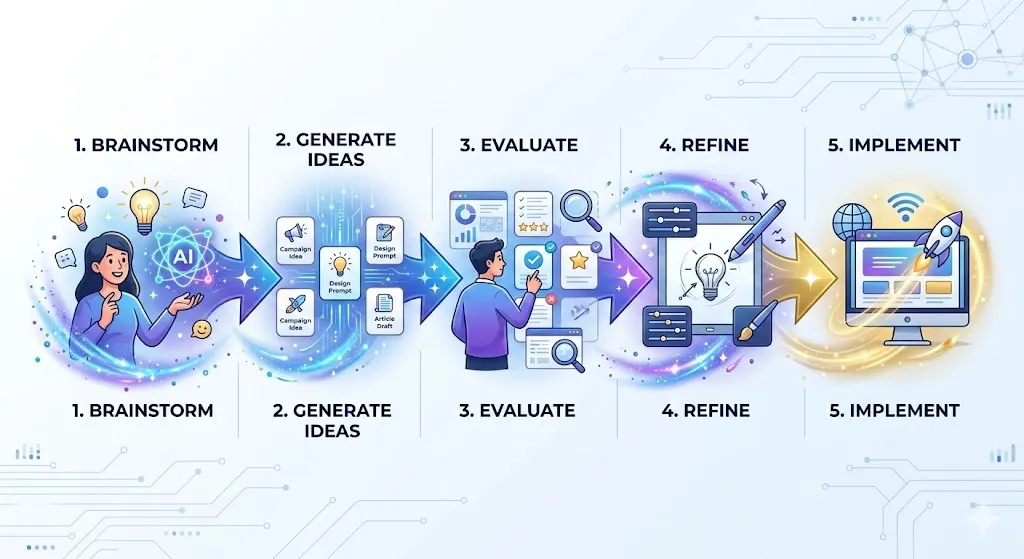
Having access to AI tools is one thing. Using them effectively to unlock breakthrough ideas is another. Let’s explore battle-tested strategies that professionals use to maximize creative output with AI assistance.
The Prompt Engineering Method
Your results from AI directly depend on question quality. Vague prompts produce mediocre ideas. Specific, well-structured prompts generate exceptional output. This is called prompt engineering—the skill of crafting questions that extract maximum value from AI systems.
Example Weak Prompt: “Give me some blog post ideas about marketing.”
Example Strong Prompt: “Generate 20 unique blog post ideas for a B2B SaaS company targeting marketing directors. Each idea should address a specific pain point these directors face when implementing marketing automation. Include potential CTAs that drive demo signups. Format as title, pain point addressed, and suggested CTA.”
The difference? The strong prompt provides context, specifies format, includes constraints, and defines success criteria. This focuses AI output toward actually usable ideas rather than generic suggestions.
The Divergent-Convergent Method
This two-phase approach mirrors how elite creative teams work. First, diverge—generate numerous ideas without judgment. Second, converge—evaluate and refine those ideas into actionable concepts.
Phase 1 – Divergence (Quantity Focus): Ask your AI tool to generate 50-100 variations of an idea. Don’t filter for quality yet. Just capture volume. This phase typically takes 15-30 minutes with AI versus days with traditional brainstorming.
Phase 2 – Convergence (Quality Focus): Review generated ideas and ask your AI to develop the top 5-10 in greater detail. Expand on feasibility, add tactical steps, consider counterarguments. This refinement transforms raw concepts into implementation-ready strategies.
The Constraint-Based Innovation Method
Counterintuitively, constraints fuel creativity rather than limiting it. By adding specific limitations to your AI prompts, you guide the system toward more innovative solutions. Netflix’s design constraints (16×9 aspect ratio, fast-cut trailers) didn’t reduce creative quality—they enhanced it.
Example: Instead of “Create social media content ideas,” try “Create social media content ideas for TikTok using only text overlay on solid color backgrounds, maximum 10 seconds, designed for users scrolling during commutes.” The constraints dramatically improve relevance and creativity.
The Cross-Domain Inspiration Method
Some of history’s greatest innovations emerged from combining unrelated fields. Velcro came from observing burrs on clothing. The Wright brothers’ aircraft borrowed principles from bicycle engineering. AI excels at this cross-domain mixing.
Ask AI to solve your creative challenge by borrowing from completely unrelated industries. “How would a luxury hotel approach this problem?” “What would a video game designer do?” “If this were a physical product instead of a service, what would change?” These perspective shifts often unlock breakthrough ideas.
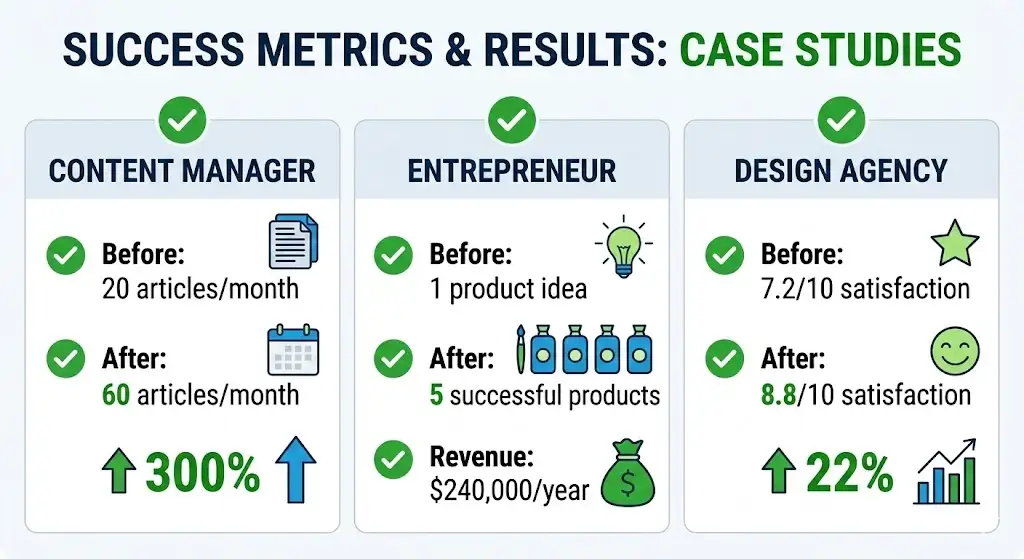
Case Study 1: Content Marketing Manager Increases Output by 300%
Situation: Sarah, a solo content marketer at a growing tech startup, faced overwhelming demand for blog posts, social content, and email newsletters. She was burning out.
AI Solution: She implemented a weekly AI brainstorming session, using Claude to generate 30 blog post ideas, 20 social media angles, and 10 email newsletter concepts every Monday morning. This took 45 minutes with AI versus 10+ hours with traditional ideation.
Results: Content output increased 300% within two months. More importantly, quality improved because Sarah could be selective, focusing on polishing the best ideas rather than scrambling to find any ideas. Her team traffic increased 45%, and engagement rates improved by 38%.
Key Takeaway: AI isn’t about replacing the creative professional. It’s about multiplying their impact by eliminating the bottleneck of initial idea generation.
Real Case Studies: AI Creativity in Action
Theory only takes us so far. Let’s examine real-world examples of how creators and entrepreneurs are using AI to dramatically improve their creative output and business results.
Case Study 2: Entrepreneur Launches 5 Successful Products Using AI Ideation
Background: James, an aspiring entrepreneur, struggled with the biggest challenge many face: validating product ideas before investing time and money.
AI-Powered Process: He used ChatGPT to brainstorm 200+ product ideas solving specific problems in his target market. For each idea, he asked AI to: research market size, identify potential customer segments, suggest marketing angles, and predict common objections. This comprehensive analysis took hours instead of weeks.
Results: From 200 ideas, he refined to 20 promising concepts, then tested 5 in the market. Four gained significant traction. Two years later, these products generate $240,000 in annual revenue. Without AI acceleration, he estimates this achievement would have taken 5-7 years.
Critical Success Factor: He didn’t use AI to avoid thinking. Instead, he used AI to explore more possibilities, then applied human judgment to select winners. The combination proved unbeatable.
Case Study 3: Design Agency Triples Client Satisfaction Scores
Challenge: A creative agency struggled with a common client problem: when presenting design concepts, clients often felt options were too similar, or didn’t include their preferred direction.
AI Integration: The agency started using DALL-E 3 and Midjourney to generate 50-100 design concept variations for each client project. Instead of presenting 3 options (the traditional approach), they could present 10-15 directions covering different aesthetics, approaches, and styles.
Impact: Client satisfaction scores jumped from 7.2/10 to 8.8/10. Project timelines shortened by 25% because clients found their preferred direction faster. The agency charged premium rates for this enhanced service, increasing profitability while improving outcomes.
Lesson: Abundance of good options increases satisfaction more than perfection of limited options.
Industry Trends: Where AI Creativity Is Growing Fastest
Certain industries are embracing AI-powered creativity faster than others. Understanding these trends reveals opportunities for your own creative work:
- Digital Marketing: Email subject lines, ad copy, and social media content see fastest AI adoption (87% of agencies use it)
- Content Creation: Blog post outlines, headline ideas, and content angles widely generated with AI (72% of creators)
- Product Development: Feature ideation and product naming increasingly AI-assisted (58% of product teams)
- Visual Design: Concept generation and mood boarding rapidly shifting to AI-first (63% of design teams in 2026)
- Video Production: Script ideation, thumbnail concepts, and storyboard generation growing AI usage (45% of video creators)
Common Mistakes When Using AI for Creative Work
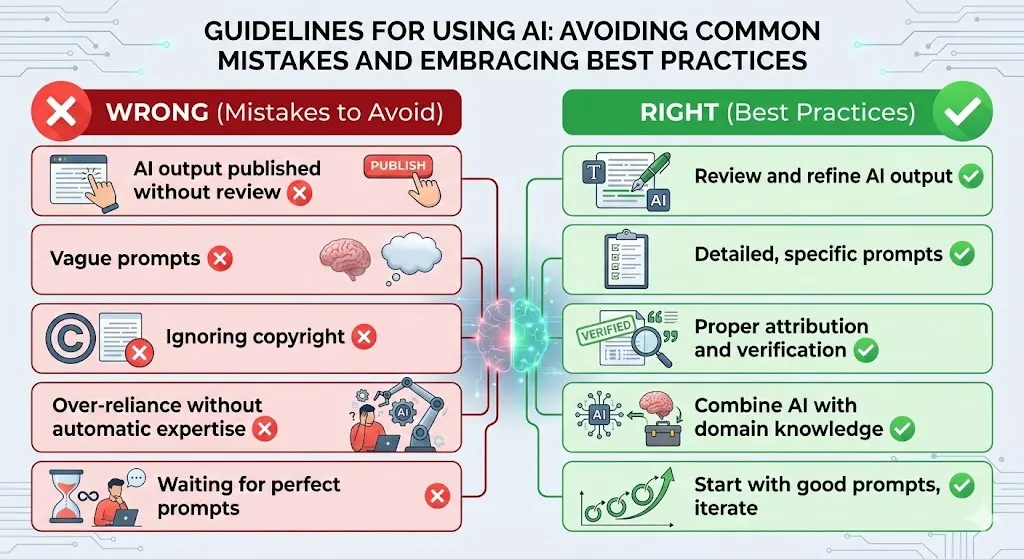
While AI is powerful, misusing it can lead to mediocre results. Let’s examine mistakes that undermine creative quality and how to avoid them.
Mistake 1: Publishing AI Output Directly Without Human Refinement
This is the most common error. AI generates great raw material, but it often lacks the personal voice, brand specificity, and human insight that makes content truly exceptional. The mistake isn’t using AI—it’s treating AI output as finished work.
Correct Approach: Use AI to generate 80% of the work, then spend 20% of your time refining, personalizing, and enhancing. This ratio reverses your old workflow where you spent 80% generating and 20% polishing.
Mistake 2: Vague Prompts Expecting Specific Results
If you ask AI a generic question, you’ll get generic answers. Many people underestimate how much specificity matters. “Give me content ideas” produces far inferior results compared to “Give me content ideas for 25-35 year old female entrepreneurs in sustainable fashion, struggling with supply chain management.”
Fix: Invest 5 minutes crafting detailed prompts. Include audience specifics, business context, desired tone, format requirements, and success metrics. Better prompts = exponentially better output.
Mistake 3: Ignoring Copyright and Attribution
While AI output is technically original, it’s trained on billions of existing works. Some output may inadvertently resemble copyrighted content. Additionally, ethical and legal requirements around AI usage disclosure are evolving. Always disclose AI usage in content creation, verify original ideas, and understand your jurisdiction’s AI regulations.
Mistake 4: Over-Relying on AI Without Domain Expertise
AI is a tool for amplifying expertise, not replacing it. Someone deep in their field using AI makes better decisions than someone new to a field using AI. The domain expertise provides judgment to evaluate which AI suggestions are valuable versus which are off-base.
Application: If you’re new to your field, use AI to accelerate learning but maintain healthy skepticism of all output. If you’re experienced, use AI to expand your already-solid foundations into new territories.
Mistake 5: Waiting for Perfect Prompts
Paradoxically, the other mistake is being too perfectionist about prompts. The best learning happens through experimentation. Start with good prompts, get output, learn from results, refine prompts, repeat. This iterative process typically produces better results faster than trying to engineer the perfect prompt from scratch.
Frequently Asked Questions About AI and Creativity
Q1: Will AI Replace Creative Professionals?
Answer: Not likely in the foreseeable future. Instead, AI is shifting what creative professionals do. Rather than spending 80% of time on initial ideation and 20% on refinement, the split inverts. AI handles rapid ideation; humans handle judgment, strategy, and unique voice. The creative professionals who thrive are those who embrace AI as a tool rather than resist it.
Q2: What’s the Learning Curve for Using AI Creatively?
Answer: The basics—using ChatGPT or Claude to brainstorm—takes minutes to learn. Most people generate usable ideas in their first session. However, advanced prompt engineering and understanding how to maximize different AI systems takes weeks to months of experimentation. Think of it like photography: basic usage is instant, mastery requires practice.
Q3: Is Using AI for Creative Work Considered Cheating?
Answer: This perspective is rapidly shifting. Major creative competitions increasingly allow AI-assisted work with disclosure. Most professional standards now require transparency about AI usage rather than prohibiting it entirely. The ethical standard is honesty about your process, not avoiding AI. Using a calculator doesn’t make you a bad mathematician; using AI doesn’t make you a bad creator. What matters is your overall contribution.
Q4: What’s the Cost of Using AI for Creative Ideas?
Answer: This varies widely. You can start free with ChatGPT’s free tier or Claude’s free plan. For advanced usage, most professional tools cost $10-30/month. For a creator or entrepreneur whose time is valuable, this investment typically pays back within days through increased productivity and better ideas.
Q5: How Do I Choose Between Different AI Tools?
Answer: Start with one free tool (ChatGPT or Claude) and master it before adding others. Different tools have different strengths: ChatGPT excels at speed and versatility, Claude at nuanced reasoning, Gemini at multimodal creativity. Once you understand your specific needs, you can identify the optimal tool. Most professionals use 2-3 tools rather than one.
Q6: Can AI Help With Every Type of Creative Work?
Answer: AI currently works best with text-based creativity (copywriting, ideation, strategy), visual concept generation (mood boards, design directions), and analytical work (market analysis, trend identification). It’s less effective with highly technical creative skills requiring specialized domain knowledge (advanced architecture, complex music production) but even these are evolving rapidly.
Taking Your First Steps With AI for Creative Ideas
The integration of artificial intelligence into creative work represents one of the most significant shifts in creative industries in decades. Unlike previous technological revolutions that displaced workers, AI for creativity primarily empowers existing creators and entrepreneurs to accomplish more, better, faster.
The creators and entrepreneurs winning in 2026 aren’t those resistant to AI. They’re those who’ve integrated it strategically into their workflow, understanding both its tremendous potential and its limitations. They use AI to multiply their creative output, not to substitute for genuine creative thinking.
Your Action Plan
Week 1: Choose one free AI tool (ChatGPT or Claude). Spend 30 minutes exploring its capabilities with your creative challenge. Don’t worry about perfection—just experiment.
Week 2-3: Implement one concrete strategy from this guide. Whether it’s the divergent-convergent method, constraint-based innovation, or cross-domain inspiration, pick one and apply it to an actual project.
Week 4: Evaluate results. Did this approach generate better ideas? Faster? More abundance? Adjust and refine your approach based on results.
Month 2+: Add complexity. Try multiple tools, refine your prompts, explore advanced techniques. Build your personal system for AI-powered creativity.
The future of creativity isn’t human versus AI. It’s human plus AI. The most valuable creative professionals aren’t the best individual ideators anymore—they’re the best at directing intelligent systems to generate possibilities, then exercising judgment to select and refine winning ideas. That’s a skill you can develop starting today.
“The best time to start using AI for creative work was a year ago. The second-best time is today. In five years, not using AI for creative amplification will be as outdated as refusing to use the internet.”
— Innovation strategist observation, 2026
Your creative potential has never been higher. The tools to unlock it are available right now. The question isn’t whether AI creativity is worth exploring—it’s why you’d wait any longer to start.
Share this article