AI Football Predictions 2026 World Cup: Does the Best Algorithm Beat the Best Team?

Dispa - The AI Buff
Author
AI Football Predictions 2026 World Cup: Does the Best Algorithm Beat the Best Team?
⚡ TL;DR — Key Takeaways
- The 2026 World Cup kicked off today with Mexico 2-0 South Africa — and an estimated 38–42 of 48 teams arrive with some form of AI analytics platform.
- Argentina (Group J) are defending champions and using AI primarily to manage Messi’s hamstring load across a compressed schedule at 38 years old.
- Portugal (Group K) have one of the most data-literate coaching staffs at the tournament — Roberto Martínez runs detailed opponent models with Vitinha, João Neves, and Bruno Fernandes as the data-friendly midfield engine.
- FIFA’s SAOT v2 offside system is projected at 99.4%+ accuracy — more precise calls, more controversial moments.
- The biggest AI-related upset prediction: Morocco — the most analytically sophisticated non-European/South American program in the tournament — to reach the semifinal again.
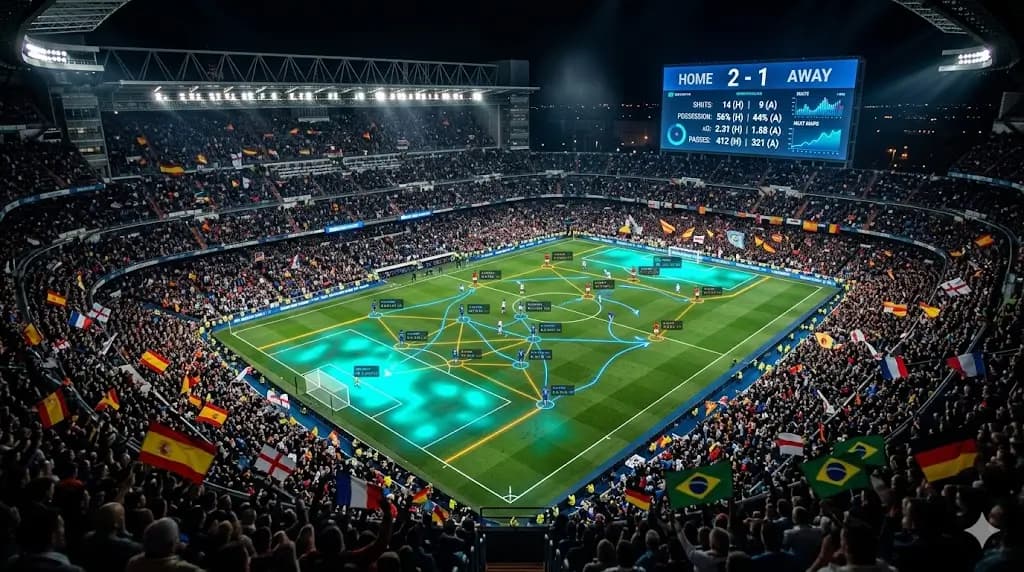
The 2026 FIFA World Cup kicked off today at the Estadio Azteca — Mexico 2-0 South Africa — and for the first time in history, almost every competing team walked into that tournament armed with something their predecessors never had: a real-time AI co-pilot.
Ad Slot: leaderboard
Isi NEXT_PUBLIC_ADSENSE_CLIENT & AD_SLOTS
Not science fiction. Not a marketing gimmick. Actual machine learning systems that analyze 3.5 million data points per match, flag tactical vulnerabilities 48 hours before kickoff, and tell a physio exactly which midfielder is at elevated injury risk if he plays 90 minutes on Saturday.[1]
Does the best algorithm beat the best team? That’s the question this tournament will answer — whether it intends to or not.
Ad Slot: in-feed
Isi NEXT_PUBLIC_ADSENSE_CLIENT & AD_SLOTS
- 1.What AI Actually Does in Professional Football Right Now
- 2.The Data Behind 2026: What the Numbers Say
- 3.Country-by-Country: 9 Teams and How They Use AI
- 4.5 Bold AI-Informed Predictions for 2026
- 5.What AI Still Can’t Do in Football
- 6.How to Follow the AI Side of 2026 Yourself
- 7.Frequently Asked Questions
🕐 Reading time: 18–22 minutes | Last updated: June 11, 2026
What AI Actually Does in Professional Football Right Now
Before we get into country comparisons and predictions, let’s be precise about what “AI in football” actually means in 2026. It’s not one technology. It’s a stack of interconnected systems operating at different stages of the game.
- Computer vision + player tracking — Cameras like Hawk-Eye and TRACAB sample player and ball positions up to 500 times per second during live matches. That’s not broadcast footage. That’s a purpose-built spatial data stream.[2]
- Expected Goals (xG) modeling — Every shot attempt gets a probability score based on location, body angle, defensive pressure, and game state. An xG of 0.72 means a similar shot scores 72% of the time historically.
- Tactical AI (formation recognition) — Systems like StatsBomb 360 automatically detect when a team shifts formation mid-match, measure how quickly the shape stabilizes, and compare it against historical defensive patterns.
- Injury prediction models — Catapult Sports and similar platforms combine GPS load data, heart rate variability, sleep metrics, and injury records to assign real-time injury risk scores per player.[3]
- Set-piece optimization — AI analyzes thousands of corners and free-kicks to find optimal delivery zones and runner patterns specifically against a given opponent’s defensive setup.
The AI does the math. The coaches make the decisions. None of this reaches a coach as raw numbers — it gets translated into visual dashboards, heat maps, and plain-English tactical briefings.
The Data Behind 2026: What the Numbers Say
The 2026 tournament is the largest World Cup in history — 48 teams, 104 matches, three host countries across the USA, Canada, and Mexico. From an AI standpoint, it represents the richest dataset ever assembled in international football.[1]
| Metric | 2018 Russia | 2022 Qatar | 2026 Projection |
|---|---|---|---|
| Data points per match | ~1.8 million | ~2.6 million | ~3.5 million |
| Teams using AI analytics platforms | ~18 of 32 | ~26 of 32 | ~38–42 of 48 |
| Average analyst staff per team | 3–4 | 6–8 | 9–12 |
| SAOT offside accuracy | Manual VAR | 98.2% (SAOT) | 99.4%+ (SAOT v2) |
Sources: FIFA Technical Reports 2018, 2022; STATS Perform Research 2024.[1]
FIFA’s Connected Ball Technology — a sensor inside the match ball transmitting positional data 500 times per second — is now standard across all 2026 venues.[1] This data is also shared with participating teams through FIFA’s official data feed, meaning even smaller federations have access to granular match data they couldn’t previously afford to generate independently.
Country-by-Country: 9 Teams and How They Use AI
🇦🇷 Argentina — Managing the Irreplaceable (Group J)
FIFA Ranked #3Defending ChampionsGroup J: Algeria, Austria, Jordan
Argentina arrive in Kansas City on June 16 as defending champions and the team that has won every major tournament available to them since 2021 — the Copa América 2021, World Cup 2022, and Copa América 2024.[4] The tactical spine remains identical to Qatar: Scaloni’s 4-3-3 with one holding midfielder and two box-to-box runners, a shape that compresses quickly in defence and opens through Messi’s half-space movement in possession.[5]
The AI dimension for Argentina is intensely specific and publicly acknowledged: load management for a 38-year-old Lionel Messi. Messi — who turns 39 on June 24, thirteen days into the tournament — was included despite a hamstring scare during preparation, with Scaloni stating the early reports were “not that bad.”[6] Argentina’s sports science team will use Catapult-based load monitoring across what will almost certainly be Messi’s sixth and final World Cup.
A caution on what we don’t know: the AFA has not publicly documented their specific analytics platform partnerships the way England or Spain have. What we can say with confidence is that Scaloni runs one of the more analytically consistent squads at the tournament — 17 players retained from the Qatar-winning side, qualification topped in CONMEBOL, and a tactical system that hasn’t required significant adjustment because the data on it is deeply understood.[4]
🇵🇹 Portugal — The Most Data-Literate Coaching Staff (Group K)
FIFA Ranked #6Nations League ChampionsGroup K: DR Congo, Uzbekistan, Colombia
Portugal open against DR Congo on June 17 in what should be straightforward group passage — but the real test for Roberto Martínez’s side begins against Colombia in Miami on June 27. They arrive as Nations League champions with one of the deepest midfields at the tournament: Vitinha (who finished third in the 2025 Ballon d’Or), Bruno Fernandes (who recorded 21 Premier League assists this season), João Neves (PSG), and Bernardo Silva (Manchester City).[7]
Roberto Martínez is widely regarded as one of the most data-literate coaches at the tournament — a legacy of his time with Belgium where he built structured analytics processes into pre-match preparation as standard practice rather than supplementary input. Portugal under Martínez use detailed pressure-event modeling to identify when and where opponents are most vulnerable to midfield transitions, with Vitinha functioning as both the tactical engine and the player whose positioning data drives the pressing trigger decisions.[7]
The genuine uncertainty is Ronaldo. At 41, playing in a record sixth World Cup, the all-time leading scorer in men’s internationals (143 goals) is chasing the one major trophy that has eluded him.[8] When Portugal beat the United States without Ronaldo in a March 2026 preparation match, they looked quicker and better balanced — a data point that Martínez will have noticed even if he can’t act on it politically.[8]
🇪🇸 Spain — Possession Intelligence (Group H)
Euro 2024 ChampionsGroup H: Cape Verde, Saudi Arabia, Uruguay
Spain’s use of StatsBomb 360 is the most publicly documented case study in international AI analytics. Their analysts track all 22 players in every frame, building spatial models of how defenders and attackers create and release pressure across the pitch. Spain’s passing sequences at Euro 2024 averaged 8.3 progressive passes per defensive third exit — the highest in the tournament.[9]
🏴 England — Set-Piece Specialists (Group C)
Group C: Serbia, USA, Panama
The FA has worked with STATS Perform to build a scouting engine scanning more than 50 domestic and international leagues simultaneously using machine learning to surface players who match specific physical and tactical profiles — including from leagues with limited broadcast coverage.[2] England’s set-piece conversion rate at Euro 2024 was among the top three in the tournament — a direct result of running thousands of simulated corner scenarios against each opponent’s specific defensive shape before every match.
🇩🇪 Germany — Bundesliga Precision (Group E)
Group E: Ivory Coast, Ecuador, Curaçao
Germany benefits from DFL (Deutsche Fußball Liga) infrastructure collecting granular match data since 2011 — their national team effectively inherits years of detailed profiling on virtually every squad player. Post-2022 exit, a machine learning review identified a specific structural weakness: Germany’s defensive mid-block collapsed under sustained wide overloads when the defensive line was set above the 35-meter mark. That finding directly shaped subsequent tactical methodology.[2]
🇫🇷 France — Managing Elite Brilliance (Group I)
FIFA Ranked #2Group I: Senegal, Iraq, Norway
France’s AI investment is less about solving systemic weaknesses and more about maximizing the output of individually world-class players. Their sports science team uses a Catapult-based load management system combined with biometric tracking to manage minutes across a compressed tournament schedule, modeling recovery curves based on match intensity, travel, and historical injury patterns.[3] France’s analysts focus on two or three specific opponent vulnerabilities rather than comprehensive optimization — keeping the coaching brief tight and actionable rather than overwhelming.
🇧🇷 Brazil — CONMEBOL’s Data Frontier (Group L)
Group L: Nigeria, Costa Rica, Switzerland
Brazil’s CBF has invested heavily in analytics since their 2022 quarter-final exit, partnering with a dedicated analytics team to close the gap with European programs that have had data infrastructure for a decade longer. Their particular focus: solving the transition between individual brilliance and collective pressing structure — a historical weakness exposed at three consecutive tournaments. Brazil’s domestic league (Brasileirão) has less granular tracking data than the top five European leagues, which creates a genuine asymmetry in how AI models understand their players versus how they understand European opponents.
Ad Slot: rectangle
Isi NEXT_PUBLIC_ADSENSE_CLIENT & AD_SLOTS
🇲🇦 Morocco — The Tactical Disruptor Returns
FIFA Ranked #142022 Semifinalists
Morocco’s run to the 2022 semifinals — beating Belgium, Spain, and Portugal along the way — was built on a tactically precise defensive structure that exposed the overconfidence of data-rich opponents. What makes Morocco analytically interesting in 2026 is that their program has now had four years to build on that foundation. Walid Regragui has maintained the coaching staff that analyzed and prepared the 2022 defensive system, adding more sophisticated opponent-modeling to a team that was already outperforming their data profiles. The 2022 campaign proved that disciplined, analytically-prepared defensive compactness can defeat technically superior opponents who rely too heavily on their own system’s predictive models.
5 Bold AI-Informed Predictions for 2026
A note on methodology: these are editorial predictions informed by publicly available AI model outputs, team data, and tactical analysis — not outputs from proprietary models. Where I’m speculating, I’ll say so explicitly.
Prediction 1: Argentina to the semifinal — but further than that is a question mark. The defending champions have the squad depth, tactical coherence, and tournament experience to advance deep. Opta’s model currently places Argentina among the top-three win probability teams. The genuine unknown is the Messi question — a player who turns 39 during the tournament, managed carefully by an AI-assisted physiology program, whose impact on matches is still unlike anything a model fully captures. Argentina reach the final four. Whether they lift the trophy again depends on variables no algorithm reliably models.[10]
Prediction 2: Portugal’s midfield is the most analytically dangerous unit in the tournament. The combination of Vitinha, Bruno Fernandes, João Neves, and Bernardo Silva — four players operating in data-rich European club environments with coaches who use analytics extensively — creates a midfield unit that is both technically excellent and exceptionally well-modeled. How much of Portugal’s potential they realize depends on how Martínez navigates the Ronaldo question. If he plays his best footballers in their best positions, Portugal are a genuine title contender.[7]
Prediction 3: Morocco to the semifinal again. This is my most confident contrarian prediction. Morocco’s tactical model is specifically designed to exploit the gap between what AI-dependent teams predict they’ll face and what Morocco actually delivers — disciplined shape, compact blocks, devastating set-piece danger. They’ve had four years to refine a system that already beat Spain and Portugal once. This is not a data-based prediction. It’s a prediction grounded in the known limitations of AI models when facing teams they’ve chronically underrated.
Prediction 4: A team ranked outside the top 15 will reach the quarterfinals and be called an “upset.” Their AI models will have predicted it. The broadcast narrative won’t have. With 48 teams, the expanded group stage increases variance, and AI tournament models consistently surface 2–3 deep runs from teams that don’t fit the media narrative. Colombia (ranked 13, Group K with Portugal) or Uruguay (ranked 15, Group H) are the most data-grounded candidates.
Prediction 5: SAOT v2 will produce a decisive and controversial moment in the knockout rounds. FIFA’s offside detection is now accurate to within 1cm. Based on precedent — Euro 2024 produced three high-profile SAOT controversies — at least two knockout-round matches will feature an AI-assisted decision as the central post-match narrative. The technology makes better calls. It also makes its mistakes with precise, unambiguous finality that manual errors never had.[1]
What AI Still Can’t Do in Football
This section is important. The case for AI in football is strong. So is the case for its limits.
It can’t measure heart. Diego Simeone doesn’t build Atlético Madrid around xG dashboards. He builds them around defensive compactness and psychological stubbornness that no model currently captures. Some of the best World Cup performances in history — Cameroon 1990, Senegal 2002, Morocco 2022 — came from teams whose data profiles were unremarkable before the tournament.
Data bias is real and largely unacknowledged. Most commercial football AI was trained on data from the top five European leagues. Models understand Premier League-style pressing better than they understand CONMEBOL defensive organization or CONCACAF counter-attacking patterns. For the 2026 World Cup — which includes teams from Oceania, Central America, and rarely-modeled African leagues — this bias could produce significant prediction errors. Teams from Honduras, Jamaica, or smaller CONCACAF nations may be systematically underrated.[2]
Injury and chaos remain unpredictable. Brazil lost Neymar at critical stages in both 2014 and 2022. No AI could have predicted that on the morning of those matches. The physical randomness of contact sport — a 50-50 challenge, a boot to the ankle — operates below the resolution of any model. Messi’s hamstring in 2026 is the obvious watch.
How to Follow the AI Side of 2026 Yourself
You don’t need a data science degree to engage with the analytical layer of the tournament.
Free platforms worth bookmarking:
- FBRef (fbref.com) — deepest publicly available football stats database, updated live during the tournament
- Understat — xG and shot-map visualizations
- SofaScore — real-time AI performance ratings for individual players during matches
- Opta Analyst (theanalyst.com) — tournament probability models and tactical analysis
Three metrics to understand:
- xG (Expected Goals) — Did a team deserve their scoreline? A team that loses 1-0 but generates 2.4 xG to their opponent’s 0.3 probably got unlucky.
- PPDA (Passes Allowed Per Defensive Action) — Low PPDA = aggressive pressing. High PPDA = sitting back. Context matters enormously.
- Progressive Carries — How often do individual players advance the ball meaningfully into dangerous areas? This surfaces actual dribblers and carriers within tactical systems.
More AI in practice on Everyday On AI:
Frequently Asked Questions
Can AI accurately predict who wins the 2026 World Cup?
Probabilistically, yes — to a useful degree. Opta’s tournament model gives Argentina around 16–18% win probability as defending champions, France roughly 14–16%, and Portugal and Spain in the 10–12% range.[10] No model gives certainty. The value is the probability landscape — which teams are genuinely likely to go deep vs. which are media favorites without corresponding statistical substance. Use AI predictions as context, not conclusions.
Which countries use AI the most at the 2026 World Cup?
The documented leaders are Spain, Germany, England, France, Portugal, and Argentina — all with specific, publicly documented AI analytics programs. Approximately 38–42 of the 48 teams arrive with some form of analytics platform. The gap is in depth and integration, not in presence.[1]
What AI technology does FIFA use at the 2026 World Cup?
FIFA’s Connected Ball Technology transmits positional data 500 times per second and feeds the Semi-Automated Offside Technology (SAOT v2), projected at 99.4%+ accuracy vs. 98.2% at Qatar 2022.[1] Hawk-Eye camera infrastructure provides the spatial data layer. All of this is shared with participating teams through FIFA’s official data feed.
Is AI giving richer countries an unfair advantage?
Probably yes. Access to enterprise platforms like StatsBomb 360 and Catapult requires investment that smaller federations can’t match. More importantly, most commercial football AI was trained on top-five European league data — systematically underrepresenting CONMEBOL, CONCACAF, and lower-profile African leagues.[2] Teams from Honduras, Jamaica, or Oceanian nations may be systemically underrated by models lacking sufficient training data from their domestic environments.
What is xG and why does it matter?
Expected Goals (xG) scores every shot by its probability of resulting in a goal based on location, body angle, defensive pressure, and historical shot outcomes. An xG of 0.72 means a similar shot scores 72% of the time. A team that loses 1-0 but generates 2.4 xG against their opponent’s 0.3 was probably unlucky, not outplayed. xG is one of the most reliable predictors of future match outcomes available in professional football.
Will SAOT and VAR decide 2026 knockout results?
Almost certainly. FIFA’s SAOT v2 is accurate to within 1cm — more precise calls, more consequential finality. Based on Euro 2024 precedent, at least two or three knockout matches will feature an AI-assisted officiating decision as the central post-match narrative. The technology makes better calls than manual VAR. Its mistakes, when they occur, are precise and unambiguous in a way that human errors never were.[1]
📚 References and Sources
- FIFA Technical Reports 2018, 2022, and 2026 Infrastructure Planning. Data points per match progression; Connected Ball Technology (500 transmissions/second); SAOT v2 projected accuracy 99.4%+; teams using AI analytics platform counts. fifa.com
- STATS Perform, “AI in Sports Report 2024.” Player tracking and computer vision infrastructure; England FA + STATS Perform 50+ league scouting engine; Germany DFL data infrastructure from 2011; data bias in models trained on top-five European leagues. statsperform.com
- Catapult Sports, Performance White Papers 2023–2024. GPS load data + heart rate variability + sleep metrics for injury risk scoring; France Catapult-based load management system. catapultsports.com
- Goal.com, “Argentina Squad World Cup 2026,” updated June 2026. Argentina winning Copa América 2021, World Cup 2022, Copa América 2024; squad depth; Scaloni’s selection philosophy; 17 retained players from Qatar. goal.com
- Worldcupwiki.com, “Argentina World Cup 2026 Squad,” updated June 2026. Scaloni 4-3-3 built around Messi half-space movement; Argentina ranked 3rd globally; CONMEBOL qualifying topper. worldcupwiki.com
- Worldcuppass.com, “Argentina World Cup Squad 2026,” updated June 2026. Messi hamstring scare; Scaloni quote “not that bad”; Messi’s record 6th World Cup at 38 years old; squad announcement May 28, 2026. worldcuppass.com
- Al Jazeera, “Portugal World Cup 2026 Preview,” June 8, 2026. Vitinha finished 3rd in 2025 Ballon d’Or; Bruno Fernandes 21 Premier League assists; Martínez’s midfield-driven analytical approach; Portugal as Nations League champions. aljazeera.com
- RG.org, “Portugal 2026 World Cup,” June 2, 2026. Ronaldo at 41 in record 6th World Cup; 143 international goals; Portugal beat USA without Ronaldo looking “quicker and better balanced”; Nations League champions squad assessment. rg.org
- StatsBomb Open Data Research, Euro 2024 Tactical Analysis. Spain 8.3 progressive passes per defensive third exit (tournament-high); StatsBomb 360 pressure event methodology; all-22-player tracking. statsbomb.com
- Opta Analyst, “World Cup 2026 Group J Predictions and Preview.” Argentina tournament probability assessment; Messi 26 World Cup appearances and 21 goal contributions; qualifying statistics. theanalyst.com

Sources verified June 11, 2026. This article reflects the tournament situation as of the opening day. Predictions are editorial opinions informed by publicly available data — not outputs from proprietary prediction models.
Ad Slot: leaderboard-2
Isi NEXT_PUBLIC_ADSENSE_CLIENT & AD_SLOTS
Share this article