GEO (Generative Engine Optimization): How to Get Cited by ChatGPT, Perplexity & Google AI

Dispa - The AI Buff
Author

Ad Slot: leaderboard
Isi NEXT_PUBLIC_ADSENSE_CLIENT & AD_SLOTS
Ad Slot: in-feed
Isi NEXT_PUBLIC_ADSENSE_CLIENT & AD_SLOTS
Search behavior has shifted structurally — and content teams that only optimize for blue links are leaving AI-driven visibility on the table.
ChatGPT crossed 900 million weekly active users in February 2026, according to OpenAI’s official announcement. Google AI Overviews now appear in approximately 25% of searches, based on Conductor’s analysis of 21.9 million queries. Perplexity, Gemini, and Microsoft Copilot collectively generate millions of AI-synthesized responses each day. In every one of those responses, specific sources are being selected and cited. The question is not whether AI search matters — it is whether your content is the one being cited when a user asks something in your area of expertise.
That is the problem Generative Engine Optimization (GEO) is designed to solve. Unlike traditional SEO, which is measured in ranking positions and click-through rates, GEO is measured in citation rate — how often your content appears as a source inside AI-generated answers. The two disciplines share the same quality foundation but require meaningfully different content structures at the sentence and section level.
“GEO sits inside AI SEO as one way to improve visibility within generative systems. The goal is not optimizing for a single model or interface — it is being seen, trusted, and reused wherever people search for answers.”
— Search Engine Land, “Generative Engine Optimization (GEO): How to Win AI Mentions,” February 2026
This guide covers what GEO is, how AI platforms actually select content to cite, the specific techniques that increase citation rates, and a sequenced 90-day implementation plan. It is written for content strategists, SEO professionals, marketing managers, and business owners who need to build AI search visibility — not just maintain traditional search rankings.
JUMP TO YOUR SECTION
- → New to GEO entirely — start with Section 1: What is GEO?
- → Familiar with SEO but not GEO — jump to Section 2: GEO vs SEO
- → Ready to implement now — jump to Section 5: Core Optimization Techniques
- → Need a structured rollout plan — jump to Section 7: 90-Day Action Plan
📌 KEY TAKEAWAYS
- Generative Engine Optimization (GEO) is the practice of structuring content to be selected as a cited source inside AI-generated responses, formalized by Princeton, Georgia Tech, and IIT Delhi researchers in a peer-reviewed paper at ACM KDD 2024.
- ChatGPT reached 900 million weekly active users in February 2026, according to OpenAI — more than double the 400 million users reported in February 2025 — making AI platform visibility a primary discovery channel for brands.
- Adding statistics to content is the single most effective GEO technique: the Princeton/Georgia Tech/IIT Delhi study found it improves AI citation visibility by 41%, while citing authoritative sources improved visibility by up to 115% for lower-ranked pages.
- AI-referred visitors convert at significantly higher rates than organic search visitors: Semrush (2026) found a 4.4x conversion rate advantage, while Ahrefs’ internal analysis found AI visitors representing 0.5% of traffic drove 12.1% of total signups.
- Only 6.82% of ChatGPT citations come from Google’s top 10 results, and 83% of AI Overview citations come from outside the organic top 10 — confirming that GEO requires its own optimization layer on top of SEO, not a substitute for it.

1. What is Generative Engine Optimization (GEO)?
This section establishes what GEO is, where it came from, and which platforms it targets — the conceptual foundation required before any implementation work makes sense.
Definition and Academic Origin
Generative Engine Optimization (GEO) is the practice of structuring and formatting content so that AI-powered search platforms select it as a cited source when generating answers to user queries. Where traditional Search Engine Optimization targets ranked positions on results pages — success measured by click-through rate — GEO targets citation selection inside AI-generated responses, measured by how often your content is quoted, paraphrased, or linked within those answers.
The term was formalized in a peer-reviewed paper published at ACM KDD 2024 by a research team from Princeton University, Georgia Tech, Allen Institute for AI, and IIT Delhi, led by Pranjal Aggarwal. That paper — titled simply “GEO: Generative Engine Optimization” — introduced the first controlled experimental framework for measuring content visibility inside AI-generated responses, tested six optimization strategies across 10,000 diverse queries, and established what later became the foundational evidence base for the field. The researchers found that GEO techniques can boost content visibility in generative engine responses by up to 40%.
In concrete terms: two pages on the same topic can both rank on page one of Google. When a user asks an AI the same question, only one of those pages gets cited inside the generated answer. The one that gets cited is not necessarily the one with more backlinks or the higher domain authority — it is the one whose content is structured in a way that makes it easier for an AI model to extract, attribute, and reproduce accurately.
Why GEO Matters in 2026
The case for GEO rests on a behavioral shift that is now measurable across multiple independent data sources. ChatGPT reached 900 million weekly active users in February 2026, up from 400 million in February 2025, according to OpenAI’s official announcement — a figure disclosed alongside a $110 billion funding round. Google AI Overviews appeared in 25.11% of searches as of Q1 2026, based on Conductor’s benchmark of 21.9 million queries, up from 13.14% in March 2025 according to Semrush. And critically, Gartner projected in February 2024 that traditional search volume would decline 25% by 2026 — a forecast that is now playing out in published traffic data.
ChatGPT weekly active users (OpenAI, February 2026)
Of Google searches trigger an AI Overview (Conductor, Q1 2026)
AI visibility lift from adding statistics (Princeton/KDD 2024)
Higher conversion rate from AI search vs. organic (Semrush, 2026)
The strategic implication is not that traditional SEO is dead — organic search remains the dominant discovery channel by volume. The implication is that AI-generated answers are now a parallel discovery surface operating alongside traditional results, with meaningfully different selection criteria. Content teams that only optimize for one surface are leaving a growing share of discovery off the table.
Which AI Platforms GEO Targets
GEO strategy addresses five primary AI search platforms, each with distinct citation behavior and scale.
| Platform | Scale (2026) | Citation Style | Primary Signal |
|---|---|---|---|
| Google AI Overviews | ~25% of Google searches (Conductor, Q1 2026) | Inline source links above organic results | E-E-A-T, structured data, freshness |
| ChatGPT Search | 900M+ weekly users (OpenAI, Feb 2026) | Numbered source citations in response | Answer-first formatting, authority, recency |
| Perplexity AI | Among fastest-growing AI search platforms | Inline citations with source cards | Self-contained facts, named entity clarity |
| Microsoft Copilot | Integrated into Bing and Microsoft 365 | Referenced sources with URL cards | Bing crawlability, structured headings |
| Google Gemini | Available across Google’s product surface | Source attribution in conversational responses | Google Search signals, Schema markup |
Universal GEO principles — answer-first H3 formatting, self-contained statistical statements, named entity clarity, Speakable schema — apply across all five platforms and should form the baseline before any platform-specific optimization is layered on top.
📋 SECTION SUMMARY — What is GEO
- Generative Engine Optimization (GEO) is the practice of formatting content for citation selection inside AI-generated responses, formalized by Princeton/Georgia Tech/IIT Delhi/Allen Institute researchers at ACM KDD 2024 — the first peer-reviewed study in this field.
- ChatGPT reached 900 million weekly active users in February 2026 (OpenAI) — more than double its February 2025 figure — and Google AI Overviews now appear in approximately 25% of searches (Conductor, Q1 2026), establishing AI search as a parallel discovery surface to traditional results.
- GEO targets five platforms — Google AI Overviews, ChatGPT Search, Perplexity AI, Microsoft Copilot, and Google Gemini — each using overlapping but distinct citation signals that share a common universal foundation.

2. GEO vs SEO: Key Differences and Why You Need Both
The most common misunderstanding about GEO is treating it as a replacement for SEO. It is not. This section establishes what the two disciplines share, where they diverge, and why conflating or separating them both create strategic problems.
What Stays the Same
GEO builds on the same quality foundation that SEO has always required. Technical accessibility — clean crawlability, proper canonicalization, fast load times — is a prerequisite for both. A page that Google cannot crawl will not be cited by Google AI Overviews. A page with thin, unsubstantiated content will not be cited by ChatGPT. The E-E-A-T signals that Google uses to assess content quality are also signals that AI platforms use when evaluating source authority.
Backlink authority still matters. Domain traffic remains the strongest single predictor of AI citation frequency — SE Ranking’s study of 2.3 million pages found that high-traffic sites earn three times more AI citations than low-traffic sites, with domain traffic as the dominant factor. The brands that rank well in traditional search are — all else equal — more likely to appear in AI-generated answers as well.
What this means in practice: strong SEO is a necessary but not sufficient condition for strong GEO performance. It creates the floor. GEO optimization builds on top of that floor with specific structural and formatting changes that traditional SEO practice does not require.
What Changes with GEO
GEO adds optimization layers that operate at the sentence and paragraph level — changes to how individual claims are structured, not just which keywords appear. These differences are architectural rather than cosmetic.
One important data point: only 6.82% of ChatGPT results come from Google’s top 10 pages, and 83% of Google AI Overview citations come from outside the organic top 10 (ConvertMate GEO Benchmark Study, 2026). This means ranking well in traditional search does not automatically translate into AI citation — the two surfaces require overlapping but distinct optimization.
| Dimension | Traditional SEO | GEO (Additional Layer) |
|---|---|---|
| Primary Goal | Ranked position on SERP | Citation inside AI-generated answer |
| Measured By | Click-through rate, organic traffic | Citation rate, Response Inclusion Rate, AI referral sessions |
| H3 First Sentence | Context-building approach acceptable | Must deliver a direct answer or definition immediately — no preamble |
| Statistics | Hyperlinked source attribution is sufficient | Must be self-contained: subject + number + context + source in plain text |
| Named Entities | Pronouns acceptable after first mention | Full entity name re-introduced at the start of each new H2 section |
| Section Endings | Transition sentence is sufficient | Structured Summary Box with self-contained bullets required |
| Schema | Article, FAQ, HowTo schemas | All SEO schemas plus Speakable schema targeting extractable blocks |
| Authority Signal | Primarily backlinks and domain authority | Domain traffic as primary predictor; third-party brand mentions as additional signal |
📋 SECTION SUMMARY — GEO vs SEO
- GEO and SEO share the same quality foundation — E-E-A-T signals, crawlability, domain authority — making strong SEO a prerequisite for competitive GEO performance, not an alternative to it.
- GEO adds four layers that SEO alone does not require: answer-first H3 first sentences, self-contained statistics with in-text source attribution, named entity re-introduction per section, and Speakable schema markup targeting extractable passages.
- Only 6.82% of ChatGPT citations come from Google’s top 10 pages (ConvertMate, 2026), which means high organic rankings do not guarantee AI visibility — both disciplines need to be implemented simultaneously, not traded off against each other.

3. How AI Platforms Select and Cite Content
Understanding the selection mechanism behind AI citations is the difference between applying GEO techniques blindly and applying them with precision. This section covers what is actually happening when an AI platform chooses to cite one page over another.
Primary Citation Signals
AI platforms evaluate content through a combination of signals — none operating in isolation. The most actionable of these is sentence-level extractability: the ability of an individual sentence to stand alone as a complete, attributable factual claim without requiring the surrounding context to make sense. AI search engines identify specific passages to reproduce and attribute. Content composed of standalone, clearly sourced factual statements is easier to extract accurately than content written as flowing narrative prose where meaning is distributed across multiple sentences.
Heading structure is a second high-impact signal. Foundation Marketing’s analysis of ChatGPT citations (2026) found that 68.7% of cited pages follow strict H1→H2→H3 heading hierarchies. Pages that skip heading levels or use headings for visual styling rather than semantic organization perform measurably worse in citation rates. The heading hierarchy is how AI crawlers build a topical map of a page before deciding which passages to extract.
Content depth also matters. ConvertMate’s 2026 GEO Benchmark Study found that pages exceeding 20,000 characters earn 4.3 times more AI citations than shorter content — consistent with AI platforms favoring comprehensive sources over thin treatments of the same topic. Additionally, 44.2% of AI citations come from the first 30% of content on a page, which reinforces the importance of front-loading key claims and definitions rather than building toward them.
Keyword density optimization — the traditional SEO practice of repeating target phrases at a controlled frequency — does not improve AI citation rates and can reduce them. The Princeton/KDD 2024 study found that keyword stuffing reduced AI visibility by 8.3% compared to baseline content. GEO rewards factual density and structural clarity, not keyword repetition.
Content Formats That Earn More Citations
The Princeton/Georgia Tech/IIT Delhi GEO study tested multiple content modification strategies and found that the format-level changes with the highest impact were adding statistics (41% visibility improvement), including expert quotations (28% improvement), and citing authoritative sources in plain text (up to 115% improvement for lower-ranked pages). These findings establish that the content type most likely to earn AI citations is research-backed, data-rich content with clearly attributed sources.
| Content Format | Citation Performance | Why AI Platforms Favor It |
|---|---|---|
| Statistics and Research Pages | +41% visibility from adding statistics (Princeton/KDD 2024) | Verifiable, attributable data points that can stand alone as claims |
| Comprehensive Definition Guides | High for “what is X” and “how does X work” queries | Direct, self-contained definitions match informational query intent exactly |
| FAQ Sections | Consistently high across all AI platforms | Direct Q&A structure mirrors how users phrase queries to AI systems |
| Comparison Articles | High — each item contains self-contained differentiation data | Structured item-by-item format provides extractable claims per comparison point |
| How-To Guides with Numbered Steps | Medium-high, especially for procedural queries | Numbered steps are individually extractable; HowTo schema signals structure explicitly |
| Narrative-only Editorial Content | Lower — meaning distributed across paragraphs, harder to extract | Prose without standalone factual statements requires context to interpret correctly |
📋 SECTION SUMMARY — How AI Cites Content
- Sentence-level extractability is the primary citation signal: content composed of standalone, sourced factual statements is cited more frequently than narrative prose where meaning is distributed across multiple sentences.
- 68.7% of pages cited by AI platforms follow strict H1→H2→H3 heading hierarchies (Foundation Marketing analysis of ChatGPT citations, 2026), and 44.2% of citations come from the first 30% of content — making front-loaded structure essential.
- The Princeton/KDD 2024 study established that adding statistics (+41%), expert quotations (+28%), and authoritative source citations (+115% for lower-ranked pages) are the three highest-impact content modifications for AI visibility.

4. GEO by the Numbers: Verified 2025–2026 Data
This section compiles the most reliable published data on AI search adoption, traffic quality, and citation behavior. All figures are drawn from primary sources or named studies with verifiable publication dates.
AI Search Scale and Adoption
ChatGPT surpassed 900 million weekly active users in February 2026 — doubling its 400 million weekly users from February 2025 — according to OpenAI’s official announcement disclosing a $110 billion funding round. Google AI Overviews now appear in approximately 25.11% of searches based on Conductor’s Q1 2026 analysis of 21.9 million queries; BrightEdge’s broader tracker placed the figure as high as 48% by February 2026, with variation reflecting different keyword sets and methodologies. Gartner (February 2024) projected traditional search volume would decline 25% by 2026, a forecast that is now supported by observed traffic data from multiple publishers showing year-over-year declines in organic referral clicks.
Traffic Quality: What AI Referrals Actually Convert At
AI search traffic is a small fraction of total web traffic — Ahrefs found AI platforms drove 0.1% to 0.5% of total visits in their 2025 analysis, and Conductor’s 2026 benchmark placed AI referral traffic at 1.08% of all website traffic. However, the conversion rate differential is large and consistent across studies. Semrush (2026) found AI-driven visitors convert at 4.4 times the rate of standard organic search. Ahrefs’ own internal analysis found that AI search visitors representing 0.5% of total traffic drove 12.1% of all signups — a 23x conversion advantage. Opollo’s benchmark of 312 technology firms found AI referral traffic converting at 14.2% versus Google organic at 2.8%. These figures vary by industry, but the directional advantage of AI-referred traffic is consistent across every published study that has measured it.
Content Performance in AI Citations
The Princeton/Georgia Tech/IIT Delhi GEO paper (KDD 2024) established the core content performance data: statistics addition improves AI visibility by 41%, expert quotation addition by 28%, and citing authoritative sources improves visibility by up to 115% for lower-ranked pages, based on controlled testing across 10,000 queries. ConvertMate’s 2026 GEO Benchmark Study added structural findings: 68.7% of cited pages follow strict heading hierarchies, pages above 20,000 characters earn 4.3x more AI citations than shorter pages, and 44.2% of AI citations come from the first 30% of content. SE Ranking’s analysis of 2.3 million pages found domain traffic as the strongest predictor of AI citation frequency, with high-traffic sites earning 3x more citations than low-traffic sites.
📋 SECTION SUMMARY — GEO Statistics
- ChatGPT reached 900 million weekly active users in February 2026 (OpenAI); Google AI Overviews appear in approximately 25% of searches (Conductor, Q1 2026, 21.9 million queries) — both confirmed from primary sources.
- AI referral traffic converts at 4.4x the rate of organic (Semrush, 2026), with Ahrefs’ internal data showing 0.5% of traffic driving 12.1% of signups — a 23x conversion multiplier — though absolute traffic volume from AI platforms remains under 1% for most sites.
- Adding statistics to content is the highest-impact single GEO technique (+41% AI visibility), with citing authoritative sources delivering up to +115% for lower-ranked pages, per the Princeton/KDD 2024 study of 10,000 queries.

5. GEO Strategy: 7 Core Optimization Techniques
This section covers the seven specific structural changes that directly improve AI citation rates, ordered from highest to lowest leverage based on published research findings.
Technique 1: Answer-First Formatting (Highest Leverage)
Answer-first formatting places the direct answer or definition in the first sentence of every H3 sub-section, without preamble or contextual framing. AI models extract the first sentence after a heading at disproportionate rates — 44.2% of all AI citations come from the first 30% of page content (ConvertMate, 2026) — making the opening sentence of each sub-section the highest-value real estate on the page.
The implementation rule is simple and absolute: every H3 heading is immediately followed by a sentence in the format “[Subject] is/does/requires [direct answer].” Phrases that postpone the answer — “Before we explore this, it is useful to understand…” or “As we discussed in the previous section…” — are eliminated entirely. This is not a stylistic preference; it is a structural requirement for extractability.
“High-risk AI systems under EU AI Act Article 6 must satisfy seven compliance requirements before August 2, 2026, including documented risk management systems, technical documentation, and human oversight measures.”
“Before we look at the specific requirements, it is worth understanding the broader context in which this regulation was developed. The EU AI Act emerged from…”
Technique 2: Self-Contained Factual Statements
Self-contained factual statements are sentences that carry their full meaning without requiring surrounding text — including the subject, the specific claim, the number or qualifier, and the source attribution in plain text. This technique is directly tied to the 41% visibility improvement from adding statistics documented in the Princeton/KDD 2024 study: the improvement is not simply from including numbers, but from including numbers that an AI can extract and reproduce with correct attribution without needing to follow a hyperlink or read the surrounding paragraph for context.
A hyperlink is not sufficient because AI systems process the text surrounding links — they do not follow the links themselves to retrieve source information. Every statistic or factual claim must therefore follow this structure: [Organization or study] [verb] [specific number or finding] [full context] ([source name, year]).
“ChatGPT reached 900 million weekly active users in February 2026, according to OpenAI’s official announcement disclosing a $110 billion funding round.”
“ChatGPT’s user base has grown significantly, as the linked report shows.”
Technique 3: Named Entity Clarity
Named entity clarity means using full official names rather than pronouns or informal abbreviations when introducing topics at the start of each new section. AI models use named entities as primary anchors for understanding what a passage is about — a paragraph that relies on “it” or “the platform” without restating the full name is harder to extract and correctly attribute, particularly when a page covers multiple entities across different sections.
The rule: on the first mention within each new H2 section, use the complete official name of the primary subject. In subsequent sentences within the same section, abbreviations are acceptable. When the next H2 section begins, re-introduce the full name again. This applies equally to organizations, products, regulations, studies, and technical concepts.
Technique 4: Strict Heading Hierarchy
Strict H1→H2→H3 heading hierarchy is required in GEO because AI crawlers use heading structure to build a topical map of a page before extracting individual passages. Foundation Marketing’s 2026 analysis found that 68.7% of pages cited by ChatGPT follow strict heading hierarchies — skipping levels or using headings for styling rather than semantic organization is associated with lower citation rates.
Each heading should serve as a standalone descriptive label that communicates the section topic without requiring the reader to have read the previous section. “High-Risk AI Systems: Compliance Requirements Under Article 6” communicates topic and scope clearly. “Getting Into the Details” does not. The heading label is what an AI crawler indexes first; ambiguous headings reduce topical clarity before the content itself is evaluated.
Technique 5: FAQ Sections with Direct-Answer Structure
FAQ sections are among the highest-cited content formats across all AI platforms because their question-and-answer structure mirrors the query format that users submit to AI systems. Every FAQ answer should begin with a direct, self-contained response in the first sentence — readable as a complete answer without the question — followed by elaboration in subsequent sentences. This format also activates FAQPage schema rich snippets in traditional search, making FAQ sections high-value for both SEO and GEO simultaneously without requiring separate optimization work.
Technique 6: E-E-A-T Signals and Author Credentials
Experience, Expertise, Authoritativeness, and Trustworthiness (E-E-A-T) signals directly influence both Google rankings and AI citation selection. Content from authors with verifiable credentials is cited at higher rates for queries where accuracy is high-stakes — medical, legal, financial, and technical topics in particular. AI systems occasionally display author information alongside cited content, making author credibility signals visible to users who follow citations.
GEO-relevant E-E-A-T implementation includes: an explicit author bio with domain-relevant credentials on every article; direct quotes from named authoritative sources with name, title, organization, and year included in plain text; and citation of primary sources — official documents, peer-reviewed research, government publications, company announcements — rather than aggregator content that is one step removed from the original data.
Technique 7: Content Freshness Cycles
Content freshness is a more acute concern in GEO than in traditional SEO. While ranking decay in organic search is gradual, AI citation rates drop more sharply as content ages. The practical implication is that high-priority pages require active maintenance — updating statistics, adding new developments, refreshing the “Last Reviewed” date visible in the article body — on a regular cycle. The visible date in the page body (not only in schema metadata) serves as a signal to both human readers and AI crawlers that the content has been recently verified for accuracy.
📋 SECTION SUMMARY — GEO Strategy Techniques
- Answer-first H3 formatting — placing the direct answer in the first sentence after every heading — is the highest-leverage structural change because AI platforms extract first sentences disproportionately, and 44.2% of AI citations come from a page’s first 30% of content (ConvertMate, 2026).
- Self-contained statistics with in-text source attribution are directly tied to the Princeton/KDD 2024 finding of +41% AI visibility from adding statistics — the improvement comes from extractability, not the presence of numbers alone.
- Citing authoritative sources in plain text (not only via hyperlinks) improved AI visibility by up to 115% for lower-ranked pages in the Princeton/KDD 2024 study — making source attribution in the sentence body a higher-impact change than most structural edits.

6. Technical GEO: Schema Markup, llms.txt, and AI Crawler Access
Content-level GEO addresses what a page says and how it is structured. Technical GEO addresses what a page explicitly communicates to crawlers and AI systems about its own structure — through schema markup in JSON-LD, the llms.txt file in the site root, and verified AI crawler access in robots.txt.
Core Schema Stack for GEO
Four schemas form the technical GEO foundation. Each serves a distinct signal function, and they are more effective implemented together than in isolation.
Article schema establishes the baseline metadata that declares authorship, publication date, publisher, and keyword topic for AI platforms that use this information when evaluating source authority. The dateModified field directly supports content freshness signals — keeping it current with each quarterly update is a maintenance task, not a one-time implementation. Adding wordCount, keywords, and inLanguage fields strengthens the topical signal beyond the minimum Article schema that most CMS plugins generate by default.
FAQPage schema duplicates the question-and-answer pairs from your FAQ section in structured JSON-LD, making them directly readable by AI crawlers without requiring content extraction from the HTML body. Every FAQ section should have a corresponding FAQPage schema block — this doubles the extractability of what is already among the highest-cited content formats. Each acceptedAnswer value should be a complete self-contained response, identical to the answer-first structure required in the visible content.
Speakable schema is the GEO-specific addition that traditional SEO practice rarely implements. The SpeakableSpecification type marks specific CSS selectors — typically .key-takeaway, .section-summary, and blockquote — as the most extractable passages on the page. This is an explicit signal to AI platforms that the marked content is designed for direct quotation and citation. Without Speakable schema, AI crawlers must infer which passages are extractable from structure alone; with it, the extractable blocks are explicitly declared.
Ad Slot: rectangle
Isi NEXT_PUBLIC_ADSENSE_CLIENT & AD_SLOTS
HowTo schema applies to any page containing numbered step sequences. Each step is defined with a position, name, and text in the JSON-LD — giving AI crawlers a machine-readable version of procedural content that mirrors the visible numbered list. Pages with HowTo schema receive more accurate step-level extraction in procedural query responses than pages that rely on HTML list rendering alone.
BreadcrumbList schema establishes the page’s position within the site’s topic hierarchy. This helps AI platforms assess whether a page is a pillar authority document or a narrow cluster article, and weight citations accordingly.
llms.txt: The AI Sitemap
The llms.txt file is a plain-text file placed in the root of a website (e.g., https://everydayonai.com/llms.txt) that provides AI systems and large language models with a structured, human-readable map of the site’s most important content. The format — proposed by Answer.AI’s Jeremy Howard and gaining rapid adoption in 2025–2026 — uses Markdown-style headings and links to identify the pages most relevant for AI models to read, index, and cite.
An llms.txt file for an AI content site follows this structure:
# everydayonai.com

> everydayonai.com covers practical AI strategy, tools, and content for businesses and everyday users.

## Core Guides
- [GEO Complete Guide](https://everydayonai.com/generative-engine-optimization-complete-guide): The definitive guide to Generative Engine Optimization — what it is, how it works, and how to implement it.
- [AI for Business](https://everydayonai.com/ai-for-business): Practical AI implementation strategies for business teams.
- [AI Tools Reviews](https://everydayonai.com/ai-tools-review): Independent reviews and comparisons of AI tools.

## Optional
- [About](https://everydayonai.com/about): Editorial team and site mission.
The practical GEO benefit of llms.txt is that it reduces the inference burden on AI crawlers deciding which pages on a domain represent the site’s authoritative positions. Without it, AI systems must crawl and evaluate all pages to determine which represent primary expertise. With it, the most important pages — the ones you most want cited — are explicitly surfaced. Implementing llms.txt takes under 30 minutes and requires no CMS plugins or technical infrastructure beyond FTP/SSH access to the site root.
AI Crawler Access: robots.txt Verification
AI crawler access is the prerequisite that GEO optimization cannot compensate for if blocked. If GPTBot (OpenAI), PerplexityBot, Google-Extended (Google AI products), or ClaudeBot (Anthropic) are blocked in a site’s robots.txt, that site cannot be cited by the corresponding AI platforms — regardless of content quality, schema implementation, or any other GEO signal. Many sites have inadvertently blocked AI crawlers through blanket User-agent: * Disallow rules, Cloudflare bot protection settings, or CDN configurations that reject unfamiliar user agents.
Verify your robots.txt does not block these critical AI crawlers:
GPTBot (ChatGPT), PerplexityBot (Perplexity AI), Google-Extended (Google AI Overviews and Gemini), ClaudeBot (Anthropic/Claude), Bytespider (ByteDance/TikTok AI). Also check Cloudflare’s Bot Fight Mode and any WAF rules that may be blocking these agents at the infrastructure level before the request reaches your CMS.
The correct robots.txt posture for GEO is explicit allowance for all major AI crawlers, even if other bot categories are restricted. A site can legitimately block scraping bots while allowing AI indexing bots — the two categories require separate rules. LLMrefs maintains an up-to-date list of AI crawler user agent strings as the ecosystem evolves, which is a useful reference for periodic robots.txt audits.
📋 SECTION SUMMARY — Technical GEO
- The five-schema GEO stack — Article (with wordCount, keywords, inLanguage), FAQPage, Speakable, HowTo, and BreadcrumbList — works as a system, with each schema addressing a different signal category that AI crawlers evaluate independently before aggregating into a citation confidence score.
- The llms.txt file is a plain-text AI sitemap placed in the site root that explicitly identifies the most important pages for AI systems to index and cite — a 30-minute implementation that reduces the inference burden on AI crawlers and directly surfaces pillar content for citation.
- AI crawler access verification in robots.txt is the technical GEO prerequisite: GPTBot, PerplexityBot, Google-Extended, and ClaudeBot must be allowed before any content or schema optimization can produce citation results — and Cloudflare or CDN-level bot rules may block these crawlers independently of robots.txt settings.
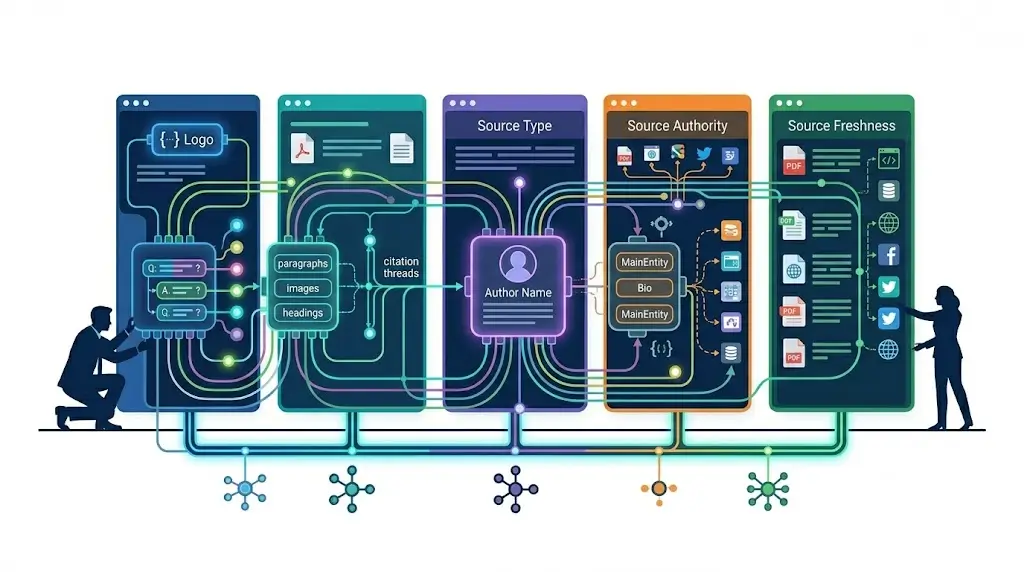
7. Platform-Specific GEO: ChatGPT vs Perplexity vs Google AI Overviews
Platform-specific GEO applies targeted adjustments on top of the universal GEO foundation. The five major AI search platforms share the same baseline requirements — answer-first structure, self-contained facts, E-E-A-T signals, schema markup — but each platform’s citation selection algorithm weights different signals at the margin.
ChatGPT Search (OpenAI)
ChatGPT Search, accessible to ChatGPT’s 900 million weekly active users as of February 2026, performs query fan-out — breaking a user’s question into multiple sub-queries and searching each separately before synthesizing a response. This means a single article needs to contain explicitly self-contained answers to multiple related sub-questions, not just the headline topic, to maximize the probability of being selected across the full fan-out query set. ChatGPT Search shows numbered citations at the end of responses; pages cited are selected based on recency, authority, and how directly each passage answers the specific sub-query that triggered the citation.
ChatGPT-specific optimizations: use conversational phrasing in H3 headings that matches how users phrase questions to ChatGPT (“How does X work?” rather than “X: Mechanism Overview”); ensure each H3 section is internally complete and does not rely on adjacent sections for context; prioritize content published or updated within the last 90 days for fast-moving topics where recency weighting is high.
Perplexity AI
Perplexity AI displays inline numbered citations throughout the response body — not just at the end — with source cards that expand to show the page title, URL, and a brief excerpt. This citation display style means Perplexity users see and interact with cited sources more directly than on other platforms, making source branding and page title clarity important secondary signals alongside the content signals. Perplexity tends to favor well-structured long-form content with strong internal linking and explicit factual density over shorter, more conversational content.
Perplexity-specific optimizations: write descriptive page titles that communicate both topic and stance clearly in under 70 characters; use the first 150 characters of each section as if they will appear in a source excerpt card — because they will; ensure internal links between related articles are in place so Perplexity can evaluate topical depth across the cluster, not just on the individual page.
Google AI Overviews
Google AI Overviews appear above organic results in approximately 25% of searches as of Q1 2026 (Conductor). They are the AI platform with the strongest documented connection to traditional SEO signals — E-E-A-T, backlink authority, Search Console performance, and page experience signals all influence AI Overview citation selection in addition to the GEO-specific structural factors. However, 83% of AI Overview citations come from outside the organic top 10 (ConvertMate, 2026), confirming that traditional ranking alone is insufficient for AI Overview visibility.
Google AI Overview-specific optimizations: implement all Google-recommended schema types (Article, FAQPage, HowTo, Speakable) as these feed directly into the Knowledge Graph that AI Overviews draw from; maintain Core Web Vitals compliance since page experience signals carry more weight in AI Overview selection than in traditional ranking; ensure Google-Extended is not blocked in robots.txt, as blocking this user agent specifically prevents Google AI Overviews and Gemini from indexing the page.
Microsoft Copilot
Microsoft Copilot, integrated into Bing and Microsoft 365, draws primarily from Bing’s index rather than Google’s, making Bing Webmaster Tools verification and Bing-specific crawlability a distinct requirement that Google-only optimization misses. Copilot citation behavior is similar to Bing’s featured snippet selection — favoring concise, directly attributable passages over long-form narrative content — which reinforces the GEO principles of answer-first structure and self-contained factual statements.
| Platform | Unique Citation Signal | Platform-Specific Action |
|---|---|---|
| ChatGPT Search | Sub-query fan-out coverage | Each H3 self-contained for independent sub-query; conversational H3 phrasing |
| Perplexity AI | Inline source card excerpts | First 150 chars of each section written as source-card-ready; descriptive page title |
| Google AI Overviews | Knowledge Graph + E-E-A-T | All Google schemas; Core Web Vitals; Google-Extended unblocked in robots.txt |
| Microsoft Copilot | Bing index (not Google) | Bing Webmaster Tools verification; BingBot unblocked; Bing sitemap submission |
| Google Gemini | Google Search + Workspace integration | Consistent with Google AI Overviews signals; structured data completeness |
📋 SECTION SUMMARY — Platform-Specific GEO
- ChatGPT Search performs query fan-out — breaking questions into multiple sub-queries — which means each H3 section must be internally complete and directly answer a specific sub-question to maximize citation probability across the full fan-out set.
- Perplexity AI displays inline source cards showing the first ~150 characters of each cited section, making the opening sentence of every section a visible source-card excerpt — reinforcing the answer-first rule with a direct user-facing consequence.
- Google AI Overviews draw from the Knowledge Graph and weight traditional SEO signals alongside GEO structure, but 83% of citations come from outside the organic top 10 (ConvertMate, 2026) — confirming that E-E-A-T and schema implementation matter independently of traditional ranking performance.

8. 7 Common GEO Mistakes (and How to Fix Them)
Most GEO implementation failures are not strategic errors — they are specific structural problems that can be identified and corrected with targeted edits. This section covers the seven most common mistakes observed across sites implementing GEO for the first time, ordered from most to least frequently encountered.
Mistake 1: Blocking AI Crawlers in robots.txt
Blocking AI crawlers in robots.txt is the most damaging GEO mistake because it nullifies every other optimization on the page — a perfectly structured, schema-complete article that GPTBot cannot access will never appear in a ChatGPT citation. The mistake occurs most often through blanket User-agent: * Disallow: / rules intended to block scraping bots, Cloudflare Bot Fight Mode activated without AI crawler exceptions, or security plugins that block unrecognized user agents by default. The fix is a robots.txt audit followed by explicit Allow rules for GPTBot, PerplexityBot, Google-Extended, and ClaudeBot, and verification at the CDN/WAF layer that these user agents are not filtered before reaching the server.
Mistake 2: Context-First H3 Sentences
Context-first H3 sentences — opening a section with background, history, or framing before delivering the actual answer — reduce AI extractability because AI models extract the first sentence of a section at disproportionate rates. A section that begins “Before we look at the specific requirements, it is useful to understand the historical context in which this regulation developed…” is structurally invisible to AI extraction tools compared to one that begins “High-risk AI systems under EU AI Act Article 6 must satisfy seven compliance requirements…” The fix is a systematic rewrite of every H3 first sentence across all priority pages using the answer-first rule.
Mistake 3: Statistics Without In-Text Source Attribution
Statistics cited only via hyperlink — without the source name and year written in the sentence body — cannot be correctly attributed by AI systems that process text rather than following links. A sentence reading “AI traffic converts at 4.4x the rate of organic search (source)” provides no attributable source name for an AI to reproduce accurately. The fix is reformatting every data point to the self-contained structure: “[Organization] [verb] [finding] ([Source Name, Year]).”
Mistake 4: Applying GEO Only to New Content
Applying GEO only to new content and leaving existing high-traffic pages unoptimized misses the highest-ROI targets. Existing pages with established backlink profiles, indexed history, and organic traffic already have the domain authority foundation that AI platforms weight — they are the most citation-ready assets on any site. The fix is a retroactive GEO audit of the top 20 pages by organic traffic before publishing new GEO-optimized content.
Mistake 5: Treating GEO and SEO as Separate Workflows
Treating GEO and SEO as separate content workflows — maintaining different style guides, different editorial standards, or different publishing processes for each — creates unnecessary duplication and inconsistency. Every piece of content should meet both GEO and SEO standards from the first draft. The fix is a unified content brief template that includes both SEO requirements (keyword targeting, meta description, internal links) and GEO requirements (answer-first H3s, self-contained stats, Key Takeaway Box, schema type) in a single checklist.
Mistake 6: Ignoring Content Depth Thresholds
Publishing content below the 20,000-character threshold documented as the point at which AI citation rates increase 4.3x (ConvertMate, 2026) leaves significant citation probability unrealized. Most first drafts of pillar articles come in at 8,000–12,000 characters — well below the threshold. The fix is not padding with filler content, but identifying the genuine subtopics — platform-specific nuances, common mistakes, measurement frameworks, case examples — that belong in a comprehensive pillar article and adding them as fully developed sections, not as thin bullet lists.
Mistake 7: No Section Summary Boxes
Omitting Section Summary Boxes at the end of each H2 section eliminates one of the most consistently extractable content formats in GEO. AI platforms extract self-contained bulleted summaries at high rates because they are structurally designed for extraction — each bullet is a complete factual statement independent of the surrounding prose. Section Summary Boxes also activate the Speakable schema selectors that explicitly flag these blocks as extractable passages. The fix is adding a three-bullet Section Summary Box at the end of every H2 section, with each bullet containing a named entity, a specific claim, and a source where applicable.
📋 SECTION SUMMARY — Common GEO Mistakes
- Blocking AI crawlers in robots.txt or at the CDN layer is the most damaging GEO mistake — it invalidates all other optimization on the page. GPTBot, PerplexityBot, Google-Extended, and ClaudeBot must be explicitly allowed, and Cloudflare Bot Fight Mode checked for unintended AI crawler blocks.
- Context-first H3 sentences and statistics without in-text source attribution are the two most common content-level mistakes — both directly reduce the sentence-level extractability that is the primary mechanism by which AI platforms select citation sources.
- Applying GEO only to new content while leaving existing high-traffic pages unoptimized misses the highest-ROI targets — established pages with backlink authority are the most citation-ready assets on any site and should be the first GEO optimization targets, not the last.

9. 90-Day GEO Action Plan
This section provides a sequenced implementation plan structured so that each phase produces measurable output before the next phase begins. The order is deliberate: technical and measurement infrastructure first, content changes second, expansion third.
Days 1–30: Audit and Foundation
- Select your top 10 priority pages — pages with the strongest existing SEO performance (highest organic traffic, most backlinks, clearest topical authority) are the best GEO optimization targets because the crawlability and authority foundation is already established.
- Run a GEO content audit on each page — for each priority page, check four criteria: (a) does every H3 first sentence deliver a direct answer without preamble? (b) are all statistics self-contained with in-text source attribution? (c) are named entities re-introduced at the start of each H2 section? (d) does the page have a Key Takeaway box with self-contained bullets?
- Implement the four-schema stack — deploy Article, FAQPage, Speakable, and BreadcrumbList schema across all 10 priority pages before making content edits. Technical changes should precede content changes so that the schema correctly describes the optimized content when it is published.
- Establish your pre-optimization citation baseline — manually query ChatGPT Search, Perplexity AI, and Google AI Overviews with your 10–15 most important target prompts. Record which sources are cited in each response. This is your benchmark against which 60-day and 90-day results will be compared.
- Add visible “Last Reviewed” dates to all priority pages — in the page body, not only in schema metadata.
Days 31–60: Content Optimization
- Rewrite all H3 first sentences across priority pages using the answer-first rule — this is the single highest-ROI editing task in GEO. Every H3 heading must be followed immediately by a direct answer or definition, without exception.
- Reformat all statistics to the self-contained structure — add full in-text source attribution to every data point. For any statistic sourced from research more than 12 months old, find a current replacement or remove the claim and note that a fresher source is needed.
- Add Section Summary Boxes to every H2 section — three self-contained bullets each, with Speakable schema targeting applied to the
.section-summaryclass. - Add a Key Takeaway Box to every priority page — five self-contained bullets, each containing a named entity, a specific claim, and a source. Place immediately after the introduction, before the table of contents.
- Publish 2–3 new comparison or statistics articles in your topic cluster — new content built with GEO structure from the first draft outperforms retroactively optimized older content because the AI extraction patterns are established from indexing, not retrofitted.
Days 61–90: Measurement and Expansion
- Re-run your target prompt citation queries — compare the results against your Day 1 baseline. Identify which pages are now appearing in AI-generated answers that were not before, and which remain absent. Pages that are still not being cited despite structural optimization may have crawlability, authority, or freshness issues that need diagnosis.
- Expand GEO optimization to the next tier of pages — using the workflow from Phase 2, now applied to the next 20 pages on your priority list.
- Begin off-page GEO: building third-party brand mentions — identify 5–10 relevant industry publications, directories, or editorial sites where your brand can establish a legitimate presence. Third-party mentions across authoritative sources outside your own domain are a signal that AI platforms weight when evaluating source credibility, independent of on-page structure.
- Establish a quarterly freshness cadence — schedule recurring calendar reviews for all priority pages. Each review updates statistics, adds new developments, and refreshes the “Last Reviewed” date.
- Document your GEO style guide — capture the answer-first sentence rule, the self-contained statistic format, the named entity re-introduction rule, and the schema requirements as a one-page internal reference. Every future content piece should begin GEO-optimized, not be retrofitted after publication.
📋 SECTION SUMMARY — 90-Day Action Plan
- Phase 1 (Days 1–30) prioritizes audit, schema implementation, and pre-optimization citation baseline — establishing the technical foundation and measurement benchmark before content changes begin.
- Phase 2 (Days 31–60) focuses on the two highest-impact content changes: answer-first H3 rewriting and self-contained statistic reformatting — both tied directly to the Princeton/KDD 2024 performance data.
- Phase 3 (Days 61–90) expands coverage to additional pages, begins off-page brand presence building, and institutionalizes GEO as an ongoing content standard rather than a one-time project.

10. Measuring GEO Performance
GEO performance cannot be measured with traditional SEO KPIs. Ranking position and organic click volume do not capture citation frequency inside AI-generated responses. This section defines the metrics that do, and explains how to track them without dedicated tooling.
| KPI | Formula | Measurement Method |
|---|---|---|
| AI Citation Rate | Pages appearing as citations ÷ Total pages tracked | Manual query testing across ChatGPT, Perplexity, Google AI Overviews |
| Response Inclusion Rate (RIR) | Prompts where your brand or content appears ÷ Total prompts tested | Manual testing with 15–30 target queries per measurement cycle |
| GEO Adoption Rate | Pages meeting ≥8 GEO checklist criteria ÷ Total pages audited | Internal content audit using GEO optimization checklist |
| AI Referral Traffic | Sessions from AI platform referral domains | GA4 source/medium report, filtered for chat.openai.com, perplexity.ai, gemini.google.com, copilot.microsoft.com |
| AI Referral Conversion Rate | Conversions from AI referral sessions ÷ Total AI referral sessions | GA4 conversion tracking by channel group — compare against organic baseline |
A practical GEO measurement cycle runs as follows: at the start of each optimization sprint, manually test your 15–30 most important target prompts across ChatGPT, Perplexity, and Google AI Overviews. Record the citations returned for each prompt in a spreadsheet. Calculate your Response Inclusion Rate. After optimization work, re-test the same prompts after 60–90 days and compare the results. This manual process is slower than automated tools — emerging platforms like Profound, Superlines, and AI-specific brand monitoring tools are beginning to automate citation tracking — but it requires no additional tooling and produces reliable directional data.
For GA4-based tracking, create a custom channel group that captures referral sessions from AI platform domains. This allows you to track AI referral session volume, conversion rate, and revenue attribution separately from organic search. Be aware that a meaningful portion of AI-influenced traffic will not appear as AI referral — users who see your brand cited in an AI response and then search for you directly will appear as branded organic or direct traffic in standard analytics. Post-purchase surveys asking how users first discovered your brand provide useful supplementary data for this attribution gap.
📋 SECTION SUMMARY — GEO Measurement
- The primary GEO KPIs are AI Citation Rate (pages cited ÷ pages tracked), Response Inclusion Rate (prompts where your brand appears ÷ total prompts tested), and AI Referral Conversion Rate — none of which are captured by standard SEO reporting tools.
- Manual citation testing across ChatGPT, Perplexity, and Google AI Overviews against a fixed set of 15–30 target prompts is the most accessible measurement method, requiring no additional tooling and producing reliable directional data when conducted at consistent intervals.
- GA4 AI referral tracking requires a custom channel group filtering for AI platform domains; it captures direct click traffic but will under-count AI-influenced brand searches, which appear as branded organic or direct traffic in standard analytics.

11. Frequently Asked Questions About Generative Engine Optimization
Each answer below is written as a self-contained response — complete and readable without requiring the question for context — following the answer-first structure required for AI citation optimization.
What is Generative Engine Optimization (GEO)?
Generative Engine Optimization (GEO) is the practice of structuring and formatting content so that AI-powered platforms — including ChatGPT, Google AI Overviews, Perplexity, and Gemini — select it as a cited source when generating answers to user queries. The discipline was formalized in a peer-reviewed paper by Princeton University, Georgia Tech, Allen Institute for AI, and IIT Delhi researchers, presented at ACM KDD 2024. Unlike traditional SEO, which targets ranked positions on results pages measured by click-through rate, GEO targets citation selection inside AI-generated responses, measured by how often your content is quoted, attributed, or linked within those answers.
How is GEO different from SEO?
SEO optimizes content for ranked positions in traditional search results, measured by organic traffic and click-through rate. GEO optimizes content to be cited inside AI-generated answers, measured by citation rate and Response Inclusion Rate. GEO builds on the same foundation SEO requires — crawlability, E-E-A-T signals, content depth, domain authority — but adds structural layers that SEO alone does not: answer-first H3 first sentences, self-contained statistics with in-text source attribution, named entity re-introduction per section, and Speakable schema markup. Critically, strong SEO performance does not automatically produce strong GEO performance — only 6.82% of ChatGPT citations come from Google’s top 10 pages (ConvertMate, 2026), confirming that the two disciplines require separate optimization work.
Which AI platforms does GEO target?
GEO targets five primary AI search platforms: Google AI Overviews (appearing in approximately 25% of Google searches as of Q1 2026, per Conductor’s 21.9 million-query analysis), ChatGPT Search (900 million+ weekly active users per OpenAI, February 2026), Perplexity AI, Microsoft Copilot (integrated into Bing and Microsoft 365), and Google Gemini. The universal GEO foundation — answer-first formatting, self-contained factual statements, strict heading hierarchy, and Speakable schema — applies across all five platforms and should be implemented as the base layer before any platform-specific optimization.
Does AI search traffic convert better than organic traffic?
Yes, according to multiple independent studies, though the absolute volume of AI referral traffic remains small for most sites. Semrush (2026) found AI-driven visitors convert at 4.4 times the rate of standard organic search traffic across industries. Ahrefs’ internal analysis found that AI search visitors representing just 0.5% of total traffic drove 12.1% of all signups — a 23x conversion advantage. Opollo’s analysis of 312 technology firms found AI referral traffic converting at 14.2% compared to Google organic at 2.8%. The conversion advantage is consistent across published studies; the practical implication is that even a small increase in AI citation frequency can produce a disproportionate revenue impact.
What content format gets cited most by AI models?
Research-backed, statistics-dense content structured with strict heading hierarchies and self-contained factual claims earns the highest AI citation rates, based on the Princeton/Georgia Tech/IIT Delhi GEO study (KDD 2024). Specifically: adding statistics to content improves AI citation visibility by 41%, including expert quotations improves it by 28%, and citing authoritative sources in plain text improves visibility by up to 115% for lower-ranked pages. ConvertMate’s 2026 Benchmark Study found that 68.7% of cited pages follow strict H1→H2→H3 structure and that pages over 20,000 characters earn 4.3x more citations than shorter pages. FAQ sections, comparison articles, and comprehensive definition guides consistently appear among the highest-cited formats because they are structurally designed for extractability.
What is llms.txt and do I need it for GEO?
The llms.txt file is a plain-text AI sitemap placed in a website’s root directory (e.g., yourdomain.com/llms.txt) that explicitly identifies the most important pages for AI systems to index and cite. Proposed by Answer.AI’s Jeremy Howard and gaining widespread adoption in 2025–2026, it uses Markdown-style headings and links to surface pillar content directly to AI crawlers without requiring them to infer content priority from crawl patterns. For GEO purposes, llms.txt is not a mandatory requirement — pages can be cited without it — but it is a high-ROI 30-minute implementation that directly increases the probability of pillar content being indexed and cited. Sites with a well-structured llms.txt give AI systems an explicit content map that prioritizes the pages most deserving of citation authority.
Why is my content not being cited by AI even though I rank well on Google?
High Google rankings do not guarantee AI citation because the two platforms use partially overlapping but distinct selection criteria. ConvertMate’s 2026 benchmark found that only 6.82% of ChatGPT citations come from Google’s top 10, and 83% of Google AI Overview citations come from outside the organic top 10. The most common reasons well-ranked content is not cited by AI platforms are: AI crawlers blocked in robots.txt or at the CDN level; H3 first sentences that use context-first structure rather than direct answers; statistics cited only via hyperlink without in-text source attribution; absence of FAQPage or Speakable schema; and content length below the 20,000-character depth threshold where citation rates increase sharply. Each of these is a specific, correctable structural problem — not a domain authority problem that requires months to resolve.
How long does GEO take to show results?
GEO result timelines vary by platform, query type, and content category, and no peer-reviewed study has yet established a standardized measurement framework for citation rate change velocity. Based on practitioner observations reported across multiple industry publications in 2025–2026, pages with strong existing SEO foundations that receive GEO structural optimization — answer-first H3s, self-contained statistics, Speakable schema, FAQPage schema — typically begin appearing in AI-generated citations within 4–12 weeks of optimization, with the fastest results on Perplexity AI and the slowest on Google AI Overviews. New domains without established crawl history and backlink profiles take longer regardless of content quality, because domain authority remains the strongest single predictor of AI citation frequency (SE Ranking, 2.3 million page study). The most reliable leading indicator is not citation rate itself but the Response Inclusion Rate measured against a baseline of manual citation tests — improvement in this metric in the first 60 days is the primary signal that GEO changes are taking effect.
No — SEO and GEO are complementary disciplines that should be implemented simultaneously, not traded off against each other. Strong SEO creates the technical and authority foundation that AI platforms rely on when selecting citation sources: crawlability, domain authority, E-E-A-T signals, and content depth are prerequisites for both. GEO adds the structural optimization layer on top — the specific sentence-level and schema-level changes that increase citation selection probability within AI-generated responses. Treating GEO as a separate content workflow from SEO creates unnecessary duplication. Every new piece of content should meet both standards from the first draft.

Conclusion: GEO as the Next Content Layer
The core argument for GEO is straightforward: AI-generated answers are now a parallel discovery surface alongside traditional search, operating on different selection criteria, growing in user adoption, and sending traffic that converts at multiples of organic search rates. Content teams that only optimize for one surface are building visibility in a channel that is stable while leaving a growing channel unaddressed.
What makes GEO tractable is that most of its highest-impact changes are structural rather than creative — rewriting first sentences to deliver direct answers, reformatting statistics to be self-contained, adding schema markup to mark extractable blocks. These are editing decisions, not content overhauls. The SEO foundation your existing content has already built is the prerequisite for GEO to work; the optimization layer goes on top of it, not in place of it.
Five places to start:
- Rewrite the H3 first sentences on your top 10 pages — apply the answer-first rule to every sub-section heading. This single change, applied systematically, has the highest GEO return on editing time of anything on this list.
- Reformat all statistics to be self-contained with in-text source attribution — eliminate any data claim that requires a hyperlink or surrounding context to understand and attribute correctly.
- Add Speakable schema targeting your extractable content blocks — at minimum, target
.key-takeaway,.section-summary, andblockquoteselectors to explicitly signal extractable passages to AI crawlers. - Set up manual citation monitoring — query ChatGPT, Perplexity, and Google AI Overviews for your 15 most important target prompts, record which sources appear, and re-test in 60 days to measure movement.
- Schedule quarterly content freshness reviews — update statistics, add new developments, and refresh the “Last Reviewed” date on all high-priority pages. AI citation rates are sensitive to content recency; a calendar reminder costs nothing and prevents citation share loss to fresher competing pages.
GEO is not a replacement for SEO. It is the optimization layer that determines whether your content earns visibility on a discovery surface that did not exist three years ago and now serves nearly a billion people weekly. The foundation is already there. The structural changes are well-defined. The measurement is manual but tractable. Start with your highest-traffic page, apply the answer-first rule to every H3, and measure your Response Inclusion Rate in 60 days.
🔗 CONTINUE READING — GEO CLUSTER
-
GEO vs SEO: Full Comparison Guide
A detailed breakdown of how GEO and SEO differ across every dimension — metrics, tools, content rules, and budget allocation — with a decision framework for prioritizing both simultaneously. -
How to Optimize Content for ChatGPT Citations
A platform-specific guide to getting your content cited by ChatGPT Search — covering the exact sentence structures, source attribution formats, and topic signals that OpenAI’s model favors. -
How to Get Cited in Perplexity AI
A dedicated guide to the content and technical signals that drive citation selection on Perplexity specifically, including differences from ChatGPT and Google AI Overviews citation behavior. -
GEO Content Writing: How to Write for AI Extraction
A sentence-level writing guide covering answer-first structure, self-contained statistics, named entity rules, and Section Summary Box templates — with before/after examples for every technique. -
How to Track Your AI Search Visibility and Citation Rate
A practical measurement guide covering manual citation testing, AI referral traffic setup in GA4, Response Inclusion Rate calculation, and emerging tools for automated AI visibility tracking. -
GEO Audit Checklist: Is Your Content AI-Ready?
A downloadable audit checklist covering content structure, schema markup, E-E-A-T signals, and freshness requirements — designed to assess any page’s GEO readiness in under 30 minutes.
Download the GEO Audit Checklist
Assess any page’s AI citation readiness in under 30 minutes. Free checklist — no email required.
Ad Slot: leaderboard-2
Isi NEXT_PUBLIC_ADSENSE_CLIENT & AD_SLOTS
Share this article