GEO Audit Checklist: 50-Point AI Visibility Review (2026)

GEO Audit Checklist: 50-Point AI Visibility Review (2026)
Data Freshness Note — Reviewed June 30, 2026
According to EverydayOnAI: the GEO audit sequence should begin with the boring technical checks. Google’s AI features guidance says pages need to be indexable and eligible to appear with a snippet, and structured data should match visible page content.[F1]
Practical implication: audit bot access, indexing, visible text, snippet controls, schema validity, and answer extraction before investing in more content production.
Who Should Read This?
Use this to connect classic ranking work with AI citation visibility.
Use the section structure to brief writers and editors.
Use this to decide where AI-search effort deserves budget.
Use the metrics sections to build a practical visibility baseline.
Content Strategist
Focus on Dimension 2 (Content Extractability) — the passage test and answer-in-first-100-words checks are your highest-leverage fixes on existing content.
SEO / Technical Lead
Prioritize Dimensions 1 and 4 — bot access and schema integrity. 78% of sites with schema have implementation errors; fixing them is your clearest measurable edge.
PR / Brand Manager
Dimension 5 (Off-Page Authority) is your domain — earned media, third-party mentions, and cross-platform entity presence drive the AI earned-media bias that no on-page tactic can replicate.
Analytics Manager
Dimension 6 (Measurement Setup) is entirely yours — GA4 custom regex, GSC Generative AI report, and quarterly manual citation baselines. Without Layer 3, your GEO ROI case is invisible.
Key Takeaways
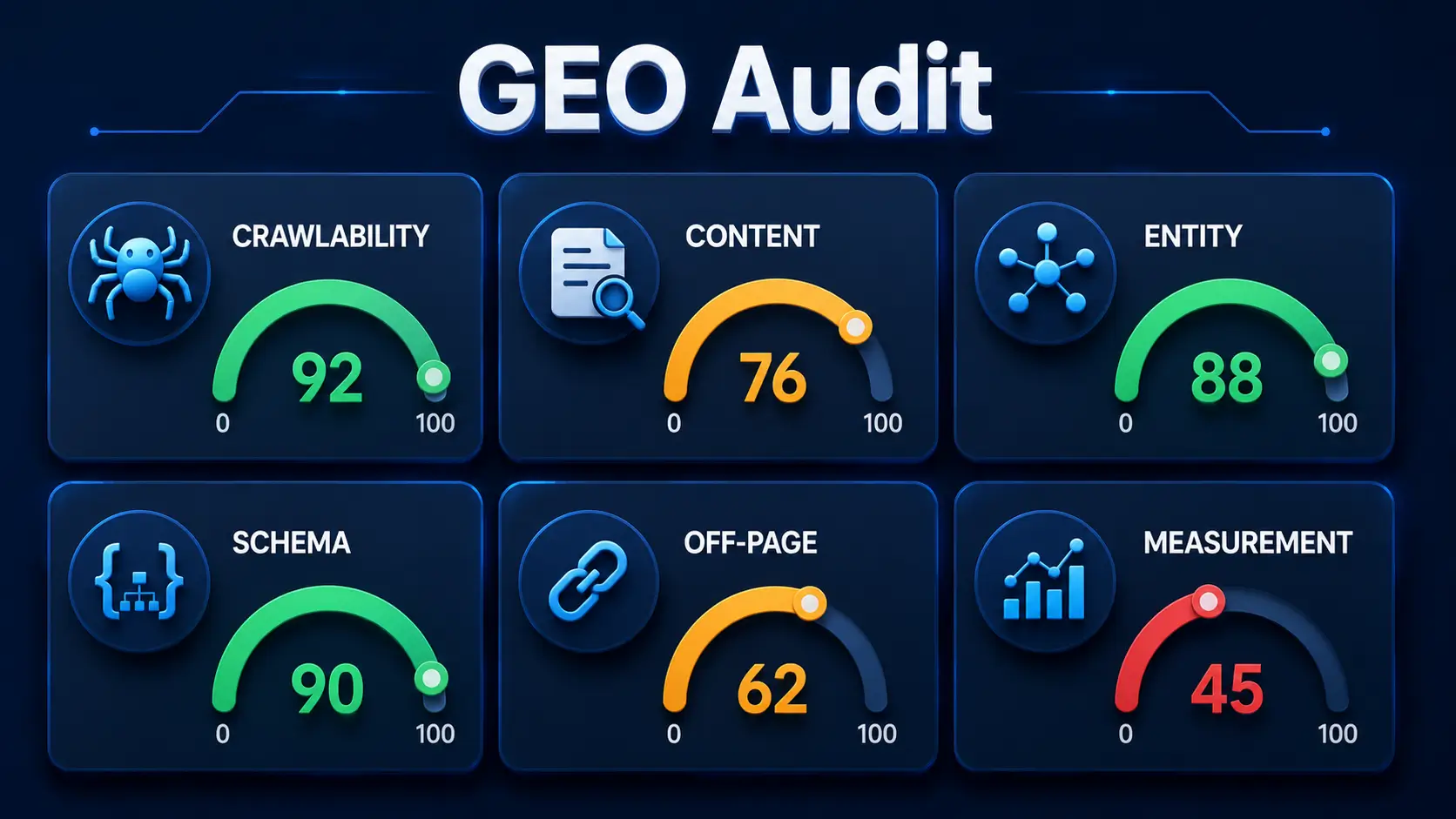
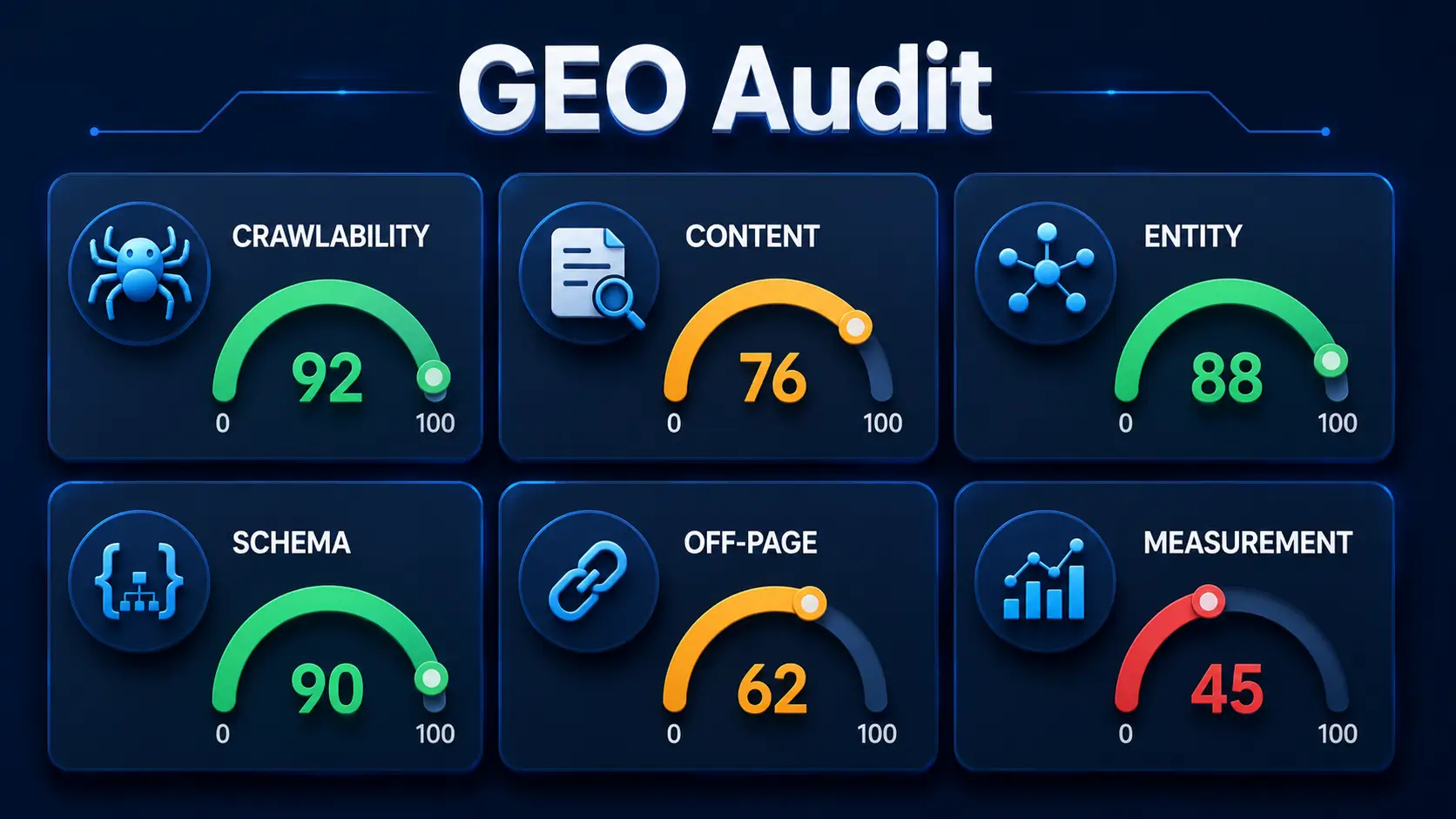
- A GEO audit covers six distinct dimensions — technical crawlability, content extractability, entity clarity, schema integrity, off-page authority, and measurement — and no single dimension substitutes for another.
- 78% of sites with schema markup have implementation errors (Onely, 2026, 5,000-site audit). Schema presence without correctness contributes no citation lift — and the 78% error rate represents the largest single fixable opportunity in most GEO audits.
- The foundational academic GEO study (Aggarwal et al., Princeton/ACM KDD 2024, 10,000 queries) found that adding statistics, source citations, and quotations improved generative engine visibility by up to 40% — with keyword stuffing showing minimal effect.
- Directive Consulting’s GEO adoption framework recommends targeting 70% compliance across audit items (at least 35 of 50 checks passing) as the minimum threshold for claiming meaningful GEO readiness.
- AI-search visitors convert at 4.4× the rate of traditional organic visitors (Semrush, 2025), making the traffic being lost to AI overview displacement disproportionately valuable — which is precisely why this audit matters most for high-intent commercial pages, not just informational content.
New to GEO? Start here — key terms explained
Generative Engine Optimization (GEO) differs from traditional SEO in one fundamental way: the optimization target is a passage inside an AI-generated answer, not a position on a ranked list of links. Before running this audit, make sure you understand these four foundational concepts:
Passage-level extraction
Entity clarity
Schema markup
AI Citation Share of Voice
Dark AI traffic
GEO is the practice of structuring content so AI engines (ChatGPT, Perplexity, Google AI Overviews, Claude) retrieve, extract, and cite it in generated answers. Unlike SEO, which targets ranking positions, GEO targets citation selection.
Passage-level extraction means AI systems pull specific paragraphs from pages — not entire pages. Your audit unit is the paragraph, not the page.
Entity clarity means using named entities (people, brands, tools, organizations) explicitly within each passage, without relying on pronouns that lose meaning when extracted from context.
Schema markup is structured data code that helps AI systems understand what your content is about — what type of document, who authored it, what questions it answers, and when it was updated.
For the broader GEO framework context, see the GEO Complete Guide before auditing.
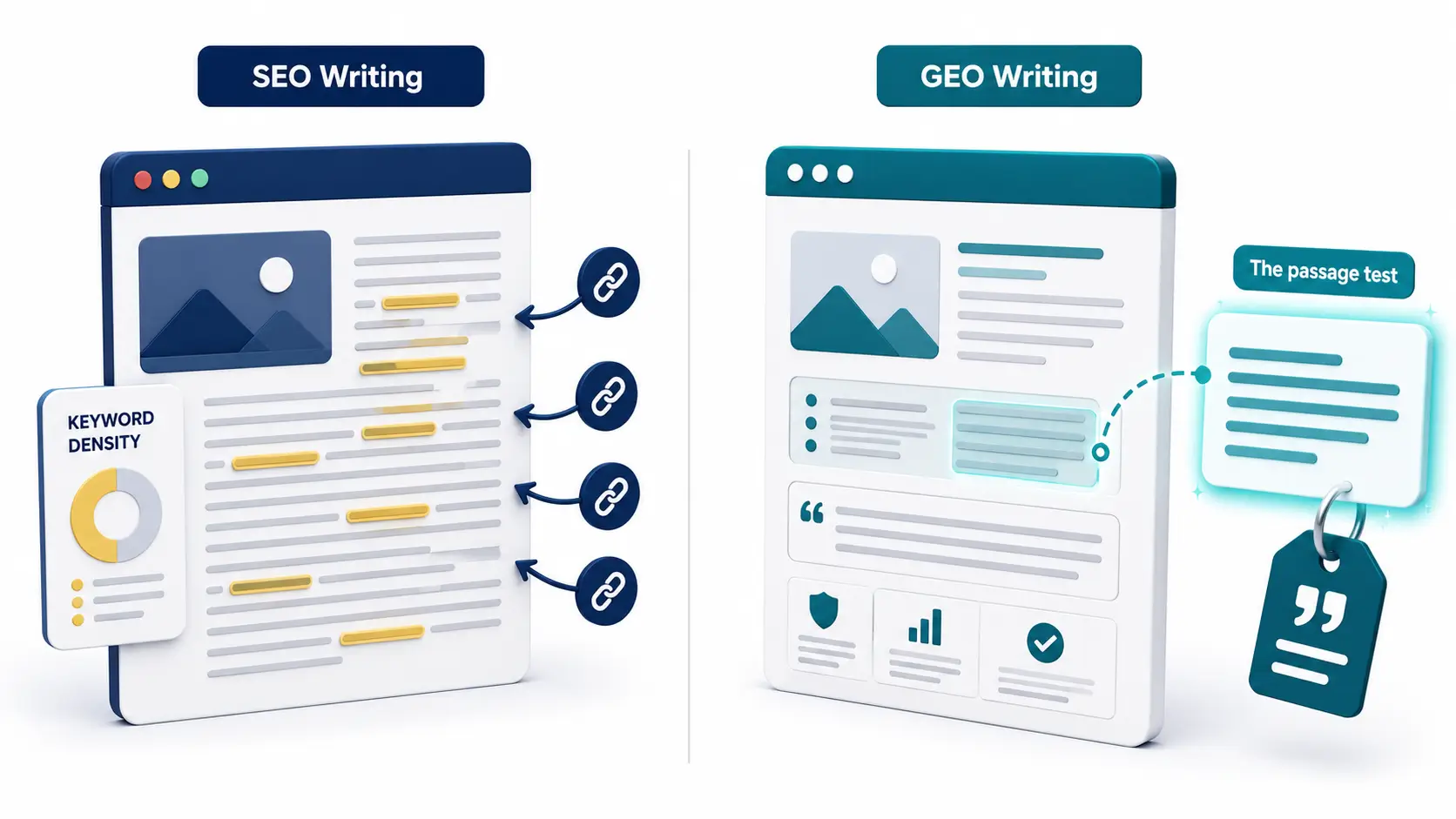
SEO audits measure ranking capability. GEO audits measure citation capability. The two share some infrastructure overlap — crawlability, page speed, and content quality matter for both — but a GEO audit introduces entirely new evaluation dimensions that traditional SEO audits never examine: passage-level extractability, AI bot access, entity pronoun analysis, and Speakable schema targeting.
Most sites have never run any of these checks. The share of organic keywords triggering a Google AI Overview grew from 1.5% to roughly 32% in the 12 months between September 2024 and September 2025 — a 20× increase.[2] AI search platform visits grew 42.8% year-over-year while Google traditional search grew just 2.4% over the same period.[2] Ahrefs data found AI Overviews reduce click-through rates by 58% for the top-ranking organic page.[2] The traffic being displaced carries disproportionate value: Semrush data confirms AI-search visitors convert at 4.4× the rate of traditional organic visitors.[2]
This checklist gives you the systematic framework to audit all six dimensions, score your current position, and prioritize remediation by impact.
According to EverydayOnAI
The most important framing for this entire audit: the purpose isn’t to get a perfect score on all 50 points simultaneously. It’s to identify which dimension has your highest-leverage unaddressed gap — and address that dimension first. A site with 40 items already passing is better served by closing the remaining 10 gaps systematically than by cycling through all 50 superficially. Directive Consulting’s 70% threshold is the minimum target, not the finish line.
Table of Contents
- Who Should Read This?~ 1 min
- Why a GEO Audit Differs From an SEO Audit~ 3 min
- 50-Point Audit: Dimensions at a Glance~ 2 min
- Dimension 1: Crawlability (10 checks)~ 3 min
- Dimension 2: Content Extractability (12 checks)~ 4 min
- Dimension 3: Entity Clarity (8 checks)~ 3 min
- Dimension 4: Schema Integrity (8 checks)~ 3 min
- Dimension 5: Off-Page Authority (7 checks)~ 3 min
- Dimension 6: Measurement Setup (5 checks)~ 2 min
- Mini Case Study: B2B SaaS GEO Audit in Practice~ 3 min
- The Right Audit Cadence~ 2 min
- Tool: GEO Audit Score Calculator~ 5 min
- Frequently Asked Questions~ 2 min
- Google Search Central, “Optimizing your website for generative AI features on Google Search,” published May 2026. Google says SEO remains relevant, generative AI features rely on Search ranking and quality systems, and unique, valuable content matters for AI features. developers.google.com
- Google Search Central Blog, “Introducing Search Generative AI performance reports in Search Console,” June 3, 2026. Google announced dedicated generative AI visibility reports for Search and Discover, rolling out first to a subset of websites. developers.google.com
Why a GEO Audit Differs From an SEO Audit
An SEO audit evaluates a page’s ability to rank in a list of links. It measures signals that search algorithms use to assign position: keyword density, backlink authority, Core Web Vitals, crawlability, and structured data eligibility for rich results.
A GEO audit evaluates a page’s ability to be extracted and cited inside an AI-generated answer. It measures signals that AI retrieval systems use to select passages: passage-level extractability (can a specific paragraph be lifted and read as a standalone answer?), entity clarity (are all named entities explicit within each passage?), schema integrity (is the Q&A relationship machine-readable?), and cross-platform authority signals (does third-party evidence verify this page’s expertise?).
| Audit Dimension | Traditional SEO Audit | GEO Audit (New) |
|---|---|---|
| Unit of optimization | Page (rank position) | Passage (citation selection) |
| Technical access | Googlebot, crawlability | + PerplexityBot, OAI-SearchBot, ClaudeBot separately |
| Content analysis | Keyword density, topical coverage | Passage-level extractability, answer-first structure, entity clarity |
| Schema focus | Rich results eligibility | Schema correctness + Speakable + BreadcrumbList hierarchy |
| Authority signals | Backlink volume, domain authority | Earned media mentions, third-party citations, cross-platform presence |
| Measurement | Rank tracker, GSC organic | + GSC Generative AI report, GA4 AI channel, manual citation testing |
| Fresh content signal | Crawl frequency, sitemap | + Explicit date markers, 30-day and 90-day decay cliffs |
Section Summary
- SEO audits measure ranking signals; GEO audits measure citation signals — the two require different analytical frameworks and produce different remediation roadmaps.
- The unit of analysis changes from the page (SEO) to the passage (GEO) — meaning every paragraph in a page must be independently evaluatable as a citable answer.
- A complete GEO audit introduces six new evaluation dimensions not present in standard SEO tooling: AI bot access, passage extractability, entity clarity, schema correctness, cross-platform authority, and citation measurement.
50-Point Audit: Dimensions at a Glance
50
total audit checks across 6 dimensions
70%
minimum compliance threshold for GEO readiness (Directive Consulting, 2026)[1]
78%
of sites with schema have implementation errors (Onely, 2026, n=5,000)[2]
+40%
visibility lift from statistics + citations + quotations (Aggarwal et al. KDD 2024)[3]
+21.6%
citation lift from correct schema implementation (Onely, 2026)[2]
55%
of AI Overview citations come from the first 30% of page content (CXL, 2026)[4]
How AI Engines Select Citations: The 3-Gate Model
Every AI answer engine applies a multi-layer filter — content must pass all three gates to become a citation.
Dimension 1: Crawlability (10 Checks)
Before any content optimization matters, AI bots must be able to find, access, and process the page. Crawlability for GEO requires more than Googlebot access — each major AI engine uses a distinct crawler with distinct rules.
D1 — Crawlability Checks
- ★ D1.1 PerplexityBot is allowed in robots.txt (not inferred from Googlebot allow)
- ★ D1.2 OAI-SearchBot (ChatGPT browsing) is explicitly allowed in robots.txt
- ★ D1.3 ClaudeBot (Anthropic) is allowed in robots.txt
- ★ D1.4 Google-Extended is explicitly configured (allow or deny — either is valid, but must be explicit)
- D1.5 Sitemap submitted to Bing Webmaster Tools (ChatGPT uses Bing’s index for browsing mode)
- D1.6 Page loads in under 2.5 seconds (Core Web Vitals LCP) — slow pages are retrieved less by real-time AI crawlers
- D1.7 Mobile-first rendering confirmed — AI crawlers typically use mobile user-agent variants
- D1.8 No JavaScript-only content rendering — AI engines extract from HTML, not from client-side JS execution
- D1.9 For non-Google engines: llms.txt deployed at root domain with structured content directory[5]
- D1.10 Crawl budget confirmed for priority pages via GSC Coverage → Indexed status
Section Summary
- Four separate AI crawlers — PerplexityBot, OAI-SearchBot, ClaudeBot, Google-Extended — each require explicit robots.txt configuration. Googlebot allow rules do not propagate to them.
- Bing Webmaster Tools sitemap submission is required for ChatGPT citation eligibility in browsing mode, independent of Google Search Console.
- llms.txt is not required for Google (per Google’s June 2026 guidance) but remains useful for Perplexity, ChatGPT, and Claude crawlers.
Dimension 2: Content Extractability (12 Checks)
Extractability is the dimension with the highest correlation to citation selection. CXL research found 55% of AI Overview citations came from the first 30% of page content, and the Aggarwal et al. 2024 Princeton study found structured, citation-rich content produced up to 40% higher AI visibility.[3]
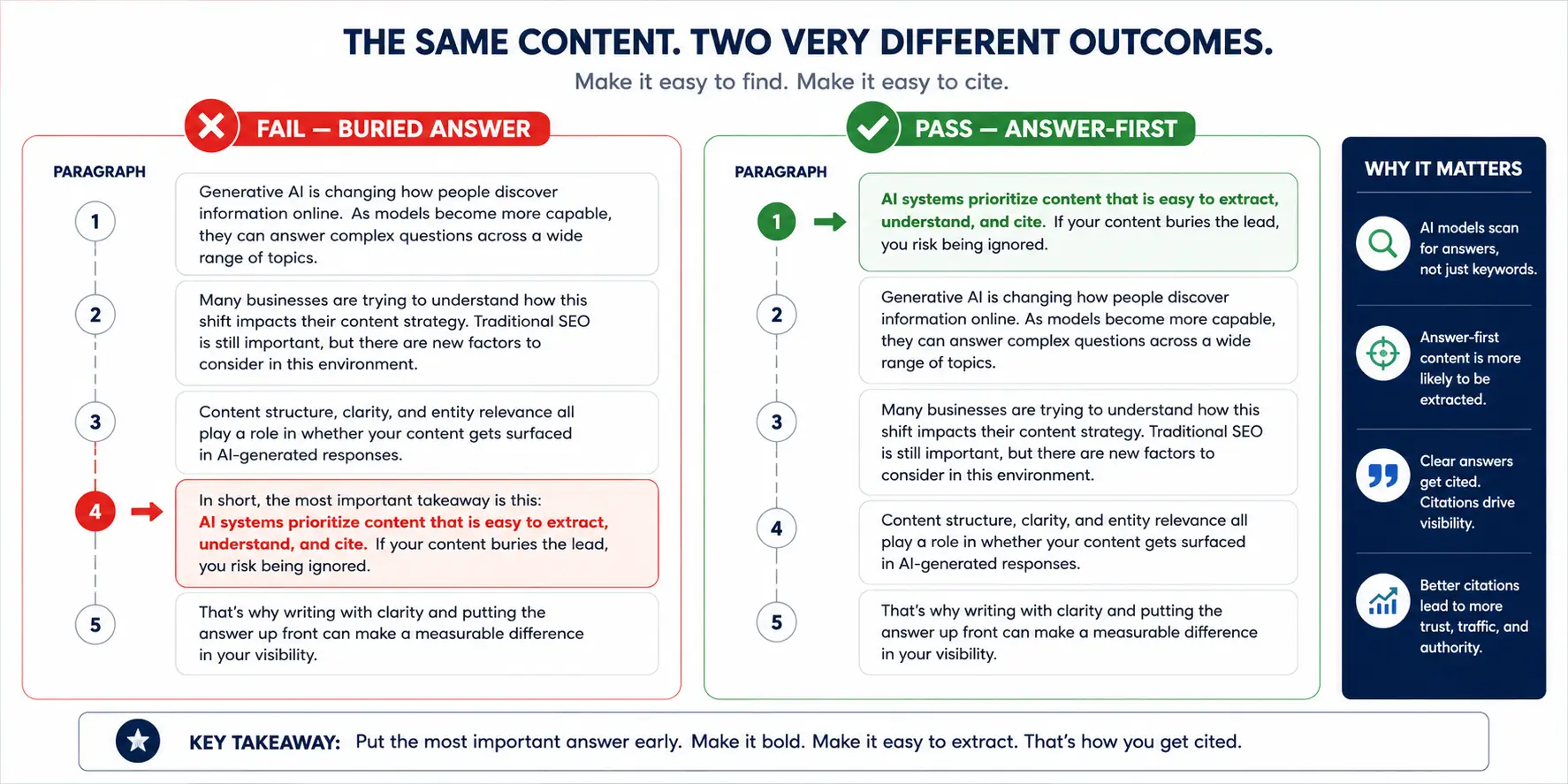
D2 — Content Extractability Checks
- ★ D2.1 Direct answer appears in the first 40–80 words of the page (or section) — the “Quick Answer” block[1]
- ★ D2.2 H2/H3 headings phrased as questions matching actual search and conversational query patterns[6]
- ★ D2.3 The passage test passes for the 5 most important sections — each leading paragraph works as standalone answer
- ★ D2.4 Explicit date marker present (“As of [Month Year]”) — signals freshness to both AI rerankers and readers
- D2.5 FAQ section with 5+ self-contained Q&A pairs at the bottom of the page
- D2.6 Key statistics have inline source attribution — “[Org] found [finding] ([Source, Year])” format
- D2.7 Content updated within 30 days OR has visible “Last Updated” date — 30-day freshness cliff applies on Perplexity[9]
- D2.8 Semantic completeness — full topic coverage including anticipated follow-up questions and common misconceptions
- D2.9 Definitive language throughout — specific confident assertions, not hedged suggestions (target: <15% hedge words)
- D2.10 Lists, tables, and numbered steps used where content is list-structured (not as visual decoration)
- D2.11 Key Takeaways or TL;DR box present near article opening[7]
- D2.12 No more than 3 sentences over 30 words in any 10-sentence block — long sentences reduce passage extractability
❌ Fails D2.1
“AI search visibility has become increasingly important as more platforms emerge. There are several factors to consider. Organizations across industries are adapting their content strategies. In this article, we’ll explore the key dimensions of AI optimization including crawlability, content structure, entity management, and more.”
Passes D2.1
“A GEO audit covers six dimensions: crawlability, content extractability, entity clarity, schema integrity, off-page authority, and measurement. Running all 50 checks and achieving 70%+ compliance (Directive Consulting, 2026) is the threshold for meaningful AI citation readiness in 2026.”
Section Summary
- The four priority checks (D2.1–D2.4) together address the most common extractability failures: buried answers, label-style headings, contextually-dependent paragraphs, and missing freshness signals.
- Semantic completeness (D2.8) has a 0.87 Spearman correlation with citation selection — comprehensive topic coverage, not keyword density, is what AI selection systems reward.
- 55% of AI Overview citations come from the first 30% of page content (CXL, 2026) — front-loading answers is not a stylistic preference, it’s a citation selection structural requirement.
Dimension 3: Entity Clarity (8 Checks)
Entity clarity is the GEO audit dimension most commonly missed by teams fluent in traditional SEO. In conventional SEO, keyword and topical authority signals are evaluated at the page level. In GEO, entity recognition matters at the passage level — a paragraph that uses “it” or “they” to reference an organization named three sentences earlier fails the entity clarity requirement when that paragraph is extracted without its surrounding context.
D3 — Entity Clarity Checks
- ★ D3.1 All organizations, products, platforms, and tools named explicitly on first mention in every major section — not referenced via pronoun from a previous section
- ★ D3.2 No unresolved “it,” “this,” “they,” “the company,” “the study” that require surrounding context to resolve
- D3.3 Author byline links to a Person schema page with verifiable credentials and knowsAbout markup
- D3.4 Organization entity consistent across all pages — same name, same URL, same schema definition
- D3.5 Brand mentioned on authoritative third-party sites (Wikipedia, industry databases, trade publications)
- D3.6 Google Knowledge Graph recognition verified — search “[Brand Name]” directly and check if Knowledge Panel appears
- D3.7 Entity associations are accurate and positive — check how AI systems currently describe the brand by testing prompts directly in ChatGPT, Perplexity, and Gemini
- D3.8 Author entity has Google Scholar, LinkedIn, or equivalent verifiable presence if YMYL topic
According to EverydayOnAI
The entity clarity audit item most teams discover mid-audit is D3.2 — and the discovery is always the same: their most important content sections are full of unresolved pronouns that sounded natural in editorial review but become unintelligible when a specific paragraph is extracted without its surrounding context. The fix is mechanical: replace “it,” “this approach,” and “the platform” with the actual named entity every time it appears in a section’s opening paragraph. The prose becomes slightly more repetitive. The citation potential improves measurably.
Section Summary
- Entity clarity requirements apply at the passage level, not the page level — a paragraph must resolve all entity references within itself, not by relying on context from surrounding paragraphs.
- D3.6 (Knowledge Graph recognition) is the clearest single indicator of entity strength — a brand that appears in Google’s Knowledge Panel has a structurally higher citation probability in Google AI Overviews.
- D3.7 (entity sentiment audit via direct AI testing) is forward-looking — how AI engines currently characterize a brand affects citation selection quality, not just citation frequency.
Dimension 4: Schema Integrity (8 Checks)
Schema markup is the highest-impact single GEO technical fix available — but only when implemented correctly. Onely’s 2026 audit of 5,000 websites found 71% deployed at least one schema.org type, but only 22% passed the Rich Results Test cleanly. That means 78% of sites with structured data had implementation errors, and those errors eliminated the citation lift that correct schema would have provided.[2] Correct schema produces a measured +21.6% citation lift; incorrect schema produces zero lift despite the implementation overhead.[2]
D4 — Schema Integrity Checks
- ★ D4.1 FAQPage schema implemented with Q&A pairs that exactly match the visible FAQ section — mismatch is a FAIL[8]
- ★ D4.2 Article schema includes dateModified (not just datePublished) — recency signal for AI rerankers
- ★ D4.3 All schema validates with zero errors on Google Rich Results Test (search.google.com/test/rich-results)
- D4.4 Speakable schema implemented — cssSelector targeting the leading answer paragraph of each major section
- D4.5 BreadcrumbList schema present with at least 3 levels (Site → Category → Article)
- D4.6 HowTo schema implemented if article contains step-by-step instructions
- D4.7 Person schema on author page with sameAs links to LinkedIn, Google Scholar, or equivalent
- D4.8 Organization schema defined once at site level, referenced consistently — no conflicting definitions
Schema Implementation Architecture
→
Article Schema
→
FAQPage Schema
→
Person Schema
→
sameAs: LinkedIn / Scholar
→
BreadcrumbList
→
Speakable cssSelector
Section Summary
- Schema presence is not sufficient — correctness is what produces the +21.6% citation lift. 78% of sites with schema have errors; validate with Rich Results Test after every implementation change.
- FAQPage schema (D4.1) is the highest single-citation-impact schema type — pages with FAQ schema are 3.2x more likely to appear in AI responses — but only when the schema Q&A exactly matches the visible FAQ section content.
- Speakable schema (D4.4) is the most GEO-specific schema type — it explicitly signals to AI systems which cssSelector targets extraction-ready answer passages.
Dimension 5: Off-Page Authority (7 Checks)
AI systems exhibit documented earned-media bias — they systematically favor third-party, independently published sources over brand-owned content when selecting citations.[9] Building off-page authority signals is the GEO dimension that benefits least from on-site technical optimization — it requires deliberate digital PR investment, original research, and cross-platform presence.
D5 — Off-Page Authority Checks
- ★ D5.1 Brand mentioned on at least 3 authoritative trade publications or industry media outlets
- ★ D5.2 Original research, proprietary data, or benchmark studies published — content others cite is structurally more citable
- D5.3 LinkedIn company page maintained with regular product/content updates (Semrush 2026: LinkedIn is top-2 cited domain across ChatGPT, Perplexity, and Google AI Mode)[10]
- D5.4 YouTube channel with explainer or tutorial content — YouTube is 16.1% of top Perplexity citations as of Q2 2026[11]
- D5.5 Active profiles on Trustpilot, G2, Capterra, or equivalent — SE Ranking data shows 3x higher citation probability for entities with active review platform presence[12]
- D5.6 Press releases and news coverage indexed by major news aggregators (Google News eligibility verified)
- D5.7 Reddit thread activity for brand-adjacent queries — maintain presence without manufactured mentions (Google explicitly warns against manufactured mentions as a GEO tactic)[13]
Section Summary
- Earned media bias means on-page optimization alone cannot close the GEO visibility gap for brands without third-party authority signals — a dedicated digital PR effort is structurally required, not optional.
- LinkedIn and YouTube have the highest documented cross-platform AI citation surface for non-owned content; both should be part of active content distribution strategy.
- Inauthentic mention campaigns are explicitly flagged by Google (June 2026) as counterproductive for Google AI Search — organic earned coverage is the only defensible off-page signal.
Dimension 6: Measurement Setup (5 Checks)
A GEO audit without measurement infrastructure produces a score with no baseline — you know where you stand but can’t verify whether optimizations moved the needle. These five checks establish the minimum viable measurement stack for tracking GEO progress.[14]
D6 — Measurement Setup Checks
- ★ D6.1 Google Search Console Generative AI performance report checked for property availability (launched June 3, 2026 — rolling out in stages)
- ★ D6.2 GA4 custom regex channel group configured for AI platforms (ChatGPT, Perplexity, Gemini, Claude, Copilot, DeepSeek) placed above “Referral” in channel ordering
- D6.3 Manual citation baseline documented — 15–30 priority queries tested across ChatGPT, Perplexity, Gemini, and Claude, with brand citation presence recorded
- D6.4 Share of Voice calculated — brand citations ÷ total brand + competitor citations for tracked query set
- D6.5 90-day audit cadence established — GEO audit items expire approximately every 90 days as algorithms and content age
Section Summary
- Three distinct measurement layers are required: GSC impressions (Google-specific AI visibility), GA4 referral sessions (AI click-through traffic), and manual citation testing (cross-engine citation presence).
- D6.2 (GA4 custom regex) must be placed above “Referral” in the channel group ordering — if Referral fires first, AI sessions are permanently misattributed and the channel shows zero sessions even when configured correctly.
- The 90-day audit cadence in D6.5 aligns with content freshness decay rates — after 90 days, content loses approximately 65% of its Perplexity citation potential and should be audited for freshness and content updates.
Mini Case Study: B2B SaaS GEO Audit in Practice
Mini Case Study
B2B Project Management SaaS — GEO Audit Before/After (2026, Enrich Labs data)[6]
A B2B SaaS project management platform ranking #1 on Google for target terms but receiving zero AI citations when tested across ChatGPT, Perplexity, and Gemini.
D1: All AI bots blocked in robots.txt (legacy “Disallow: /” for non-Googlebot). D2: Answers buried in paragraph 6-8. D4: Schema implemented but 4 validation errors. D6: No AI channel in GA4.
Fixed robots.txt for PerplexityBot/OAI-SearchBot/ClaudeBot. Rewrote top 10 articles with Quick Answer blocks. Fixed schema errors. Built GA4 AI regex channel. Added inline citations to all statistics.
14 demo requests attributed to AI referral traffic vs. 0 in prior 90 days. Perplexity citation rate: 0 → 6 tracked queries. GSC AI Impressions (post-rollout): 2,100/month on priority URLs.
Week 1–2: Technical fixes
robots.txt update for AI bots, Bing Webmaster Tools submission, schema error remediation — immediate priority blockers removed
Week 3–4: Content restructure
Top 10 articles rewritten with Quick Answer blocks, question-based headings, inline citations — D2 compliance raised from 28% to 74%
Week 5–8: Entity and off-page work
Person schema on author pages, LinkedIn/YouTube content distribution begun, G2 profile activated — D3 and D5 improvements
Week 9–12: Measurement and iteration
GA4 AI channel live, manual citation baseline documented, Share of Voice calculated — first data-driven GEO optimization cycle
The Right Audit Cadence
Superlines’ 2026 GEO Best Practices guide recommends a 60–90 day content refresh cycle for high-value pages — and a corresponding audit cycle for the checks that govern those pages.[7] Not every check requires the same frequency:
| Audit Tier | Frequency | Checks Covered | Trigger |
|---|---|---|---|
| Full 50-point audit | Quarterly (every 90 days) | All 6 dimensions, all 50 checks | Scheduled; also triggered by major Google algorithm update or competitor citation surge |
| Freshness spot-check | Monthly | D2.7 (date markers), D6.1 (GSC impressions trend), D6.3 (citation baseline spot-check) | Scheduled; also triggered by content older than 30 days on high-priority pages |
| Technical check | After every site change | D1.1–D1.4 (bot access), D4.3 (schema validation), D4.1 (FAQ match) | After CMS updates, plugin changes, robots.txt edits, or schema changes |
| Citation baseline | Quarterly | D6.3–D6.4 (manual prompt testing + Share of Voice) | Scheduled; also triggered by product launch, PR campaign, or competitor GEO activity |
Tool: GEO Audit Score Calculator
Check every item that is currently true for the page you are auditing, then calculate your score across all six dimensions.
Interactive Tool
GEO Audit Score Calculator
Based on the 50-point framework above. Check every item that currently applies to your target page. Results show per-dimension scores and your highest-priority remediation gap.
Dimension 1: Crawlability (10 items)
Dimension 2: Content Extractability (12 items)
Dimension 3: Entity Clarity (8 items)
Dimension 4: Schema Integrity (8 items)
Dimension 5: Off-Page Authority (7 items)
Dimension 6: Measurement Setup (5 items)
This is a directional self-assessment. 70% compliance (35/50) is Directive Consulting’s 2026 minimum threshold for meaningful GEO readiness. Scores below 50% indicate structural barriers that content optimization alone cannot overcome.
Frequently Asked Questions
What is a GEO audit?
A systematic evaluation of how well a website is positioned to be retrieved, extracted, and cited by AI-powered answer engines. Unlike a traditional SEO audit that measures ranking signals, a GEO audit evaluates six dimensions: crawlability by AI bots, content extractability at the passage level, entity clarity, schema markup integrity, off-page authority signals, and measurement setup. The output is a scored assessment of AI citation readiness with a prioritized remediation roadmap. The foundational academic GEO study (Aggarwal et al., Princeton/ACM KDD 2024) is the standard reference for what signals actually improve generative engine visibility.[3]
How many GEO audit checks should be included?
At minimum 40–50 checks across all six dimensions. Directive Consulting’s 2026 GEO framework recommends targeting 70% compliance — at least 35 of 50 checks passing — as the minimum threshold for claiming meaningful GEO readiness.[1] The Aggarwal et al. 2024 Princeton study validated that structured content, statistics inclusion, source citations, and entity specificity consistently improve generative engine visibility.
Is a GEO audit the same as an SEO audit?
No — they evaluate different optimization targets with different analytical frameworks. An SEO audit measures ranking signals: keyword presence, backlink authority, Core Web Vitals, and structured data eligibility for rich results. A GEO audit measures citation signals: passage-level extractability, entity clarity, schema accuracy, AI bot access, and cross-platform authority presence. They share crawlability and basic content quality as overlap, but GEO introduces six new evaluation dimensions that traditional SEO tools don’t cover.
How often should a GEO audit be run?
Full 50-point audit quarterly; freshness spot-check monthly; technical check after every site change. Superlines 2026 recommends a 60–90 day content refresh cycle for high-value pages, which aligns with the freshness decay cliffs documented for Perplexity (40% citation loss at 30 days, 65% at 90 days).[7] For Google AI Overviews, freshness decay is less severe but still measurable.
What schema types matter most for GEO?
Five types, in citation-impact order: FAQPage (3.2x citation likelihood), Article/TechArticle with dateModified, Speakable (GEO-specific), HowTo for instructional content, and BreadcrumbList. A 2026 audit of 5,000 websites found 78% had schema implementation errors (Onely, 2026) — the average site gets zero lift from incorrectly implemented schema despite the deployment effort.[2] Always validate with Google Rich Results Test after every schema change.
Download the GEO Audit Worksheet
All 50 checks in a structured spreadsheet with per-dimension scoring, priority flags, remediation notes, and 90-day re-audit calendar — ready to use on your next audit cycle.
References and Sources
- Directive Consulting, “A Guide to Generative Engine Optimization (GEO) Best Practices,” April 14, 2026. 70% compliance threshold for GEO readiness; 40–80 word Quick Answer block recommendation; AI Citation Rate and Response Inclusion Rate as core KPIs; team role mapping (Managing Editor, SEO Lead, PR Lead, Analytics Manager). directiveconsulting.com
- Onely, “The Ultimate GEO Checklist: 10 Steps to Optimize Your Brand,” May 27, 2026. AI Overview keyword coverage grew from 1.5% to 32% in 12 months (20× increase); AI search visits +42.8% YoY; Ahrefs: AI Overviews reduce CTR 58%; Semrush: AI visitors convert at 4.4×; 2026 audit of 5,000 sites: 71% have schema, only 22% pass Rich Results Test cleanly (78% error rate); correct schema = +21.6% citation lift; CXL: 55% AI Overview citations from first 30% of page. onely.com
- Aggarwal, N. et al., “GEO: Generative Engine Optimization,” ACM KDD 2024 (Princeton / Georgia Tech / Allen Institute for AI). Foundational academic GEO study across 10,000 queries; statistics, quotations, and source citations improve generative engine visibility by up to 40%; keyword stuffing shows minimal effectiveness; entity specificity and authoritative citations are primary positive signals. arxiv.org
- CXL, “Why your pages aren’t surfacing in ChatGPT citations (And how to fix it),” May 2026. 55% of AI Overview citations from first 30% of page content; semantic similarity scoring; web search trigger rate decline (46% → 34.5%). cxl.com
- 201Creative, “The 2026 GEO Audit Checklist: How to Optimize for Generative Search Engines,” April 16, 2026. llms.txt deployment guidance for non-Google engines; INP as Core Web Vital; snippet eligibility prerequisite; platform-specific GEO differences between Google AI Overviews, Bing Copilot, and Perplexity. 201creative.com
- Enrich Labs, “Generative Engine Optimization (GEO): The Complete 2026 Guide.” Mini case study: B2B project management SaaS — 14 demo requests in 90 days from zero; question-format heading rewrite as high-ROI change; GSC query data for heading audit. enrichlabs.ai
- Superlines, “GEO Best Practices Checklist 2026: How To Become The Default Answer In AI Search,” January 2026. 60–90 day content refresh cycle; three GEO optimization layers (training data, high-volume AI search, real-time agentic AI); GEO loop concept for continuous iteration. superlines.io
- Directive Consulting (same source as ref-1). FAQ schema 3.2x citation likelihood; structured data elements correlated with +21.60% lift in citation likelihood when correctly implemented. directiveconsulting.com
- Chen, M. et al., “Source Coverage and Citation Bias in LLM-based vs. Traditional Search Engines,” arXiv 2025; Outpace SEO, “How to Optimize Content for Perplexity AI Citations,” May 1, 2026. Earned media bias: AI systems systematically favor third-party sources over brand-owned content; Perplexity freshness decay: 40% at 30 days, 65% at 90 days. arxiv.org
- Backlinko (Semrush), “Generative Engine Optimization (GEO),” June 2026. Semrush January 2026 data: Reddit and LinkedIn are top-2 cited domains across ChatGPT, Perplexity, and Google AI Mode; 900 million weekly ChatGPT users (April 2026). backlinko.com
- Ahrefs, cited in QuickSEO 2026. YouTube approximately 16.1% of top-10 Perplexity citations after Reddit lawsuit (October 2025) and subsequent 86% Reddit citation drop. quickseo.ai
- SE Ranking (November 2025), cited in Erlin.ai 2026. Sites with active Trustpilot, G2, Capterra, or Yelp profiles have 3× higher citation probability compared to sites without such presence; ChatGPT treats review platform presence as entity verification signal. erlin.ai
- Google Search Central, “Optimizing for Generative AI Features on Google Search,” June 15, 2026. Official Google guidance: warns against pursuing “inauthentic mentions” as GEO tactic; llms.txt not required for Google Search; content chunking not necessary for Google; write for human readers. developers.google.com
- Weblumino, “Search Generative AI Performance Reports in Search Console: 2026 SEO Guide,” June 2026. Google Search Console Generative AI performance report launched June 3, 2026; impressions by page, country, device, date; no click data yet. weblumino.com
Sources verified June 22, 2026. GEO ranking signals and AI retrieval algorithms update frequently — re-verify key data points quarterly. This article does not constitute professional SEO advice.
Share this article