GEO Content Writing Guide: How to Write for AI Citation (2026)

GEO Content Writing Guide: How to Write for AI Citations
Data Freshness Note — Reviewed June 30, 2026
According to EverydayOnAI: GEO writing should not become formulaic “AI bait.” Google’s 2026 generative AI optimization guidance emphasizes unique, valuable, non-commodity content and confirms that generative AI features are rooted in Search ranking and quality systems.[F1]
Practical implication: write passage-level answers, but keep original analysis, first-hand examples, and source-backed interpretation. Generic summaries are easier to extract, but weaker as authority signals.
Who Should Read This?
Use this to connect classic ranking work with AI citation visibility.
Use the section structure to brief writers and editors.
Use this to decide where AI-search effort deserves budget.
Use the metrics sections to build a practical visibility baseline.
📌 Key Takeaways
- The unit of optimization has shifted from the page to the passage. Google’s AI Overviews, ChatGPT, and Perplexity don’t rank entire pages — they extract specific paragraphs. GEO writing starts at the passage level, not the page level.
- Google published its official AI optimization guide on June 15, 2026, explicitly calling several popular GEO tactics unnecessary for Google Search — including llms.txt files, artificial content chunking, and pursuing “inauthentic mentions.” The guide recommends writing for human readers with clear organization. This is Google-specific; non-Google engines have different requirements.
- Cited text is nearly twice as likely to contain definitive language as uncited text — 36.2% versus 20.3% (Contently, 2026). Writing with confident, specific assertions outperforms hedged language across all studied AI engines.
- Entity clarity — using named entities rather than referential pronouns — is a non-obvious but high-impact GEO writing discipline. A paragraph that refers to “it” or “they” or “the company” fails the passage test because the extracted paragraph loses its meaning without surrounding context.
- The single-sentence citation test is the fastest diagnostic available: find the sentence in each section that an AI would most likely quote. If that sentence doesn’t exist explicitly — if the key claim must be inferred rather than extracted — rewrite the section to make it explicit.
📋 Table of Contents
- Who Should Read This?~ 1 min
- The Shift: From Page Optimization to Passage Optimization~ 3 min
- What Google’s Official 2026 Guide Actually Says~ 4 min
- Four Dimensions Every GEO-Optimized Section Needs~ 4 min
- The Passage Test: One Question That Diagnoses Every Paragraph~ 3 min
- The Single-Sentence Citation Test~ 3 min
- Entity Clarity: The Non-Obvious Rule~ 3 min
- Heading Architecture for AI Extraction~ 3 min
- Before & After: SEO Writing vs. GEO Writing~ 3 min
- Five GEO Writing Myths Worth Debunking~ 3 min
- Tool: Paragraph GEO Readiness Checker~ 2 min
- GEO Content Writing Checklist~ 2 min
- Frequently Asked Questions~ 2 min
- Google Search Central, “AI Features and Your Website,” last updated December 2025. Google states that SEO best practices remain relevant for AI Overviews and AI Mode, that there are no additional technical requirements beyond Search eligibility and snippets, and that AI features may use query fan-out. developers.google.com
The Shift: From Page Optimization to Passage Optimization
Traditional SEO is a page game. You optimize a page to rank at position one for a target keyword. The unit of success is where the page lands in a list of links. The unit of optimization is the page — its authority, its topical depth, its technical health.
GEO is a passage game. When an AI model answers a question, it doesn’t return a list of pages — it extracts specific passages from multiple pages and synthesizes them into a direct answer. The unit of success is whether your passage appears in that synthesis and whether your page is cited as the source. The unit of optimization is the paragraph — its self-containment, its clarity, its extractability.
This shift changes the fundamental writing question. In SEO, the question is: “Does this page signal strong relevance for this topic?” In GEO, the question is: “Does every paragraph in this page work as a standalone, citable answer to an implied question?” A page can rank #1 on Google and fail the GEO passage test on every section — and it will produce zero AI citations for all the traffic it sends.[4]
The evidence for this shift comes from multiple directions. Research on 55,393 Google AI Overview queries found that AI systems surface specific relevant passages from pages, not the overall page authority.[1] Mike King’s passage-level optimization research — frequently cited in 2026 GEO discourse — argues directly that Google’s AI Overviews don’t rank entire pages but rather pull specific, highly relevant paragraphs.[4] The practical implication: your unit of optimization is no longer the page. It’s the passage.
📋 Section Summary
- GEO shifts the optimization unit from page to passage — AI models extract specific paragraphs from pages, not page-level authority signals, when constructing answers.
- A page can rank #1 on Google and produce zero AI citations if its paragraphs aren’t structured for passage-level extraction.
- The writing question changes: from “does this page signal relevance?” to “does every paragraph in this page work as a standalone citable answer?”
What Google’s Official 2026 Guide Actually Says
On June 15, 2026, Google published its first official AI optimization guide — ai-optimization-guide on the Google Search Central documentation site — representing Google’s own perspective on what content creators should and shouldn’t do to appear in AI Overviews and AI Mode.[5] The guide is worth reading in full. For content writers, the most important elements are what Google explicitly says to ignore.
What Google says to ignore for Google Search:
✗ llms.txt files — “you don’t need to create them for Google Search”
Google explicitly states: “You don’t need to create new machine-readable files, AI text files, markup, or Markdown to appear in Google Search (including its generative AI capabilities).” This is Google-specific guidance — llms.txt remains useful for other AI crawlers (OAI-SearchBot for ChatGPT, ClaudeBot, PerplexityBot) that don’t operate on Google’s infrastructure.
✗ Artificial content “chunking” — not how Google works
Google says to ignore “tactics like ‘chunking’ content” as a GEO tactic for Google Search. In June 2026, Google confirmed its systems can understand multiple topics on a page and surface the relevant part on their own — artificial chunking isn’t necessary for Google specifically. However, clear heading structure and answer-first sections remain beneficial for human readers and pass-through to AI extraction quality.
✗ Pursuing “inauthentic mentions” — Google won’t reward it
Google explicitly warns against pursuing inauthentic mentions as a GEO tactic. Earned, natural mentions in authoritative publications remain valuable; manufactured mention campaigns are not.
What Google actually recommends for AI visibility: Write content for human readers with clear organization. Use paragraph and section structure with headings that aid navigation. Add high-quality, relevant images and video. Follow existing Google SEO best practices — they translate directly into AI visibility for Google’s systems. Google’s message: “Creating content that people find unique, compelling, and useful will likely influence your website’s presence in generative AI search in the long run more than any of the other suggestions in this guide.”[5]
💬 According to EverydayOnAI
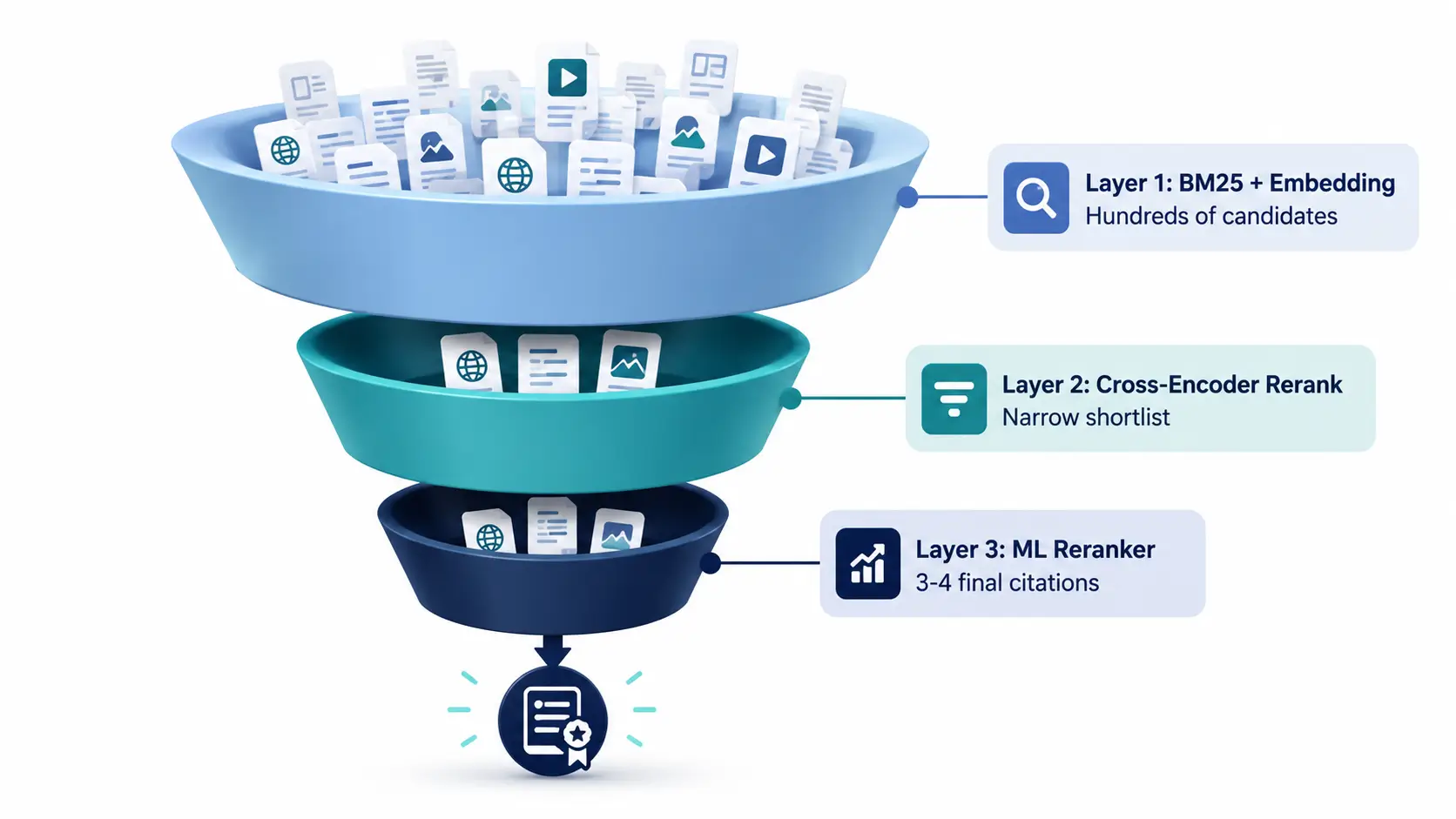
Google’s June 2026 guide is worth reading carefully — and carefully contextualizing. Google is telling content creators what matters for Google’s AI systems specifically: Google Overviews, AI Mode, and Google’s generative features. It is not telling content creators what to ignore across ChatGPT, Perplexity, and Claude — those platforms have separate retrieval architectures with separate optimization requirements. The guidance on llms.txt is accurate for Google; it’s potentially limiting for other engines. The guidance on chunking reflects Google’s own ability to parse page structure without artificial segmentation — not a claim about how Perplexity’s Layer 2 cross-encoder or ChatGPT’s fan-out query system process the same content. Read the Google guide as authoritative guidance for Google’s ecosystem specifically, and as one important input — not the final word — for cross-platform GEO content strategy.
📋 Section Summary
- Google’s June 15, 2026 official guide explicitly marks three popular GEO tactics as unnecessary for Google Search: llms.txt files, artificial content chunking, and inauthentic mention campaigns.
- Google’s recommendation is consistent with broad content quality principles: write for humans, organize clearly, add images and video, follow standard SEO best practices.
- This guidance is Google-specific — llms.txt and structured chunking may remain relevant for ChatGPT, Perplexity, and Claude optimization. The guide should be read as authoritative for Google’s ecosystem, not as cross-platform GEO guidance.
Four Dimensions Every GEO-Optimized Section Needs
Research across Lumar, Contently, AuthorityTech, and ZipTie.dev converges on four properties that AI systems evaluate when deciding whether to select a passage for citation.[6]
Dimension 1: Extractability. Key information can be isolated and referenced without losing meaning. AI systems extract snippets, not entire pages — a passage that requires surrounding context to be understood is not extractable. Extractability requires self-contained sentences, named entities rather than referential pronouns, and complete claims that stand alone. A sentence that begins “This approach improves results because…” is not extractable from context — but “Answer-first content structure improves AI citation rates because AI systems extract leading sentences first when scanning for citable passages” is.
Dimension 2: Verifiability. Every statement is sourced or factual. AI systems applying a cross-encoder or ML reranker filter are effectively asking: “Can I trust this statement?” Unverified claims, superlatives without basis (“the most effective approach”), and opinion-stated-as-fact all reduce verifiability scores. Verifiable content includes: specific statistics with named sources and year, named methodologies, documented examples with outcomes, and explicit sourcing language (“per the 2026 arXiv study of 55,393 AI Overview queries”).
Dimension 3: Comprehensiveness. Full topic coverage rather than shallow treatment. Semantic completeness has a 0.87 Spearman correlation with citation selection across AI engines.[3] Comprehensive content covers related subtopics, anticipated follow-up questions, common misconceptions, and the full chain of implications — not just the main point. A comprehensive section on GEO writing covers not just “what to do” but “why it works,” “where it fails,” and “how to diagnose problems.”
Dimension 4: Definitiveness. Confident, specific assertions rather than hedged, vague language. Cited text is nearly twice as likely to contain definitive language as uncited text — 36.2% versus 20.3% in Contently’s analysis of thousands of cited and uncited passages.[7] “This approach might improve results” fails definitiveness. “This approach improves AI citation rates by eliminating the extractability failure most pages have in their opening paragraphs” passes it.
| Dimension | Failing Example | Passing Example |
|---|---|---|
| Extractability | “It can be useful in this context because it helps with the issue described above.” | “Answer-first content structure improves AI citation because extraction systems scan opening sentences first.” |
| Verifiability | “Studies show that GEO-optimized content performs significantly better in AI search.” | “Semantic completeness has a 0.87 Spearman correlation with AI citation selection (ZipTie.dev, 2026, analyzing Perplexity citation data).” |
| Comprehensiveness | A section covering GEO writing rules without addressing why each rule matters or where it fails. | A section covering the rule, the mechanism behind it, the failure mode when it’s not applied, and a diagnostic test. |
| Definitiveness | “Hedged language might reduce citation probability in some AI contexts.” | “Cited text contains definitive language at 36.2% vs 20.3% for uncited text — hedging reduces AI citation probability across all studied engines.” |
📋 Section Summary
- Four dimensions determine AI passage selection: Extractability (self-contained without context), Verifiability (sourced, factual), Comprehensiveness (full topic coverage, 0.87 correlation with citation), and Definitiveness (specific confident assertions, 36.2% vs 20.3% for cited vs uncited text).
- Content that scores well on all four dimensions consistently outperforms content strong in one or two — AI selection tends to be cumulative, not categorical.
- Definitiveness is the dimension that SEO writing most consistently fails on — keyword-targeting encourages comprehensive coverage but not always confident assertion.
The Passage Test: One Question That Diagnoses Every Paragraph
The passage test is the fastest single diagnostic available for GEO content quality. It asks one question of every paragraph in a piece of content:
“If an AI had to lift this paragraph out of the page and use it as a standalone answer to the section’s implied question — could it?”
A paragraph passes the test if it satisfies three conditions: Self-containment — the paragraph makes complete sense without the preceding three paragraphs of context. Definitiveness — the paragraph contains a specific claim or answer, not an introduction to a claim that appears later. Entity clarity — every entity in the paragraph is named, not referenced by pronoun or generic descriptor that requires context to resolve.
Most pages fail this test on a large proportion of their paragraphs. Transition paragraphs (“Now that we’ve established X, let’s look at Y”) fail by definition. Build-up paragraphs that defer the main claim until the next paragraph fail. Contextually-dependent paragraphs that use “this,” “they,” or “the company” to reference entities named three paragraphs earlier fail.
The practical application: take any three consecutive paragraphs from a high-value page and apply the passage test to the middle one. Read it in isolation. Does it answer the implied question of the section? Does it contain a specific, citable claim? Do all its entity references make sense out of context? If any answer is “no,” the paragraph needs revision — not because it’s bad writing, but because it’s been written for linear human reading rather than non-linear AI extraction.[8]
📋 Section Summary
- The passage test asks whether any paragraph can be extracted and read in isolation as a complete, citable answer — the three conditions: self-containment, definitiveness, entity clarity.
- Most pages fail on a large proportion of paragraphs — transition paragraphs, build-up paragraphs, and contextually-dependent paragraphs all fail by structural design.
- The test is not about writing quality — excellent prose can fail the passage test because excellent prose is often designed for linear reading, which is the opposite of AI extraction.
The Single-Sentence Citation Test
If the passage test is the section-level diagnostic, the single-sentence citation test is the paragraph-level diagnostic. It asks: “Find the sentence in this paragraph that an AI would most likely extract as a direct quote. Does that sentence exist explicitly in the text, or would the AI have to synthesize it from multiple sentences?”
The design principle behind this test: AI systems extract phrases, not paragraphs. The passage they cite is typically one to three sentences — often the opening sentence of a well-structured section, the sentence containing the key statistic, or the sentence that most directly answers the implied question. Good GEO writing makes that sentence easy to find and easy to extract.
The architecture of a high-performing GEO paragraph therefore has a specific structure. Lead sentence (25-50 words): the main claim, stated definitively, with enough context to stand alone. Evidence sentence: the specific data point, study, or example that verifies the lead claim, with source attribution. Implication sentence: what the claim means for the reader’s situation, written in actionable terms. The lead sentence is the one an AI quotes; the evidence sentence is what makes the citation defensible; the implication sentence is what the human reader needs.[9]
The test to run on your own content: for each major section, try to identify the single sentence that best represents that section’s key claim. If you can’t find it — if you need two or three sentences to represent the claim — rewrite the section with an explicit lead sentence that contains the complete claim in one breath.
Entity Clarity: The Non-Obvious Rule
Entity clarity is the GEO writing rule most frequently overlooked by content teams familiar with SEO — because SEO has no equivalent requirement at the sentence level, and good prose writing often uses pronouns and generic descriptors to avoid repetition.
GEO writing has a specific requirement: every entity referenced in a passage must be identifiable by name within that passage, without relying on context from surrounding paragraphs. “AI systems favor content that uses specific names, not generic terms. Mention your brand, products, people, and partners by name. This helps AI systems connect your content with recognized entities.” is the principle as articulated in GEO best practices.[1]
The practical implication runs deeper than brand mentions. Consider this paragraph: “The study found that it improved performance by 43%. Researchers say this is the most significant finding in the field.” “It,” “this,” and “the field” all require context from surrounding text to resolve. An AI extracting this paragraph produces an uncitable fragment. Now compare: “Ahrefs’ 2026 study of 15,000 long-tail queries found that FAQ schema improved AI citation rates by 43% on average. Ahrefs researchers described this as the largest measured schema impact in AI search citation data.” Every entity is named; every reference resolves within the paragraph. The second version passes entity clarity; the first fails it regardless of how well-written it is by prose standards.
Entity clarity checklist for any paragraph:
- No unresolved “it,” “this,” “they,” “the company,” or “the study” that requires prior context
- Every percentage or statistic has its source named within the same sentence
- Every product, platform, or tool is referred to by its full name on first mention in the paragraph
- Every person mentioned is identified by their role or organization when relevant
📋 Section Summary
- Entity clarity requires that every entity referenced in a passage be identifiable by name within that passage — without relying on context from surrounding paragraphs.
- This rule conflicts with good prose style (which uses pronouns to avoid repetition) — GEO writing deliberately sacrifices some stylistic elegance to preserve extraction integrity.
- The entity clarity checklist (no unresolved pronouns, named sources within each sentence, full names on first mention) is a practical paragraph-level editing tool, not a page-level consideration.
Heading Architecture for AI Extraction
Heading structure serves a different function in GEO writing than in SEO writing. In SEO, headings signal topical organization to a crawling algorithm and help users navigate long content. In GEO, headings function as the labels AI systems use to identify which passage answers which sub-query — meaning the heading itself is part of the extraction context for the passage beneath it.
The question-heading principle: Format H2 and H3 headings as actual questions — the same questions your audience would type into ChatGPT, Perplexity, or Google AI Mode. When someone asks Perplexity “How does GEO content writing differ from SEO writing?”, a page with that exact question as an H2, followed by a concise factual answer in the opening paragraph, has a structural advantage over a page that buries that comparison in a section titled “Understanding the Landscape.”[8]
The one-topic-per-section rule: Each H2 section should address exactly one distinct topic or question. AI systems use heading structure as a document map — sections with multiple topics produce ambiguous extraction contexts that reduce citation probability. If a section covers three related ideas, break it into three sections with three question headings, even if each section is shorter.[1]
The hierarchy principle: Use H2 headings for distinct parallel ideas; use H3 headings to break those ideas into specific components. This hierarchy helps AI models understand how information fits together and makes it easier to extract specific claims. H2: “How to Write for AI Citation” → H3: “The Passage Test” → H3: “Entity Clarity” → H3: “Heading Architecture.” This is how this article is structured — not as a stylistic choice but as a GEO extraction design decision.[2]
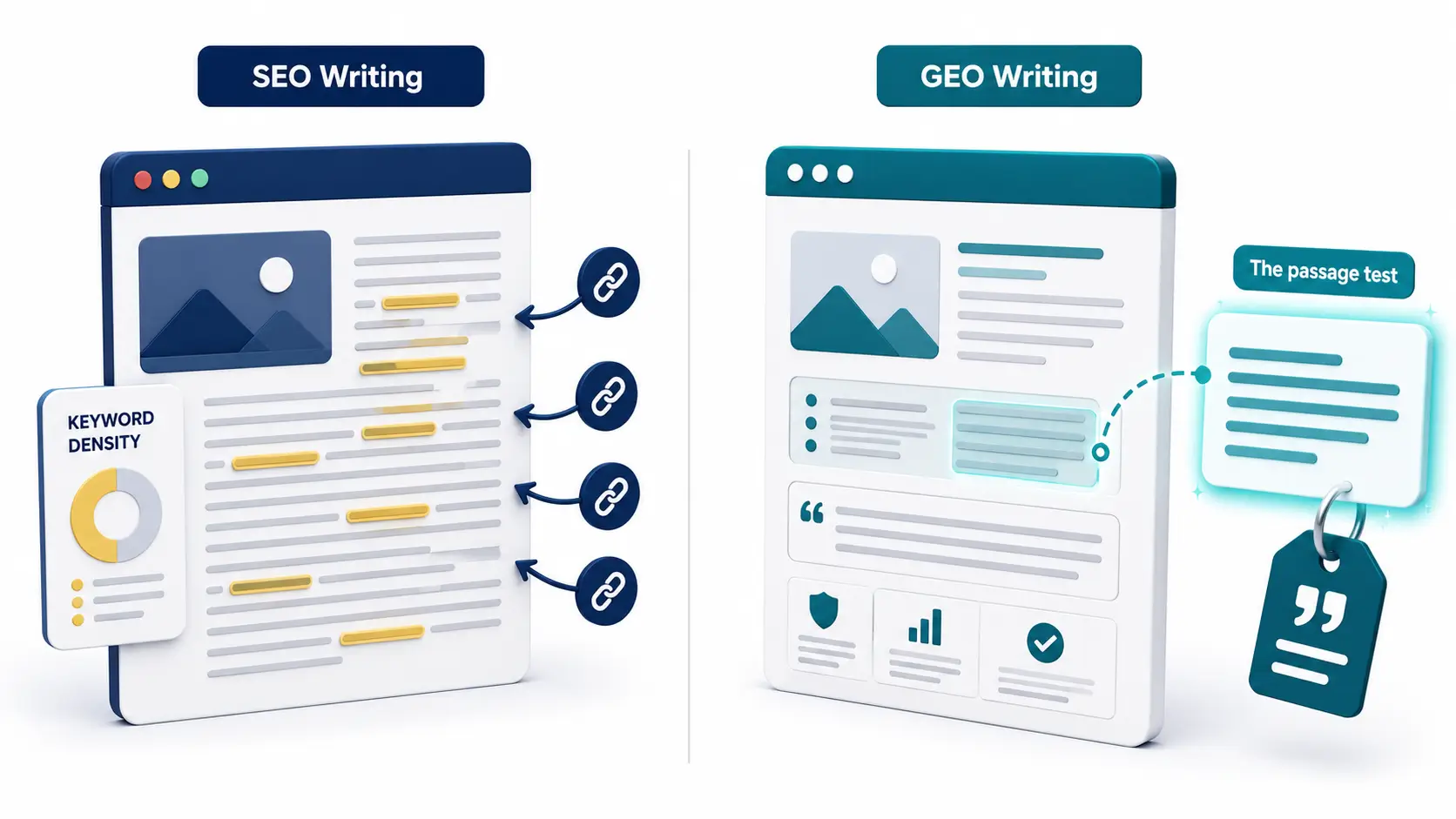
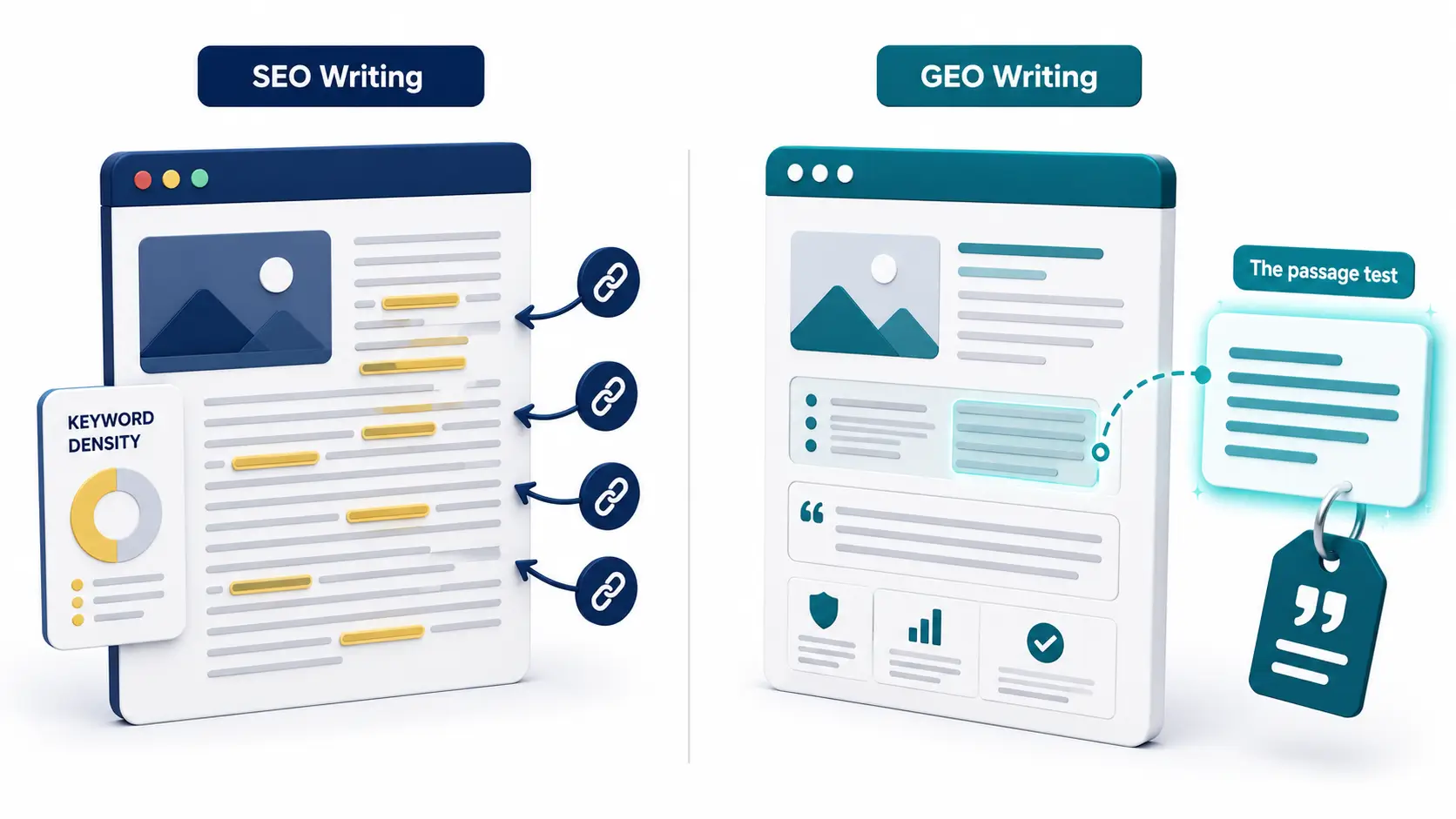
Before & After: SEO Writing vs. GEO Writing
✖ SEO Writing — Page-Level Optimization
“What is generative engine optimization? GEO is a comprehensive strategy that companies use to improve their presence in AI search. It involves various techniques that can help businesses appear in the answers generated by AI tools like ChatGPT and Google’s AI Overviews. There are many aspects to consider when developing your GEO strategy.”
✔ GEO Writing — Passage-Level Extraction
“Generative engine optimization (GEO) is the practice of structuring content so that AI systems — ChatGPT, Perplexity, Google AI Overviews — can retrieve, extract, and cite it in generated answers. Unlike traditional SEO, which optimizes pages for ranking position, GEO optimizes paragraphs for citation extraction — the unit of success shifts from page rank to passage selection.”
✖ Entity Ambiguity (Fails Passage Test)
“Their study found that it improved performance significantly. The company said this validates what they’ve been saying for years about the importance of structured data in this kind of content.”
✔ Entity Clarity (Passes Passage Test)
“Ahrefs’ 2026 analysis of 15,000 queries found that FAQ schema improved AI citation rates by 43%. Ahrefs interpreted the finding as validation of structured data as a primary citation signal — the largest single-schema impact documented in AI search citation research.”
Five GEO Writing Myths Worth Debunking
✗ Myth 1: “You need to write shorter content for GEO”
AI systems favor comprehensive coverage (semantic completeness at 0.87 correlation). Shorter content is not a GEO advantage — extractable content is. A 5,000-word article with well-structured, entity-clear, definitive passages consistently outperforms a 500-word article on the same topic, because the longer article answers more sub-queries and demonstrates the comprehensiveness that signals authority to Layer 3 AI rerankers.
✗ Myth 2: “GEO content writing is different from good content writing”
Google’s June 2026 official guide makes this point explicitly: “Creating content that people find unique, compelling, and useful will likely influence your website’s presence in generative AI search in the long run more than any of the other suggestions in this guide.” GEO writing is good writing — clear, specific, evidenced, well-organized — plus the additional passage-level disciplines of entity clarity and explicit lead sentences.
✗ Myth 3: “Keyword density matters for GEO”
Semantic completeness (how comprehensively a passage covers a topic’s entity landscape) is what AI selection systems evaluate — not keyword frequency. Stuffing target keywords into GEO content produces no improvement; building semantic richness by covering the full entity ecosystem of a topic produces measurable improvements in citation selection.[3]
✗ Myth 4: “GEO and SEO require different content”
Content optimized for AI citation tends to perform well in traditional search too — the principles align more than they conflict.[2] Answer-first structure, clear headings, authoritative sourcing, and comprehensive coverage all benefit both algorithms and AI extraction. The GEO-specific disciplines (entity clarity, explicit lead sentences, passage test compliance) add to SEO best practices rather than replacing them.
✗ Myth 5: “You need special markup files for all AI engines”
Google explicitly says llms.txt isn’t needed for Google Search. However, this is Google-specific — other AI crawlers (PerplexityBot, OAI-SearchBot, ClaudeBot) use different infrastructure, and llms.txt can provide structured site-level context for those crawlers that Google’s own infrastructure doesn’t need. The accurate statement: llms.txt may benefit non-Google AI visibility; it is not required for Google AI Search.
Tool: Paragraph GEO Readiness Checker
Paste any paragraph below and run a quick passage test against the four GEO dimensions.
🎯 Interactive Tool
Paragraph GEO Readiness Checker
Paste a paragraph from your content below. The checker applies the passage test and four-dimension analysis to identify specific issues.
This tool applies heuristic text analysis — it flags likely issues but cannot perfectly evaluate semantic meaning. Use as a starting diagnostic, then apply the passage test manually: read the paragraph in isolation and ask whether it works as a standalone citable answer.
GEO Content Writing Checklist
✓ Before You Write
- ★ Identify the specific sub-questions this page must answer — not just the main keyword, but the 3-5 follow-up questions an AI would generate from the main topic
- Map heading structure as question-headings before writing body content
- Identify the primary data points and named sources that will anchor the verifiability of each section
✓ When Writing
- ★ Write the lead sentence of each section first — 25-50 words, complete claim, named entities — before writing supporting detail
- ★ Apply entity clarity: no unresolved pronouns, no generic references that require context to resolve
- Use definitive language: specific assertions with numbers, comparisons, named outcomes — not hedged suggestions
- Apply the passage test to every third paragraph as you write
- Attribute statistics inline — “[Stat] per [Source, Year]” in the sentence body, not just in a references section
✓ When Editing
- ★ Apply the single-sentence citation test to each major section: find or write the sentence an AI would quote
- Run the Paragraph GEO Readiness Checker above on your 5 most important paragraphs
- Check all H2/H3 headings are phrased as questions or definitive statements — not topic labels
- Verify FAQ schema is implemented with Q&A pairs matching likely sub-queries for this page
Frequently Asked Questions
How is GEO content writing different from SEO writing?
SEO writing optimizes for page ranking; GEO writing optimizes for passage extraction. SEO rewards intent matching, topical depth, and authority signals — the unit of optimization is the page. GEO rewards clarity, definitiveness, extractability, and entity specificity — the unit of optimization is the paragraph. A page can rank #1 on Google and produce zero AI citations if its paragraphs aren’t structured for standalone extraction. Both disciplines are necessary and largely compatible; GEO writing adds passage-level disciplines to existing SEO best practices.[4]
What is the passage test for GEO content?
One question applied to every paragraph: “Can this paragraph be lifted out, read in isolation, and function as a complete, citable answer?” Three conditions for passing: self-containment (no reliance on surrounding context), definitiveness (specific claim present, not deferred to the next paragraph), and entity clarity (all entities named, no unresolved pronouns). Most pages fail on a high proportion of paragraphs — transition and build-up paragraphs fail by structural design. The fix is not to eliminate those paragraph types but to ensure each section has at least one lead paragraph that passes all three conditions.
What does Google’s official 2026 GEO guide recommend?
Write for human readers with clear organization. Google’s June 15, 2026 guide explicitly says to ignore llms.txt files, artificial content chunking, and inauthentic mention campaigns for Google Search specifically.[5] Its positive recommendation: content that people find unique, compelling, and useful. Standard SEO best practices (clear headings, quality images/video, well-organized paragraphs) translate directly to AI visibility for Google’s systems. Note: this guidance is Google-specific — ChatGPT, Perplexity, and Claude have different retrieval architectures with different optimization requirements.
What is the single-sentence citation test?
Find the sentence in each section that an AI would most likely extract as a direct quote. If that sentence exists explicitly — typically the lead sentence of a well-structured section — the section passes. If the key claim must be synthesized from multiple sentences rather than extracted from one, rewrite the section to produce an explicit lead sentence of 25-50 words that contains the complete claim with enough self-contained context to stand alone.
What are the four dimensions of GEO-optimized content?
Extractability (self-contained without context), Verifiability (sourced and factual), Comprehensiveness (0.87 correlation with citation selection), and Definitiveness (36.2% vs 20.3% definitive language in cited vs uncited text).[6] Content scoring well on all four consistently outperforms content strong in one or two. The four dimensions correspond directly to what AI reranking systems evaluate when filtering the candidate pool down to final citations.

Conclusion: Write the Answer, Then Write Around It
The single operating principle that changes GEO content writing practice is this: write the answer first, then write around it. In traditional content writing, you build toward the main point. In GEO writing, you state the main point, then support it — because AI systems extract the beginning of sections, not the conclusions of build-up sequences.
Every section of this article was written with that principle. The lead sentence states the core claim. The following sentences provide evidence, implication, and context. If you extracted any lead sentence from any section of this article, it should function as a standalone answer to the implied question of that section. That’s the design — and it’s the design every GEO-optimized piece of content should follow.
💬 According to EverydayOnAI
Google’s official guide saying “write for humans, not for GEO hacks” is not a contradiction of everything in this article — it’s an endorsement of the underlying principle. All the passage-level disciplines covered here (entity clarity, explicit lead sentences, definitive language, comprehensive coverage) produce content that’s better for human readers AND better for AI extraction. They aren’t tricks layered on top of good content — they’re what good content looks like when clarity is the primary design goal. The GEO hacks that Google is calling out (artificial chunking, llms.txt for Google, manufactured mentions) are precisely the surface-level tactics that add overhead without improving the underlying content quality. The discipline of GEO writing, by contrast, makes every paragraph clearer, every claim more specific, and every section more useful — regardless of which engine is reading it.
📚 Go Deeper: Complete AI SEO Hub on EverydayOnAI
Download the GEO Content Writing Template
A structured writing template with passage-test prompts, the four-dimension checklist, lead-sentence starter patterns, entity clarity editing guide, and a 10-paragraph GEO audit worksheet for your highest-value existing pages.
📚 References and Sources
- Totheweb, “GEO: The Complete Guide to AI-First Content Optimization 2026.” Passage-level extraction; AI crawlers don’t run JavaScript; question headings; specific entity naming; arXiv study of 55,393 Google AI Overview queries. totheweb.com
- TrySight AI, “Geo Optimized Content Writing: Complete AI Guide 2026,” April 20, 2026. Logical heading hierarchies; authoritative tone increases citation probability; evergreen + timely update content strategy; GEO writing and SEO content overlap. trysight.ai
- ZipTie.dev, “How to Optimize Content for Perplexity AI: The Complete Framework,” March 30, 2026. Semantic completeness 0.87 Spearman correlation; cited content 32% more explicit concepts. ziptie.dev
- WPManageNinja, “GEO and SEO Best Practices: Complete Optimization Guide,” May 21, 2026. GEO rewards clarity, definitiveness, structure; page can rank #1 and produce zero AI citations; passage-level optimization per Mike King; single-sentence self-containment test. wpmanageninja.com
- Google Search Central, “Optimizing for Generative AI Features on Google Search,” published June 15, 2026. Official Google guidance: llms.txt not required for Google Search; artificial chunking not required; inauthentic mentions to ignore; write for human readers; quality, compelling, useful content as the primary factor. developers.google.com
- Lumar, “How to Optimize Your Content for AI Search Visibility (Content GEO / AEO),” May 19, 2026. Four content GEO dimensions: extractability, verifiability, comprehensiveness, definitiveness; content as source material for AI systems. lumar.io
- Contently, “How to Optimize Content for Perplexity AI: A 2026 Tactical Guide,” May 20, 2026. Cited text 36.2% definitive language vs 20.3% uncited; answer capsule structure (40-60 words); short descriptive question headings. contently.com
- OptimizeGEO, “Step-by-Step Guide to GEO in 2026.” Single passage test (“if an AI had to lift one paragraph…”); question-heading architecture alignment with user prompts; write like the AI you want to be quoted by. optimizegeo.ai
- Incremys, “GEO Content Strategy 2026: AI-Cited Content,” April 3, 2026. First sentence as standalone answer; precise data (“15%”) preferred over approximate (“about 15%”); semantic universe mapping for sub-query coverage. incremys.com
- LLMrefs, “Generative Engine Optimization (GEO): The 2026 Guide,” March 30, 2026. Cloudflare AI bot blocking warning; overlap between Google top links and AI-cited sources dropped from 70% to below 20%; PerplexityBot in robots.txt. llmrefs.com
Sources verified June 22, 2026. Google’s official AI optimization guide (ref-5) is authoritative for Google Search specifically; cross-platform GEO practices may differ for ChatGPT, Perplexity, and Claude as noted throughout the article.
Share this article