AI Governance Metrics: What to Measure
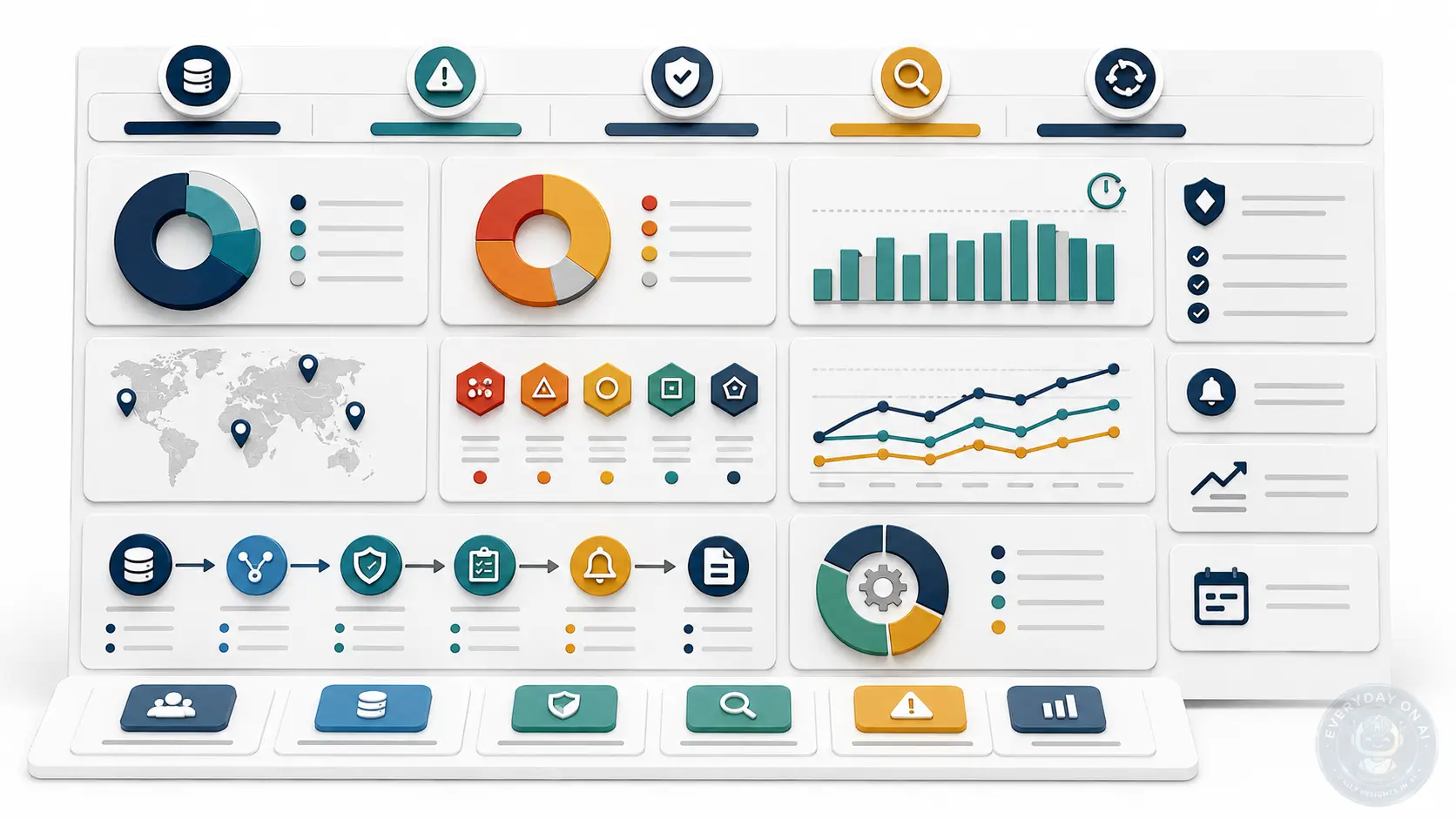


AI Governance Metrics: What to Measure at Each Maturity Level
AI governance metrics measure whether AI systems are known, owned, risk-classified, controlled, monitored, documented, and improved. The best metrics do not only count meetings, policies, or training sessions. They show whether governance is working in production: inventory coverage, evidence freshness, risk review completion, human oversight, incident response, vendor review, tool permission control, and improvement velocity.
Beginner-friendly explanation
Think of AI governance metrics like dashboard lights. They do not prove the whole organization is safe, but they show whether basic controls are visible: what AI exists, who owns it, what risk it carries, whether someone reviewed it, and whether the system is still being monitored after launch.
Key Takeaways
- Early AI governance metrics should prioritize inventory coverage, named ownership, and risk classification.
- NIST AI RMF supports a risk management approach that can be organized around govern, map, measure, and manage activities.[1]
- ISO/IEC 42001 reinforces the need for maintaining and continually improving AI management systems.[2]
- High-risk systems need metrics that show documentation, record-keeping, human oversight, and risk management are alive, not archival.[3]
- AI agents require metrics for tool access, approvals, action logs, rollback, and excessive agency risk.
Table of Contents 13 min read
Estimated time by section: why metrics matter 2 min, dashboard 3 min, maturity levels 2 min, agents 2 min, example 2 min, FAQ 2 min.
Why AI Governance Metrics Matter
AI governance without metrics tends to drift toward policy theater. Teams can say they have a policy, a committee, and a review process, but still miss the operational questions that matter: which AI systems exist, who owns them, what data they touch, what risk they create, what evidence proves review, and whether the controls still work after the system changes.
Good metrics help leaders see whether AI governance is becoming more reliable. They also create a common language across AI engineering, security, legal, compliance, privacy, product, procurement, and internal audit.
The first AI governance dashboard should be boring on purpose. Before tracking advanced model behavior, track whether the organization knows what AI exists, who owns it, how risky it is, and what evidence proves the controls.
Core AI Governance Dashboard Metrics
| Metric | What It Measures | Why It Matters | Possible Target |
|---|---|---|---|
| AI inventory coverage | Percentage of known AI systems entered in the AI register. | Unknown systems cannot be governed. | 90%+ for production systems |
| Owner coverage | Percentage of systems with named business and technical owners. | Accountability fails without ownership. | 100% for production systems |
| Risk classification coverage | Percentage of systems with documented risk class. | Controls should follow use-case risk. | 100% for high-impact systems |
| Approval evidence freshness | How recently high-risk systems were reviewed or approved. | Old approvals may not match current behavior. | Reviewed after major changes or at set cadence |
| Monitoring coverage | Systems with defined operational, quality, safety, or security monitoring. | Governance must continue after launch. | All medium/high-risk systems |
| Incident response readiness | Systems with AI-specific escalation and remediation paths. | Teams need a plan when AI fails. | All high-risk and agentic systems |
| Evidence completeness | Systems with linked inventory, risk, approval, monitoring, and change records. | Audit readiness depends on retrievable evidence. | High for regulated or buyer-facing systems |
| Control improvement velocity | Governance gaps closed per cycle. | Maturity should improve, not merely be reported. | Trend should move upward |
AI Governance Metrics by Maturity Level
The right metrics change as maturity improves. A Level 1 organization should not start with a complex AI assurance dashboard. It should first measure whether AI systems are even visible.
| Maturity Level | Primary Metrics | What Good Looks Like | What to Avoid |
|---|---|---|---|
| Level 1: Ad hoc | Inventory discovery, shadow AI reports, owner identification | Teams start finding unknown AI use and assigning owners. | Overbuilding dashboards before basic inventory exists. |
| Level 2: Policy-based | Policy adoption, training completion, intake usage, risk rubric adoption | Policy begins turning into repeatable workflow. | Counting training as proof of control effectiveness. |
| Level 3: Controlled | Approval completion, risk gate cycle time, minimum control coverage | Important systems go through repeatable controls. | Treating launch approval as the end of governance. |
| Level 4: Audit-ready | Evidence completeness, log retention, review freshness, sampling pass rate | Reviewers can trace decisions and controls across the lifecycle. | Keeping evidence in tools that cannot be reconstructed later. |
| Level 5: Adaptive | Change-trigger response time, incident learning, control update frequency | Monitoring, incidents, vendor changes, and regulations update controls. | Reporting maturity without changing the operating model. |
Metrics for RAG Systems and AI Agents
RAG systems and AI agents need extra metrics because they introduce retrieval sources, tool permissions, action paths, and trust boundaries. OWASP’s LLM risk categories include concerns such as prompt injection, sensitive information disclosure, supply chain weaknesses, excessive agency, vector and embedding weaknesses, misinformation, and unbounded consumption.[4]
| System Type | Metric | Question It Answers |
|---|---|---|
| RAG | Retrieval source coverage | Do retrieved sources have owners, trust levels, and access controls? |
| RAG | Citation verification rate | Are answers citing sources that actually support the claim? |
| RAG | Stale content rate | How much retrieved content is outdated or ownerless? |
| AI agent | Tool permission review coverage | Have tool scopes been reviewed and approved? |
| AI agent | Sensitive action approval rate | Do state-changing actions require human approval? |
| AI agent | Action log completeness | Can the team reconstruct prompt, context, tool call, decision, and result? |
| AI agent | Rollback coverage | Can harmful or mistaken actions be reversed? |
Worked Example: A Metrics Snapshot for One AI Portfolio
This is an illustrative metrics snapshot, not a claim about a real company. Use the structure to make your own dashboard more concrete.
| Metric | Current Snapshot | Interpretation | Next Action |
|---|---|---|---|
| Inventory coverage | 34 of 41 known AI systems registered | Visibility is improving, but 7 systems still sit outside governance records. | Assign owners for the 7 missing systems within 30 days. |
| Risk classification | 22 of 34 registered systems classified | Governance cannot yet prioritize review depth reliably. | Classify the 12 unscored systems before approving new expansions. |
| Evidence completeness | 9 of 14 medium/high-risk systems have approval evidence | Five important systems may be hard to defend in buyer or audit review. | Attach approval records or rerun review. |
| Agent approval gates | 3 of 5 agentic workflows require human approval for state-changing actions | Two workflows have excessive action risk. | Add approval gates or reduce tool scope. |
Before and After: What Changes When You Apply This
| Area | Before | After | Why It Matters |
|---|---|---|---|
| Leadership view | Governance status is described qualitatively. | Leaders see coverage, gaps, freshness, and trends. | Decisions become more concrete. |
| Audit readiness | Evidence is gathered only when requested. | Evidence completeness is tracked continuously. | Review pressure decreases. |
| AI agents | Tool permissions are assumed safe. | Permissions, approvals, logs, and rollback are measured. | Action risk becomes visible. |
| Improvement | Metrics report activity. | Metrics drive control backlog decisions. | Maturity improves over time. |
Common Mistakes
- Measuring activity instead of control health. Meeting count is not a governance metric unless it changes decisions or evidence.
- Skipping owner coverage. Metrics without accountability become reporting theater.
- Using one dashboard for every risk level. High-risk systems need deeper evidence and monitoring metrics.
- Ignoring exceptions. Track where systems bypass normal review and why.
- Forgetting change triggers. Model updates, vendor changes, new tools, and new data sources can invalidate old metrics.
FAQ
What are AI governance metrics?
AI governance metrics are indicators that show whether AI systems are known, owned, risk-classified, controlled, monitored, documented, and improved.
What is the most important AI governance KPI?
For early programs, the most important KPI is usually AI inventory coverage with named owners and risk classifications, because unknown AI systems cannot be governed.
How should AI governance metrics change by maturity level?
Early maturity focuses on inventory and ownership. Controlled maturity adds approvals and minimum controls. Audit-ready maturity tracks evidence quality, monitoring, incidents, and control freshness.
Should AI governance dashboards include AI agents?
Yes. Agentic systems should include tool permission metrics, approval-gate metrics, action logs, rollback coverage, and incident signals because the model can affect systems through tools.
Conclusion
AI governance metrics should help the organization see whether AI oversight is real, current, and improving. Start with visibility and ownership, then move toward controls, evidence, monitoring, incidents, and adaptive improvement. A mature dashboard does not merely describe governance work. It shows whether governance is changing the way AI systems are built, launched, operated, and reviewed.
If a metric cannot trigger a decision, investigation, owner action, or control update, it probably belongs in a status report, not the governance dashboard.
5 Things to Remember
- Measure inventory before advanced assurance.
- Track evidence freshness, not only evidence existence.
- Separate metrics by risk level.
- Add special metrics for RAG and AI agents.
- Use metrics to update the governance roadmap.
References
AI Governance Maturity Cluster
Use this metrics guide as the dashboard layer after the model, checklist, and template are in place.
Next Step
After choosing your metrics, use the AI Governance Maturity Assessment Checklist to validate whether those metrics are backed by evidence.
Share this article