Colorado AI Act : What It Means for US Companies and the Path to Federal AI Regulation

Dispa - The AI Buff
Author

Colorado’s Governor Jared Polis signed SB 24-205 into law on May 17, 2024, and then, in his own signing letter, urged legislators to fix it before it took effect.[1]
Ad Slot: leaderboard
Isi NEXT_PUBLIC_ADSENSE_CLIENT & AD_SLOTS
That opening tells you almost everything you need to know about how Colorado’s AI Act came to be. It’s a first-mover law — ambitious, consequential, and deliberately imperfect. Colorado became the first US state to enact comprehensive AI regulation not because everyone agreed it was ready, but because lawmakers decided that waiting for perfection was its own form of failure.
Since then, the law has survived a failed special legislative session, intense industry lobbying from over 150 representatives, a five-month implementation delay, and ongoing federal preemption threats.[2] Every core provision — risk assessments, impact assessments, transparency requirements, the duty of reasonable care — survived intact. The deadline is June 30, 2026. It’s coming.
“In the absence of congressional action, Colorado’s law may help to set the tone for predictive artificial intelligence regulation nationwide, and it may impact the behavior of developers and deployers across state lines as they seek compliance with Colorado’s requirements.”
Ad Slot: in-feed
Isi NEXT_PUBLIC_ADSENSE_CLIENT & AD_SLOTS
— National Association of Attorneys General, October 2024[3]
This guide is for US companies — and the non-US companies serving Colorado residents — who need to understand exactly what the Colorado AI Act requires before June 30, 2026. I’ll cover the law’s architecture, what “high-risk AI” means in practice, the distinct obligations for developers vs. deployers, how the safe harbor and affirmative defenses actually work, what compliance looks like operationally, and what Colorado’s law signals about where US federal AI regulation is heading.
This article is part of our EU AI Act Compliance Guide cluster. For a comparison of how Colorado’s Act stacks up against the EU AI Act and other US state laws, see our EU AI Act vs. US AI Policy guide.
Let’s start with the law’s fundamental architecture — because it’s different from any prior US regulation, and understanding that difference changes how you approach compliance.
The Architecture: What Kind of Law Is SB 24-205?
Before diving into specific requirements, you need to understand what kind of law you’re dealing with — because Colorado’s AI Act is architecturally different from most US regulations, and that difference shapes every compliance decision.
The “Reasonable Care” Standard — Not a Checklist
Most US regulations work as prescriptive checklists: do X, Y, Z, and you’re compliant. Colorado’s AI Act works differently. It imposes a duty of reasonable care on both developers and deployers of high-risk AI systems — meaning the legal question isn’t “did you check the boxes?” but “did you exercise appropriate care given the known and foreseeable risks?”[4]
This is a significant architectural choice. It means compliance under Colorado law is inherently fact-specific and context-dependent. An AI system that poses minimal discrimination risk in a low-stakes deployment context requires less documentation and oversight than one deployed in a high-stakes context with known bias issues in the training data. The law doesn’t flatten that distinction into a single compliance checklist — it scales obligations to risk.
The tradeoff is legal uncertainty. “Reasonable care” is a common law standard that will ultimately be defined through enforcement actions and, potentially, litigation. Unlike the EU AI Act’s prescriptive Annex IV requirements, Colorado’s law leaves substantial interpretation to the Attorney General’s rulemaking authority and eventual enforcement practice. For compliance planning purposes, the law’s specific requirements provide the minimum floor — but demonstrating “reasonable care” in an enforcement action will require showing that you genuinely engaged with the risks, not just that you completed required paperwork.
Who the Law Applies To: Extraterritorial Reach
Colorado’s AI Act applies to any person doing business in Colorado who develops, substantially modifies, or deploys a high-risk AI system making consequential decisions affecting Colorado consumers.[4] The territorial scope is consumer-facing — it’s about who the AI affects, not where the company is located.
A US company headquartered in New York that uses an AI hiring tool to screen applicants across the country — including Colorado residents — is subject to the Act for those Colorado-affecting deployments. A European company’s AI that makes credit decisions for Colorado residents falls within scope. The test is whether your AI makes consequential decisions about people in Colorado, not whether you have a physical office or tax presence there.
One important nuance: the law distinguishes between developers (entities that develop or intentionally and substantially modify a high-risk AI system) and deployers (entities that use a high-risk AI system in a production context to make consequential decisions about consumers).[5] A company can be both simultaneously — if you build your own AI and use it in your operations, you carry both sets of obligations. And importantly, if you take a third-party AI and substantially modify it for your own purposes, you shift from pure deployer to developer status for that modified version.
Implementation Timeline and What Changed
Understanding the timeline helps you understand the political context and what’s still fluid.
| Date | Event | Significance |
|---|---|---|
| May 17, 2024 | Governor Polis signs SB 24-205 — with reservations | Colorado becomes first US state with comprehensive AI law; Polis immediately calls for improvements |
| May 7, 2025 | SB 25-318 (amendment bill) fails to pass before legislative session end | Significant attempted amendments — new “algorithmic discrimination” definition, expanded exemptions, delayed deployer obligations — all fail |
| August 28, 2025 | Governor signs SB 25B-004 after special session | Effective date delayed from February 1, 2026 to June 30, 2026; all core provisions unchanged |
| January 2026 | Colorado 2026 regular session begins; new amendment bills introduced | Further narrowing attempts underway; outcome uncertain at time of writing |
| June 30, 2026 ⚠ | SB 24-205 effective date — all obligations apply | Compliance deadline for developers and deployers of high-risk AI affecting Colorado consumers |
| February 1, 2027 | Deployer disclosure and impact assessment requirements fully enforced | Some deployer-specific provisions have a secondary effective date per the glacis.io analysis[6] |
The most important takeaway from this history: despite intense industry opposition, the law’s core framework survived intact. The American Bar Association reported in November 2025 that “nothing fundamental changed” through the special session process.[2] Companies that delayed compliance planning hoping amendments would significantly reduce obligations made a strategic error.
⚠ 2026 Session Monitoring Required
The Colorado 2026 regular session, which began in January 2026, has introduced new amendment bills. While the June 30, 2026 deadline is currently set, the scope of some obligations may shift before that date. Monitor the Colorado General Assembly (leg.colorado.gov) for bill activity, and build your compliance program around the law as enacted — not around hoped-for amendments.
What Is a “High-Risk AI System” Under Colorado Law?
The high-risk definition is the critical gateway to Colorado AI Act compliance. If your AI system doesn’t qualify as high-risk, almost none of the law’s substantive requirements apply. Get this classification wrong — in either direction — and you’re either wasting compliance resources or creating serious legal exposure.
The “Consequential Decision” Test
Under SB 24-205, an AI system is high-risk when it makes, or is a substantial factor in making, a consequential decision affecting a Colorado consumer.[4] Two elements require careful analysis.
First: “substantial factor.” An AI system doesn’t need to make the final decision to be high-risk — it just needs to be a substantial factor in that decision. The most significant question for most deployers is exactly how direct the AI’s influence needs to be. Pacific AI’s compliance guidance offers useful framing: “the fastest way to scope exposure is to start with the decision workflow rather than the model.” If a system’s output can materially influence whether someone gets a job, a loan, or housing, treat it as high-risk until you have documented rationale for a different classification.[7]
Second: “consequential decision.” The Act defines this specifically as any decision that has a material legal or similarly significant effect on the provision or denial to a consumer of one of the eight covered services, or on the cost or terms of those services.[4] The “cost or terms” addition is important — an AI that doesn’t deny you insurance but significantly raises your premium based on demographic factors still qualifies.
The Eight Covered Sectors (with Examples)
Consequential decisions in the following eight sectors trigger high-risk classification under SB 24-205:[4]
1. Education enrollment or education opportunities. AI that determines admission to educational programs, allocates scholarships, or evaluates academic performance in ways that affect enrollment qualifies. Note that AI tutoring tools that adapt content delivery without affecting enrollment decisions do not.
2. Employment or employment opportunities. This is the most immediately impacted sector for most US companies. CV screening tools, interview analysis AI, performance evaluation systems, promotion recommendation engines, and workforce reduction tools all qualify. If your AI makes or substantially influences who gets hired, promoted, evaluated, or laid off, it’s high-risk.
3. Financial or lending services. Credit scoring AI, loan application processing tools, mortgage approval systems, and any AI that affects whether or on what terms a consumer receives financial services qualifies.
4. Essential government services. AI systems used by government agencies or their contractors to determine eligibility for government benefits, services, or programs fall within this category.
5. Healthcare services. AI that influences clinical treatment decisions, diagnostic recommendations, or healthcare access falls within scope. This category can interact with federal FDA or ONC regulations — the law provides specific exemptions for systems approved by relevant federal agencies where those approvals impose equivalent or stricter standards.
6. Housing. AI used in tenant screening, rental pricing algorithms that affect individual pricing based on demographic factors, or mortgage approval decisions affecting housing access qualifies.
7. Insurance. Underwriting AI that determines individual policy eligibility, premium levels, or coverage terms qualifies. The law also specifically exempts insurers subject to Colorado insurance commissioner regulations if those regulations are substantially equivalent or stricter — but this exemption requires affirmative verification, not assumption.[4]
8. Legal services. AI that substantially influences legal representation decisions, bail recommendations, sentencing inputs, or other legal process outcomes affecting consumers qualifies.
What Is Explicitly Excluded
The Act excludes several categories that might otherwise seem to fall within its scope. Anti-fraud systems that do not use facial recognition are excluded. Systems used purely for internal procedures with no consumer-facing impact are excluded. Cybersecurity and data security systems are excluded. AI systems approved, authorized, or cleared by federal agencies like the FDA or FAA — where those approvals impose substantially equivalent or stricter standards — are also excluded.[8]
The small business exemption is more limited than it might appear. Companies with fewer than 50 employees are partially exempt — but only if they do not use their own data to train or fine-tune the AI system. Customizing a model with proprietary data removes the exemption entirely.[9] This matters significantly for SaaS companies that offer “customizable” AI products built on customers’ own data.
Classification Decision Table: 12 Real-World Examples
| AI System | Sector | High-Risk? | Reasoning |
|---|---|---|---|
| CV screening tool that ranks job applicants | Employment | Yes | Substantial factor in employment opportunity decision |
| Employee scheduling optimization AI | Employment (adjacent) | No | Operational, not a decision about employment opportunity |
| Credit scoring model for personal loans | Financial services | Yes | Determines access to financial services |
| Transaction fraud detection (no account freeze) | Financial (adjacent) | No | Anti-fraud system, explicitly excluded; no consequential consumer decision |
| AI clinical decision support for diagnosis | Healthcare | Yes | Substantial factor in healthcare service decisions |
| AI scheduling for medical appointments | Healthcare (adjacent) | No | Operational scheduling, not a clinical or access decision |
| Tenant screening AI for rental applications | Housing | Yes | Consequential housing access decision |
| Property management AI for maintenance scheduling | Housing (adjacent) | No | Operational, no consequential consumer decision |
| University admissions AI ranking applicants | Education | Yes | Substantial factor in education enrollment decision |
| Adaptive learning content recommendation | Education (adjacent) | No | No access or enrollment decision; purely content-level |
| Insurance underwriting AI for individual policies | Insurance | Yes | Determines access and cost of insurance services |
| AI chatbot answering insurance product questions | Insurance (adjacent) | No | Information provision, not a coverage decision; also covered by chatbot disclosure rules |
Developer Obligations: Five Core Requirements
Under SB 24-205, developers carry five distinct obligations, all grounded in demonstrating that they took reasonable care to prevent algorithmic discrimination.[4] If you develop or substantially modify high-risk AI systems deployed in Colorado, these apply to you starting June 30, 2026.
Requirement 1: Duty of Reasonable Care
Developers must use reasonable care to protect consumers from any known or reasonably foreseeable risks of algorithmic discrimination arising from the intended and contracted uses of their high-risk AI system. This standard — notably flexible — covers both the AI’s performance in intended use cases and foreseeable misuse scenarios.
What “reasonable care” looks like in practice for a developer: bias testing across protected demographic groups before deployment; documentation of training data sources and known limitations; evaluation of the system for algorithmic discrimination prior to market placement; and ongoing monitoring after release for discrimination issues reported by deployers. The law doesn’t mandate a specific testing methodology — but your choice of methodology, and the evidence that you actually ran it, will be central to any enforcement defense.
Requirement 2: Documentation Disclosure to Deployers
Developers must make available to deployers (or other developers downstream in the distribution chain) the documentation and information necessary for a deployer to complete an impact assessment of the high-risk AI system.[4]
The law specifies the types of documentation that must be provided, including: a general statement describing reasonably foreseeable uses and known harmful or inappropriate uses; high-level summaries of the training data used and data governance measures; documentation of how the system was evaluated for algorithmic discrimination; intended use cases, foreseeable limitations, and technical capabilities; and artifacts such as model cards, dataset cards, or prior impact assessments necessary for deployers to complete their own assessments.
This creates a direct contractual implication: your deployer agreements must address which party is responsible for providing which documentation, and developers who withhold documentation necessary for impact assessment compliance are exposed both to direct regulatory liability and to indemnification claims from deployers.
Requirement 3: Public Statement Requirement
Developers must maintain a publicly available statement — on their website or in a public use case inventory — summarizing the types of high-risk AI systems they develop and make available, and how they manage known or reasonably foreseeable risks of algorithmic discrimination.[4] This statement must be kept current and updated when material changes occur.
This requirement creates ongoing reputational accountability beyond regulatory exposure. Your public statement becomes searchable, quotable, and potentially usable as evidence in enforcement proceedings. Draft it with legal review, and treat updates with the same seriousness as material disclosures in other regulated contexts.
Requirement 4: 90-Day Discrimination Reporting to AG
Within 90 days of discovering, or receiving a credible report from a deployer, that a high-risk AI system has caused or is reasonably likely to have caused algorithmic discrimination, developers must notify the Colorado Attorney General and all known deployers of the system.[4]
This reporting obligation starts running from the moment of discovery — not from when discrimination is confirmed. “Reasonably likely to have caused” is a lower bar than confirmed causation. If your monitoring program flags a potential discrimination issue, the 90-day clock starts. Build your internal escalation procedures with this timeline explicitly in mind.
Requirement 5: Responding to AG Documentation Requests
Upon request from the Colorado Attorney General, developers must provide specified documentation within 90 days. Developers may designate submitted documentation as proprietary to prevent disclosure under the Colorado Open Records Act, and sharing information with the AG does not waive attorney-client privilege.[4]
This provision gives the AG investigative tools without requiring litigation. From a compliance planning perspective, maintain documentation that you could produce within 90 days of an AG request — and ensure that documentation is genuinely organized and retrievable, not scattered across engineering repositories and personal drives.
Deployer Obligations: Five Core Requirements
Deployers — the organizations using high-risk AI to make or substantially influence consequential decisions about Colorado consumers — face the most operationally intensive compliance obligations under SB 24-205. The law places the consumer-protection interface primarily at the deployer level.[4]
Requirement 1: Risk Management Policy and Program
Deployers must establish and maintain a risk management policy and program that specifies the principles, processes, and personnel used to identify, document, and mitigate known or reasonably foreseeable risks of algorithmic discrimination. Critically, this is described as an iterative process — it must be regularly reviewed and updated over the lifecycle of the AI system, not completed once at deployment.[4]
The risk management policy and program aligns most directly with NIST AI RMF’s GOVERN and MANAGE functions. If your organization is already building to NIST AI RMF standards — for EU AI Act compliance or for general AI governance — you have a significant head start on this requirement. The policy format doesn’t need to be proprietary — Colorado’s law doesn’t specify a template — but it must address the specific risks of algorithmic discrimination in your specific deployment context.
Requirement 2: Annual Impact Assessments
Deployers must complete an annual impact assessment of each high-risk AI system they deploy. The assessment must cover: a description of the system and its purpose; the deployment context; the data used; an evaluation of the system’s reasonably foreseeable risk of algorithmic discrimination; a description of mitigation measures; a description of categories of data used to make consequential decisions; and a description of affected consumer categories.[5]
Impact assessments must be completed before deploying a high-risk AI system and annually thereafter. Third parties contracted by deployers can complete the assessments on their behalf — there’s no requirement for internal completion. Deployers must retain the most recently completed assessment, all records concerning each assessment, and all prior assessments for at least three years following the final deployment of the system.[10]
Requirement 3: Consumer Notification and Disclosure
Before a deployer deploys a high-risk AI system to make or substantially influence a consequential decision concerning a specific consumer, the deployer must notify that consumer that a high-risk AI system will be used, and provide: a statement disclosing the purpose of the system; a description in plain language of the high-risk AI system; the contact information for the deployer; and instructions on how the consumer can access additional information or exercise their rights.[10]
Additionally, if the high-risk AI system makes an adverse consequential decision about a consumer — denying them a job, loan, housing, or other covered service — the deployer must notify the consumer of that adverse decision and how they can appeal it. This creates a dual notification obligation: before-the-decision notice and after-the-adverse-decision notice.
Requirement 4: Right to Appeal Adverse Decisions
Deployers must provide consumers with an opportunity to appeal, via human review if technically feasible, any adverse consequential decision arising from the deployment of a high-risk AI system.[4]
The “technically feasible” qualifier provides some flexibility — but courts and the AG are unlikely to accept that pure cost or operational inconvenience makes human review technically infeasible. The feasibility standard is engineering feasibility, not business preference. If you’re deploying high-risk AI in Colorado, build a human review pathway into your decision workflow before June 30, 2026.
There is one critical exception: if a delay in the appeal process would pose a risk to the consumer’s life or physical safety, the normal appeal requirement may be modified. This carve-out is primarily relevant for emergency healthcare or public safety applications.
Requirement 5: 90-Day Discrimination Reporting to AG
Deployers face the same 90-day reporting obligation as developers: within 90 days of discovering that a deployed high-risk AI system has caused algorithmic discrimination, the deployer must disclose that discovery to the Colorado Attorney General.[4] This obligation runs independently of whether the developer has also reported — both parties carry independent reporting duties when they discover discrimination issues.
Ad Slot: rectangle
Isi NEXT_PUBLIC_ADSENSE_CLIENT & AD_SLOTS
Safe Harbor, Exemptions, and Affirmative Defenses
Colorado’s AI Act is unusual among US regulations in providing a structured safe harbor pathway — and understanding it is as important as understanding the base obligations, because it fundamentally changes the compliance calculus.
The NIST AI RMF Safe Harbor
SB 24-205 creates a rebuttable presumption of compliance — effectively a safe harbor — for developers and deployers that satisfy three conditions simultaneously:[4]
First, they must be in compliance with the Act’s substantive requirements. Second, they must be in compliance with a nationally or internationally recognized risk management framework for AI systems that the Act or the Attorney General designates. Third, they must take specified measures to discover and correct violations, including through feedback mechanisms, adversarial testing (red-teaming), or internal review processes.
The NIST AI Risk Management Framework (AI RMF 1.0)[11] is the primary framework expected to qualify for this safe harbor, along with ISO/IEC 42001. The Colorado Attorney General has rulemaking authority to formally designate approved frameworks, but building your compliance program around NIST AI RMF provides the strongest current safe harbor position.
What makes this safe harbor strategically important: it means Colorado AI Act compliance and EU AI Act compliance share significant substantive overlap when NIST AI RMF is used as the underlying governance framework. Organizations that build to NIST AI RMF standards, layer EU AI Act-specific requirements on top for EU-facing systems, and add Colorado’s specific deployer obligations for Colorado-facing systems can satisfy all three frameworks from a single governance foundation.
Statutory Exemptions: Who Is Excluded
Several categories of entities or systems are fully or partially exempt from SB 24-205’s requirements. The most practically significant:
Insurance sector exemption: Insurers subject to Colorado insurance commissioner regulations that are substantially equivalent or stricter than SB 24-205 are in full compliance with the Act.[4] This is not an automatic exemption — it requires verification that the applicable insurance regulations actually meet the equivalence threshold.
Banking sector exemption: Banks and credit unions subject to examination by state or federal prudential regulators under published guidance that applies to high-risk AI systems are in full compliance — if that guidance meets specified criteria.[4]
Federal agency approval exemption: AI systems that have been approved, authorized, certified, cleared, or granted by a federal agency like the FDA or FAA — where those approvals impose substantially equivalent or stricter obligations — are exempt.[8] The Center for Democracy and Technology has flagged this as potentially overly broad, and its boundaries will likely be tested in enforcement.
Small business partial exemption: Businesses with fewer than 50 employees are partially exempt — but critically, only if they do not use their own proprietary data to train or fine-tune the AI system. Any customization with your own data eliminates this exemption.
Affirmative Defense: Discovery and Cure
Even after a violation has occurred, SB 24-205 provides an affirmative defense for developers and deployers who discover and cure the violation before the AG takes enforcement action. To use this defense, the entity must have discovered the violation through feedback, adversarial testing/red-teaming, or an internal review process — and must have been in compliance with a recognized risk management framework at the time.[5]
This affirmative defense design has an important structural implication: it incentivizes genuine monitoring and testing programs, not just initial compliance efforts. Organizations that run ongoing bias testing and red-teaming are protected even when they find problems — as long as they fix them promptly. Organizations that never test and are surprised by discrimination issues in an enforcement action have no equivalent defense available.
Enforcement and Penalties: How the AG Will Use This Law
Understanding Colorado’s enforcement structure helps you prioritize compliance investments. The law’s enforcement architecture creates different risk profiles than most federal enforcement.
Penalty Structure and Accumulation Risk
Violations of SB 24-205 are treated as unfair trade practices under Colorado’s Consumer Protection Act, with a maximum penalty of $20,000 per violation.[12] That number sounds manageable — until you consider how violations are counted.
Violations are counted separately for each affected consumer or transaction. An AI hiring tool that screens out 500 qualified Colorado applicants on discriminatory grounds generates up to $10 million in potential penalties. A credit scoring system that denies loans to 1,000 Colorado consumers on the basis of a protected characteristic generates up to $20 million. The $20,000 per-violation figure is not a ceiling on the case — it’s a per-consumer multiplier that can produce company-threatening liability at scale.
Before taking enforcement action, the AG must provide notice of a violation and allow the company 60 days to cure the identified deficiency.[12] This cure period is a meaningful protection — but it requires you to have a compliance infrastructure that can actually identify and fix problems within 60 days. Companies that receive notice of violations with no existing documentation, no monitoring program, and no established processes will struggle to cure within that window.
The Private Right of Action Ambiguity
One of the most important unresolved questions in Colorado’s AI Act is whether consumers can sue directly. The law gives the Colorado AG exclusive enforcement authority and does not explicitly create a private right of action. However — and this is significant — it also makes violations an unfair trade practice under the Colorado Consumer Protection Act, which does allow private rights of action.[5]
This ambiguity has not been resolved by the legislature or by court decision. Until it is, companies should plan for the possibility that consumer litigation is available — particularly in employment discrimination cases where plaintiffs’ lawyers are already experienced in testing novel litigation theories against AI systems.
The 60-Day Cure Period Before Enforcement
The AG’s obligation to provide a cure period before enforcement is a meaningful protection that distinguishes Colorado’s approach from more aggressive enforcement models. In practice, this means the first wave of Colorado AI Act enforcement will likely target companies that:
Receive a discrimination complaint or self-report a violation, fail to cure within 60 days, and then face formal enforcement. The 60-day cure period is only useful if you have a functioning compliance program that can diagnose the root cause of a discrimination issue and implement genuine remediation within that window. Companies with no compliance infrastructure face the practical reality that 60 days is very short for diagnosing and fixing an AI discrimination problem that may be embedded in training data or model architecture.
Practical Compliance Roadmap: What to Do Before June 30, 2026
With roughly three months to the effective date as of this writing, the question isn’t whether to start — it’s what to prioritize first. The answer differs significantly depending on whether you’re a developer, a deployer, or both.
If You Are a Developer
Your primary pre-June 30 priorities are documentation and disclosure. Before your high-risk AI systems are deployed or continue to be deployed in Colorado contexts, you need three things ready.
First, a bias testing record — documented evidence that you evaluated your system for algorithmic discrimination across protected demographic groups before market placement, with the methodology described and findings disclosed. This doesn’t need to be a perfect record; it needs to be an honest one that demonstrates you took the risk seriously.
Second, a documentation package for deployers — the model cards, dataset documentation, impact assessment artifacts, and system capability descriptions that deployers need to complete their own impact assessments. If you don’t have this package ready, deployers cannot satisfy their own obligations under the law, and they will be asking for it from you starting June 30.
Third, a public statement on your website describing the high-risk AI systems you develop and how you manage discrimination risks. This is visible and public — it should be reviewed by legal counsel and kept current.
If You Are a Deployer
Deployers face the most immediate operational compliance requirements. Before June 30, 2026, you need three things operational, not just documented.
First, a risk management policy and program — not a policy document sitting in a shared drive, but a functioning governance process with named owners, defined procedures for identifying and escalating discrimination risks, and a review cadence. This is the requirement that creates the most organizational change for companies new to AI governance.
Second, a consumer notification workflow — the process, UI elements, and legal language for notifying consumers before consequential AI-influenced decisions and after adverse decisions. This typically requires product changes, and product changes take time. If you haven’t started building this, start immediately.
Third, a human review appeal pathway — the operational process for consumers to request human review of adverse AI decisions, the qualifications and authority of human reviewers, and the escalation path. This may require staffing changes in addition to process design.
If You Are Both Developer and Deployer
Companies that build and use their own high-risk AI carry both sets of obligations. The practical approach: treat your organization as having two distinct compliance functions — a product/engineering function carrying developer obligations, and an operations/HR/legal function carrying deployer obligations — with explicit coordination between them. The documentation you produce as a developer (bias testing, model cards, training data documentation) feeds directly into the impact assessments you complete as a deployer. Build that documentation flow into your development pipeline, not as a separate compliance exercise.
Colorado AI Act Compliance Readiness Checklist
✓ Colorado AI Act Compliance Readiness Checklist (Pre-June 30, 2026)
Scope Assessment (Both Developers and Deployers)
- ☐ AI systems inventory completed — all AI systems identified across organization
- ☐ High-risk classification analysis completed per consequential decision test
- ☐ Colorado-affecting deployments identified — which systems affect Colorado residents
- ☐ Developer vs. deployer status determined for each high-risk system
- ☐ Applicable exemptions assessed and documented (insurance, banking, federal approval, small business)
Developer Requirements
- ☐ Algorithmic discrimination bias testing completed and documented for each high-risk system
- ☐ Deployer documentation package prepared: model cards, dataset documentation, impact assessment artifacts
- ☐ Public website statement drafted, reviewed by legal, and published
- ☐ 90-day AG reporting escalation process established
- ☐ Developer agreements updated to address documentation disclosure obligations
Deployer Requirements
- ☐ Risk management policy and program document created with named process owners
- ☐ Initial impact assessment completed for each high-risk system
- ☐ Annual impact assessment schedule established (or delegated to third party)
- ☐ Consumer pre-decision notification workflow built and tested
- ☐ Consumer post-adverse-decision notification process established
- ☐ Human review appeal pathway operational with qualified reviewers
- ☐ 90-day discrimination reporting process to AG documented and owned
- ☐ Impact assessment records retention schedule established (3-year minimum)
Safe Harbor Positioning
- ☐ NIST AI RMF (or ISO/IEC 42001) alignment documented for each high-risk system
- ☐ Adversarial testing / red-teaming program established to support affirmative defense
- ☐ Internal review process for violations documented and tested
What Colorado Signals About the Future of US Federal AI Regulation
The strategic reason to care about Colorado’s AI Act extends beyond Colorado itself. With the federal government actively stepping back from comprehensive AI regulation in 2025–2026, Colorado has become the de facto laboratory for US AI governance. What happens there will shape what comes next — either by inspiring replication across other states, or by generating enforcement precedents that influence how the federal government eventually acts.
The “Brussels Effect” Applied to Colorado
The EU AI Act created what scholars call the “Brussels Effect” — the phenomenon where stringent regulations in one jurisdiction force global companies to upgrade their practices everywhere, because building jurisdiction-specific AI versions is operationally infeasible for most products. A similar “Denver Effect” is already observable.
Companies deploying AI in employment, credit, housing, and healthcare across the US are choosing to build Colorado-compliant systems rather than maintaining separate Colorado and non-Colorado versions of their AI tools. When your risk management program, bias testing methodology, and consumer notification workflows are built to Colorado standards, they apply to all your users — not just those in Colorado. This voluntary extension of Colorado standards beyond Colorado borders creates a de facto national floor even without federal legislation.
The National Association of Attorneys General noted directly that Colorado’s law “may impact the behavior of developers and deployers across state lines.”[3] That prediction is already proving accurate.
The Realistic Path to Federal AI Regulation
Two scenarios dominate the realistic near-term outlook for US federal AI regulation, and Colorado figures prominently in both.
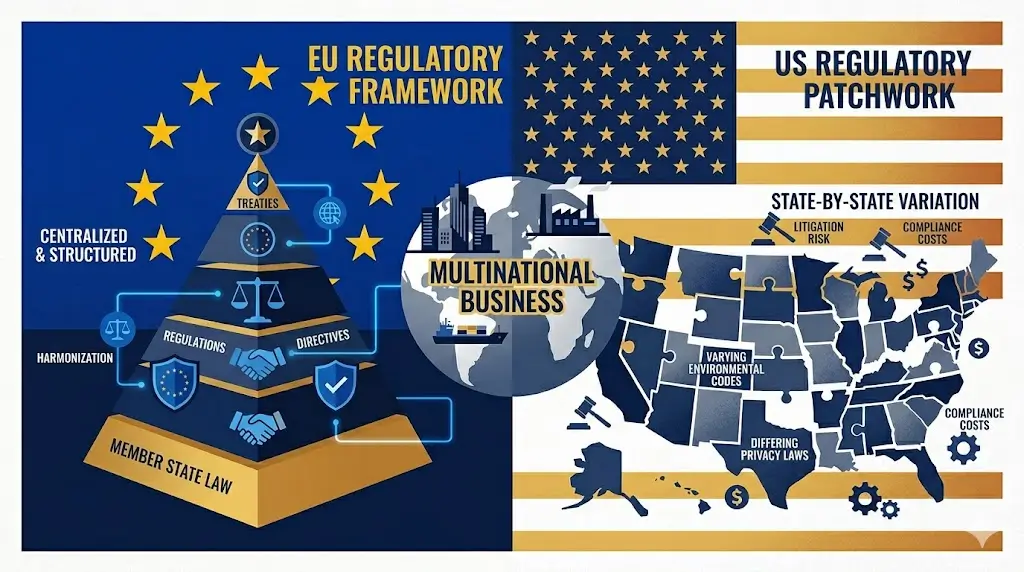
Scenario A: State proliferation forces federal action. As more states enact AI laws — Connecticut’s proposed law is closely modeled on Colorado’s, and several other states have active bills — the compliance complexity for multistate businesses becomes untenable. The Chamber of Commerce and major tech industry groups who lobbied against Colorado’s law have simultaneously been the loudest voices calling for a federal preemptive standard, precisely to avoid a 50-state compliance patchwork. If that argument gains political traction, federal legislation may emerge — but it would likely be modeled substantially on Colorado’s framework, since that’s now the established template. Companies that built Colorado-compliant programs will find the transition significantly easier.
Scenario B: Federal preemption without replacement. The current administration’s preferred approach appears to be challenging state AI laws through the DOJ AI Litigation Task Force while not enacting comprehensive federal AI requirements. If federal preemption succeeds legally, state AI laws could be invalidated — but this requires years of litigation with uncertain outcomes, as noted in our companion guide on EU AI Act vs. US AI Policy. Companies building Colorado-compliant programs are not wasting resources either way: if preemption fails, they’re compliant; if preemption succeeds and is replaced by federal law, their governance infrastructure translates directly.
Either way, Colorado’s law is not a compliance detour. It’s early positioning for wherever US AI governance lands.
Frequently Asked Questions: Colorado AI Act
When does the Colorado AI Act take effect?
June 30, 2026. The original effective date was February 1, 2026, but Governor Polis signed SB 25B-004 on August 28, 2025, delaying implementation to June 30, 2026.[13] The 2026 regular legislative session is considering further amendments, but the June 30, 2026 deadline remains in force as of March 2026. Monitor leg.colorado.gov for any changes before the deadline.
What is a “high-risk AI system” under the Colorado AI Act?
Any AI system that makes or is a substantial factor in making a consequential decision about a Colorado consumer. A consequential decision is one with a material legal or similarly significant effect on whether a consumer receives education, employment, financial services, government services, healthcare, housing, insurance, or legal services — or on the cost or terms of those services.[4] The key test is decision impact on individual consumers — not simply whether the AI is used in one of the eight sectors.
Does the Colorado AI Act apply to out-of-state companies?
Yes. The Act applies to any person “doing business in Colorado” who develops or deploys high-risk AI affecting Colorado consumers, regardless of company headquarters. If your AI makes consequential decisions about Colorado residents, you are in scope — whether you’re based in New York, California, or Berlin. The territorial test is consumer-facing, not company-location-based.
What is the penalty for violating the Colorado AI Act?
Up to $20,000 per violation, counted separately for each affected consumer.[12] This per-consumer counting means aggregate penalties can be severe for AI systems affecting large numbers of Colorado consumers. Before enforcement, the AG must provide a notice and a 60-day cure period. There is no private right of action explicitly authorized — though the Consumer Protection Act framing creates legal ambiguity about this.
What is the safe harbor under the Colorado AI Act?
A rebuttable presumption of compliance for companies following NIST AI RMF or another designated framework. The safe harbor requires: (1) substantive compliance with the Act’s requirements; (2) alignment with a recognized risk management framework such as NIST AI RMF or ISO/IEC 42001; and (3) active measures to discover and correct violations, including through testing, feedback mechanisms, or internal review. The safe harbor makes NIST AI RMF alignment the strategic foundation of any Colorado AI Act compliance program.[4]
What is an impact assessment under the Colorado AI Act?
An annual assessment that deployers must complete for each high-risk AI system, covering the system’s purpose and deployment context, data used, discrimination risk evaluation, mitigation measures taken, consumer categories affected, and — per the failed amendment that signaled policy direction — whether the system poses risks of limiting accessibility for certain individuals. Assessments must be completed before first deployment and annually thereafter. Three years of records must be retained following the system’s final deployment.[10]
📚 References and Sources
- Epstein Becker Green, “Colorado’s Historic SB 24-205 Concerning Consumer Protections in Interactions with AI Signed Into Law.” References Governor Polis signing statement expressing hope for amendments before effective date. workforcebulletin.com
- STACK Cybersecurity, “Colorado AI Act (SB 24-205) Compliance Guide,” January 30, 2026. Comprehensive developer/deployer obligations guide; cites ABA November 2025 finding that “nothing fundamental changed” despite special session lobbying. stackcyber.com
- National Association of Attorneys General, “A Deep Dive into Colorado’s Artificial Intelligence Act,” October 2024. Analysis of CAIA architecture and national implications. naag.org
- Colorado SB 24-205, “Consumer Protections for Artificial Intelligence” (formally: “An Act Concerning Consumer Protections for Interactions with Artificial Intelligence”), signed May 17, 2024; effective June 30, 2026. Colorado General Assembly. leg.colorado.gov | Full text: content.leg.colorado.gov
- Ogletree Deakins, “Colorado’s Artificial Intelligence Act: What Employers Need to Know,” May 2024. Analysis of developer/deployer distinction, affirmative defenses, and NIST AI RMF safe harbor. ogletree.com
- Glacis.io, “Colorado AI Act (SB 24-205) Compliance Guide,” December 2025. Notes secondary effective date of February 1, 2027 for certain deployer-specific provisions. glacis.io
- Pacific AI, “Colorado AI Act Compliance Guide for Developers and Deployers,” January 2026. Practical guidance including “decision-first” classification approach. pacific.ai
- Center for Democracy and Technology, “FAQ on Colorado’s Consumer Artificial Intelligence Act (SB 24-205),” December 2024. Critical analysis of exemptions and enforcement provisions. cdt.org | Also: coloradosb205.com, exemptions overview.
- TrustArc, “Complying With Colorado’s AI Law: Your SB24-205 Compliance Guide,” October 2025. Small business exemption analysis; impact assessment requirements. trustarc.com
- American Bar Association, “Colorado Enacts Law Regulating High-Risk Artificial Intelligence Systems,” July 2024. Comprehensive legal analysis; impact assessment record retention requirements (3 years). americanbar.org
- National Institute of Standards and Technology (NIST), “AI Risk Management Framework (AI RMF 1.0),” NIST AI 100-1, January 26, 2023. Primary framework supporting Colorado AI Act safe harbor. nist.gov
- ALM Corp, “The Colorado AI Act (SB 24-205): Complete Compliance Guide for Developers and Deployers,” February 3, 2026. Penalty analysis; 60-day cure period; AG enforcement authority. almcorp.com
- Akin Gump, “Colorado Postpones Implementation of Colorado AI Act, SB 24-205,” August 2025. Analysis of SB 25B-004 delay provisions. akingump.com | Also: GovTech, “Colorado Passes Bill Amending Current AI Legislation,” September 3, 2025. govtech.com
- Epstein Becker Green / Healthlaw Advisor, “Will Colorado’s Historic AI Law Go Live in 2026? Its Fate Hangs in the Balance in 2025.” Detailed analysis of failed SB 25-318 amendments and special session outcomes. healthlawadvisor.com
All sources verified as of March 2026. Colorado AI Act is subject to ongoing 2026 legislative session amendment activity — monitor leg.colorado.gov for updates before the June 30, 2026 effective date. This article does not constitute legal advice. Consult qualified Colorado employment and consumer protection counsel for organization-specific compliance guidance.
Also relevant for your Colorado AI Act compliance program:
-
- → EU AI Act Classification Guide
Colorado’s high-risk definition mirrors EU AI Act Annex III in several sectors. This classification guide helps you map systems consistently across both frameworks. - → EU AI Act Documentation Requirements: Annex IV Guide
Colorado’s developer documentation obligations are lighter than EU Annex IV — but if you operate in both markets, this guide shows how to build documentation that satisfies both.
- → EU AI Act Classification Guide
→ EU AI Act vs. US AI Policy in 2026
How Colorado’s Act compares to the EU AI Act — compliance dividend, key divergences, and dual-market strategy for multinational teams.
- → How to Conduct an AI Impact Assessment: A Practical Template
Colorado’s annual impact assessment obligation — and how to design one template that satisfies both Colorado SB 24-205 and EU AI Act Article 27 FRIA requirements. - → Shadow AI: The Silent Compliance Risk
Colorado’s 90-day discrimination reporting clock starts the moment you discover AI discrimination — including from shadow AI tools your compliance team doesn’t know are running.
Get the Colorado AI Act Compliance Template Pack
Pre-structured templates for Colorado SB 24-205 compliance — including the Impact Assessment Template, Risk Management Policy Framework, Consumer Notification Language Library, and NIST AI RMF safe harbor mapping guide.
Built specifically for HR technology, fintech, healthcare AI, and insurtech teams deploying high-risk AI systems with Colorado resident exposure. Includes EU AI Act cross-reference for dual-market teams.
Ad Slot: leaderboard-2
Isi NEXT_PUBLIC_ADSENSE_CLIENT & AD_SLOTS
Share this article