AI Governance for Enterprise: How to Move from Policy to Operational Readiness (2026)

Dispa - The AI Buff
Author

Ad Slot: leaderboard
Isi NEXT_PUBLIC_ADSENSE_CLIENT & AD_SLOTS

📌 Key Takeaways
Ad Slot: in-feed
Isi NEXT_PUBLIC_ADSENSE_CLIENT & AD_SLOTS
- CAIO adoption nearly tripled in twelve months — from 26% of organizations (IBM IBV, 2025) to 76% (IBM CEO Study, May 2026, 2,000 CEOs across 33 countries) — making named AI executive accountability the norm, not the exception, in 2026.
- The EU AI Act’s high-risk system deadline was postponed by 16 months following a May 7, 2026 political agreement: Annex III obligations now apply December 2, 2027 (not August 2, 2026), and Annex I obligations apply August 2, 2028. Prohibited practices and GPAI obligations remain unaffected and already in force.
- The gap between AI policy and AI governance — not a knowledge gap but an execution gap — is where most enterprise AI risk lives. Five specific gaps separate policy-level from operational governance: inventory completeness, accountability specificity, infrastructure-embedded controls, continuous evidence generation, and scalability.
- ModelOp reports enterprises can establish minimum viable governance frameworks in under 90 days; full operational maturity across a complete AI portfolio typically takes 12-18 months.
- Organizations with a CAIO see generative AI prototypes reach production at a 44% success rate versus 36% without dedicated AI leadership — and report nearly double the longevity for AI systems that stay in production beyond three years.
Twenty enterprise data and AI leaders walked into a private dinner organized by Ethyca in late 2025. What they said — off-record, frank, and consistent enough to be pattern, not anecdote — was this: their AI governance programs had stopped at policy.[1] The policies were written, reviewed, and approved. The ethics principles were articulated. The responsible AI framework was posted on the intranet. And the actual AI systems in production? Running without the controls those policies described. No one had operationalized the policy.
This is the defining challenge of enterprise AI governance in 2026. It is not a knowledge problem — organizations understand, broadly, what good AI governance requires. It is an execution problem. The gap between what governance documents say and what governance systems do is where most enterprise AI risk actually lives.
“A PDF, an ethics committee, or a model card doesn’t enforce anything in production. AI governance only works when it governs the real operating surface — the infrastructure where data flows, decisions are made, and risk actually lives.”
— Ethyca, AI Governance: Framework, Compliance & Operational Guide, 2026[1]
💬 According to EverydayOnAI
The Ethyca dinner anecdote captures something we see repeatedly across enterprise AI governance content: the gap isn’t between organizations that “get it” and organizations that don’t. It’s between organizations whose governance lives in a document and organizations whose governance lives in their deployment pipeline. Both groups can sound identical in a board presentation. The difference only becomes visible when something goes wrong — and by then it’s a much more expensive problem to discover. This guide is built around that diagnostic distinction throughout: not “do you have a policy” but “what actually happens at 2 AM when a system misbehaves.”
This guide is a BoFu resource for enterprise leaders who have moved past “should we do AI governance?” and are now grappling with “how do we actually make it work at scale?” It covers the organizational structures that make governance operational, the technical infrastructure that makes it continuous, the metrics that make it measurable, and the specific implementation challenges that distinguish enterprise-scale governance from project-level governance.
Throughout this guide, you’ll find links to our dedicated deep-dives on each major implementation topic. This is the enterprise implementation hub.
Policy vs. Operational: The Gap That Kills Enterprise AI Programs
Every enterprise that has attempted AI governance has a policy. Almost none has fully operationalized it. Understanding the precise gap between these two states is the starting point for fixing it.
A policy-level AI governance program has: a responsible AI policy document, an AI ethics statement, perhaps an AI risk classification framework, and possibly an AI governance committee that meets periodically. It has human beings discussing principles and reviewing proposals. What it typically does not have is the technical infrastructure to enforce those principles at the point where AI systems actually operate — in production, at scale, continuously.
The diagnostic question is specific: if a high-risk AI system in your portfolio exhibits unexpected bias drift at 2 AM on a Sunday, what happens? Does an automated alert trigger? Does a named on-call owner receive it? Is there a documented escalation path? Can the system be paused automatically if the drift crosses a defined threshold? If the answer to any of those is “probably not” or “I’d have to check,” you have policy-level governance, not operational governance.
“A useful AI governance framework is operational. It defines what systems exist, who owns them, what risks they create, what controls apply, and what evidence is available for oversight.”
— IE Business School, “Responsible AI Governance in 2026: Frameworks and Failures”[2]
The Five Dimensions of Operational Readiness
Moving from policy to operational requires closing five specific gaps.
Gap 1: Inventory completeness. Policy-level governance often assumes the AI inventory is known. Operational governance discovers it. Most enterprises have 2-5x more AI systems in production than their governance programs account for — including AI capabilities embedded in approved SaaS tools, AI modules used by third-party vendors, and “shadow AI” adopted by employees without formal approval. Operational governance starts with a complete, continuously updated AI register, not with the AI systems leadership knows about.
Gap 2: Accountability specificity. Policy-level governance assigns accountability to functions (“legal and compliance will own AI governance”). Operational governance assigns it to named individuals with documented decision rights, system-level ownership, and consequences for non-compliance. The difference is measurable: when something goes wrong with a specific AI system, can you name the person responsible for the response within thirty seconds? If not, accountability is functional, not operational.
Gap 3: Controls in the infrastructure, not in the policy document. Policy-level governance describes what controls should exist. Operational governance embeds controls in the development pipeline, the deployment infrastructure, and the production monitoring system. A bias testing requirement in a policy document that no one runs against code before deployment is not a control — it is a policy statement. A bias test that is a required gate in the CI/CD pipeline that fails the build if fairness thresholds are not met is a control.
Gap 4: Continuous evidence generation. Policy-level governance produces documentation in response to audits. Operational governance produces audit-ready evidence continuously, as a byproduct of normal system operation. The distinction matters most when something goes wrong: organizations with operational governance can reconstruct exactly what was happening with a specific AI system at a specific time. Organizations with policy-level governance cannot.
Gap 5: Governance that scales with the AI portfolio. Policy-level governance breaks as the AI portfolio grows — the same committee that could review five AI systems cannot review fifty. Operational governance is designed from the start to scale: automated controls handle routine governance tasks, human review focuses on exceptions and high-risk cases, and monitoring infrastructure covers the full portfolio without requiring linear staffing increases.
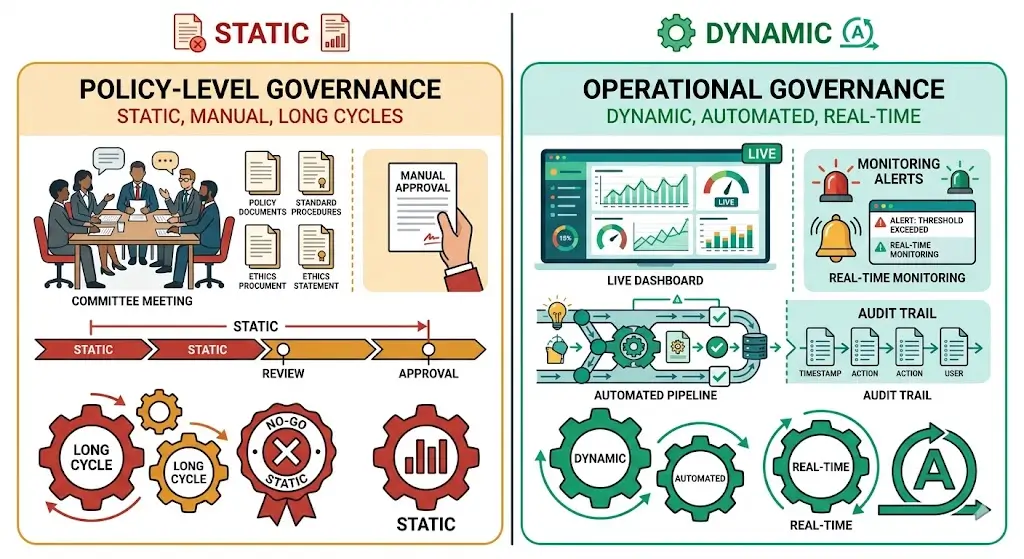
| Dimension | Policy-Level Governance | Operational Governance |
|---|---|---|
| AI Inventory | Known AI systems, informally tracked | Complete register, continuously updated, including shadow AI |
| Accountability | Assigned to functions; unclear for incidents | Named individuals per system; documented decision rights |
| Controls | Described in policy; manually applied | Embedded in pipeline and infrastructure; automated enforcement |
| Evidence | Compiled reactively for audits | Generated continuously; audit-ready at all times |
| Monitoring | Periodic review; manual reports | Continuous automated monitoring with defined alerting thresholds |
| Scalability | Breaks as portfolio grows | Designed to scale; automated for routine, human for exceptions |
| Regulatory defense | Policy statements and intentions | Documented evidence of controls operating as designed |
📋 Section Summary
- The defining failure mode of enterprise AI governance is stopping at policy — written principles with no infrastructure to enforce them in production.
- Five specific gaps separate policy-level from operational governance: inventory completeness, accountability specificity, infrastructure-embedded controls, continuous evidence generation, and scalability design.
- The diagnostic test is concrete: can you name the accountable person for a specific AI incident within thirty seconds, and can your system demonstrate automated response capability? If not, governance is policy-level regardless of how comprehensive the written policy is.
The Organizational Structure: CAIO, Committee, and System Owners
Operational governance requires a specific organizational architecture that policy-level governance typically lacks: a three-tier structure with clear decision rights at each level.
Tier 1: Executive Ownership — The CAIO Function
The Chief AI Officer is the executive responsible for enterprise AI strategy, governance, and implementation — translating AI capabilities into measurable business outcomes while maintaining accountability for risk and regulatory compliance.[3] This is the single fastest-moving data point in enterprise AI governance: as of an IBM Institute for Business Value CEO study covering 2,000 CEOs across 33 countries (May 2026), 76% of organizations globally now have a CAIO — up from just 26% a year earlier.[4] Among FTSE 100 companies specifically, nearly 48% have a CAIO or functional equivalent.[9]
76%
of organizations globally now have a CAIO (May 2026), up from 26% one year prior[4]
44% vs 36%
generative AI prototype-to-production success rate with vs. without a CAIO[10]
91%
of high-maturity organizations have a dedicated AI leader or centralized AI office[10]
28% vs 13%
report direct revenue growth from AI, with vs. without dedicated AI leadership[10]
According to IESE Business School, the CAIO carries three critical functions: technological oversight (AI infrastructure, model performance, deployment readiness), ethical governance (transparency, fairness, and bias guardrails), and organizational transformation (evangelizing AI adoption and training teams across the organization).[5] The transformational dimension — building the organizational culture that makes governance self-sustaining — is consistently the most underestimated and the most determinative of long-term success.
What distinguishes the CAIO from the CTO, CIO, or CDO is breadth of mandate. The CTO builds platforms. The CIO manages infrastructure. The CDO ensures data quality. The CAIO sits across all three, owning the strategic and ethical vision for how AI creates value and manages risk organization-wide — without being subordinate to any of those individual functions’ priorities.[5]
💬 According to EverydayOnAI
The jump from 26% to 76% CAIO adoption in twelve months is one of the fastest executive-role institutionalization curves we’ve seen documented. It’s worth reading skeptically as well as descriptively: a title appearing on an org chart is not the same as the operational accountability this guide is built around. Some of that 76% almost certainly reflects relabeling — a CTO or Chief Data Officer absorbing “AI” into an existing title without a meaningful change in mandate or resources. The useful question isn’t “do you have someone with CAIO in their title” but “does that person have genuine authority to pause a deployment, and a budget line to act on it.” The data on production success rates (44% vs 36%) suggests the accountability effect is real even amid the relabeling — but it’s the accountability, not the title, doing the work.
For a comprehensive treatment of the CAIO role — responsibilities, metrics, reporting structures, and how to determine whether your organization needs one — see our dedicated guide: What Does a Chief AI Officer Actually Do?
Tier 2: Cross-Functional Governance — The AI Governance Committee
Below the CAIO function, operational governance requires a cross-functional AI governance committee with genuine decision authority — not an advisory body, but an operational governance body that approves AI deployments, adjudicates risk classification disputes, reviews incident reports, and sets governance standards.
Effective committees share four structural traits: cross-functional membership spanning legal, technical, business, and risk functions; defined decision rights with documented escalation thresholds (which decisions the committee makes directly vs. which it delegates); a standing cadence separate from ad hoc crisis review; and a charter that specifies what happens when the committee is bypassed — because committees without enforcement teeth become rubber stamps under deadline pressure.
For a complete operational design guide to the AI governance committee — charter templates, decision rights frameworks, and meeting cadence models — see: How to Build an Effective AI Governance Committee.
Tier 3: System-Level Ownership
The tier most frequently missing entirely. Every AI system in the portfolio needs a named individual owner — not a team, not a function, a person — accountable for that system’s risk posture, monitoring response, and incident escalation. System owners are the operational layer that makes Tier 1 and Tier 2 governance enforceable at the point where AI actually runs.
📋 Section Summary
- CAIO adoption jumped from 26% to 76% of organizations globally in twelve months (IBM IBV, May 2026) — named AI executive accountability has become the institutional norm faster than almost any prior C-suite role.
- The three-tier structure (CAIO, cross-functional governance committee, system-level owners) provides decision rights at strategic, cross-functional, and operational levels respectively — all three tiers are necessary; none substitutes for the others.
- Organizations with dedicated AI leadership show measurably better outcomes: 44% vs 36% production success rate, and 28% vs 13% reporting direct revenue growth from AI — though the title itself matters less than the genuine authority and resources behind it.
The Technical Infrastructure of Operational Governance
Organizational structure alone does not produce operational governance — it requires technical infrastructure that makes governance continuous rather than periodic. Four components form the technical backbone.
Component 1: The AI System Registry
The foundational technical artifact: a complete, continuously updated inventory of every AI system in production, including risk classification, system owner, data sources, model lineage, and deployment status. Unlike a one-time inventory exercise, an operational registry integrates with deployment pipelines so new systems are captured automatically rather than discovered during the next audit cycle.
Component 2: Automated Bias and Performance Monitoring
Bias monitoring that runs only at deployment is policy-level governance. Operational governance requires continuous automated monitoring that detects performance degradation, demographic disparate impact, and behavioral drift in production — and routes alerts to accountable owners within defined timeframes.
The technical requirements: baseline performance metrics (accuracy, error rates, false positive/negative rates disaggregated by demographic group) captured at deployment; continuous comparison of production metrics against baseline with statistical significance testing; alerting infrastructure that routes anomaly notifications to system owners with enough context to assess severity; and a documented threshold framework that defines what level of performance deviation requires immediate escalation vs. review at the next governance cycle.
Component 3: Governance-as-Code in the Development Pipeline
The most durable technical governance infrastructure embeds governance checkpoints into the development and deployment pipeline as automated code gates — analogous to security scanning in DevSecOps. A model card requirement that blocks deployment if not completed. A bias test that fails the build if demographic performance gaps exceed defined thresholds. A risk classification check in the deployment workflow that routes high-risk systems to governance committee review before production approval.
When governance is infrastructure rather than process, it applies consistently regardless of deadline pressure, personnel changes, or organizational growth. The organizations that achieve genuine operational readiness are consistently those that treat governance as an engineering problem — not just a legal and compliance problem.
Component 4: Automated Evidence and Audit Trail
Regulators and auditors don’t accept governance descriptions — they ask for evidence. Operational governance generates that evidence continuously as a byproduct of system operation: timestamped logs of AI decisions, records of governance review approvals, bias test results with dates and methodologies, monitoring alert history and response records, and change control documentation for model updates. This evidence infrastructure means that an audit response that previously took weeks of manual compilation can be produced in hours or days.
For a survey of the specific tools and platforms that provide these technical capabilities — model registries, bias monitoring, governance-as-code, and audit trail infrastructure — see our dedicated guide: Top 8 AI Governance Tools and Platforms to Watch in 2026-2027.
📋 Section Summary
- Four technical components make governance operational rather than periodic: an automatically-updated AI system registry, continuous bias/performance monitoring with defined alert thresholds, governance-as-code gates embedded in CI/CD pipelines, and automated audit-ready evidence generation.
- The common thread across all four: governance treated as engineering infrastructure, not as a legal/compliance process layered on top of unchanged technical systems.
- Evidence generation as a continuous byproduct (vs. reactive audit compilation) is the component that most directly determines audit response time — from weeks down to hours or days.
AI Governance Maturity: Four Stages Every Enterprise Passes Through
Enterprise AI governance programs develop in recognizable stages. Understanding where your organization sits on the maturity curve helps prioritize investment and calibrate expectations about what “good enough” looks like at each stage.
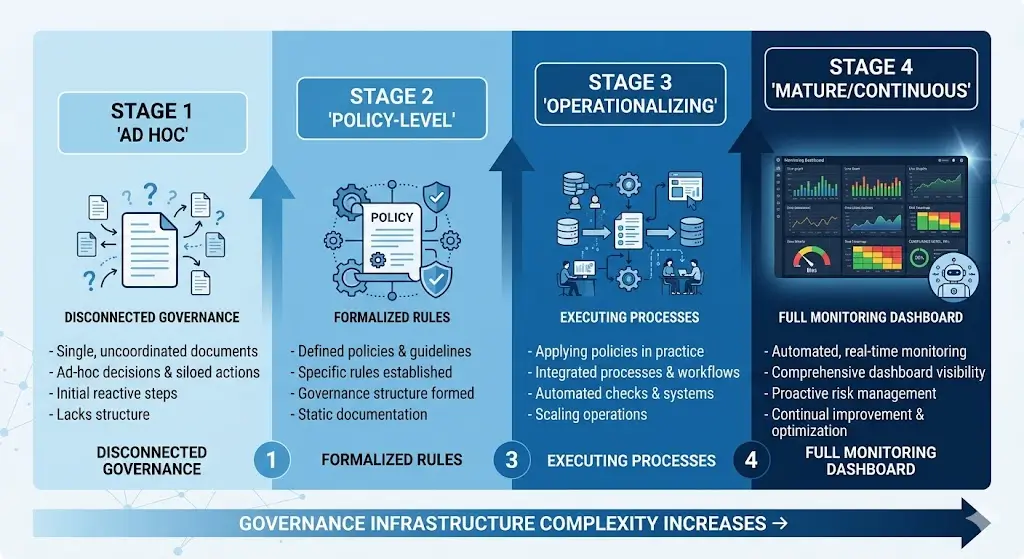
Stage 1: Ad Hoc Governance
AI systems are deployed without formal governance structures. No AI inventory exists. Risk assessment is informal or absent. Accountability for AI outcomes is undefined. This stage is not “evil” — it’s where nearly every organization starts, and where many organizations remain for longer than they realize. The primary risk at Stage 1 is that AI systems are accumulating governance debt: the longer they run without documentation, monitoring, and defined ownership, the harder and more expensive the remediation becomes.
Stage 2: Policy-Level Governance
The organization has AI policies, an ethics statement, and possibly a governance committee. Documentation exists for some AI systems. Bias testing may occur informally. The primary gap: policies are not consistently enforced in production. This is where most enterprise governance programs stall — because the work of writing policies feels complete, while the work of operationalizing them is unglamorous, resource-intensive, and doesn’t produce a deliverable that looks impressive in a board presentation.
Stage 3: Operationalizing Governance
The organization is actively closing the gap between policy and operations. An AI inventory is being built and maintained. Named system owners are being assigned. Technical controls are being embedded in development pipelines. Monitoring infrastructure is being deployed. This stage is characterized by significant organizational friction — governance requirements impose new overhead on development teams, procurement processes, and vendor relationships. The friction is necessary and productive: it means governance is real enough to be encountered as an obstacle, not just an aspiration.
Stage 4: Mature/Continuous Governance
Governance is operational, continuous, and embedded in organizational culture. The AI inventory is complete and maintained automatically. Controls run in the pipeline without manual intervention. Monitoring covers the full portfolio with automated alerting. Evidence is generated as a byproduct of operations. The governance committee focuses on novel risk scenarios and strategic governance questions, not routine oversight. This stage is achievable in 12-18 months with dedicated resources; it requires ongoing investment to maintain.
| Stage | Inventory | Accountability | Controls | Monitoring | Evidence |
|---|---|---|---|---|---|
| 1: Ad Hoc | None or informal | Undefined | None | None | None |
| 2: Policy-Level | Partial, manual | Functional, not named | Documented; inconsistently applied | Periodic manual review | Compiled reactively |
| 3: Operationalizing | Building toward complete | Named; decision rights in progress | Embedded for priority systems | Automated for priority systems | Semi-automated |
| 4: Mature | Complete; auto-maintained | Named; documented; enforced | Embedded across full portfolio | Continuous; automated alerts | Continuous; audit-ready |
📋 Section Summary
- Four maturity stages — Ad Hoc, Policy-Level, Operationalizing, Mature/Continuous — describe a recognizable, sequential path most enterprises follow.
- Stage 2 (Policy-Level) is where most programs stall, because policy completion feels like progress while operational work is harder to demonstrate to a board.
- Stage 3 friction (new overhead on development, procurement, vendor processes) is a healthy sign, not a problem to avoid — it indicates governance has become real enough to be an obstacle rather than an aspiration.
Tool: Governance Maturity Self-Assessment
Answer based on your organization’s current state across the five operational readiness dimensions from Section 1, mapped against the four maturity stages above.
🎯 Interactive Tool
AI Governance Maturity Self-Assessment
Five quick questions covering the five operational readiness dimensions. Answer based on your organization’s current state — not your target state.
1. AI Inventory
2. Accountability
3. Technical Controls
4. Monitoring & Evidence
5. Scalability
Ad Slot: rectangle
Isi NEXT_PUBLIC_ADSENSE_CLIENT & AD_SLOTS
This is a directional self-assessment, not a formal governance audit. Scores are illustrative — actual operational readiness depends on factors specific to your AI portfolio, industry, and regulatory exposure.
Regulatory Alignment at Enterprise Scale
Enterprise AI governance must navigate multiple regulatory frameworks simultaneously — not sequentially. The EU AI Act, Colorado’s AI Act, the NAIC Model Bulletin, NYC Local Law 144, and sector-specific requirements in healthcare, financial services, and government all apply to different subsets of an enterprise’s AI portfolio. Building separate compliance programs for each is both inefficient and unsustainable at enterprise scale.
💬 According to EverydayOnAI
This section required a significant update since original publication. On May 7, 2026, EU lawmakers reached a political agreement that postpones the EU AI Act’s high-risk system deadline by 16 months. If your organization built an implementation plan around the original August 2, 2026 deadline, that plan now has substantially more runway — but the right response is to use that runway for more thorough implementation, not to deprioritize the work. Regulatory delays of this kind are common during major legislative rollouts; treat the extension as risk-adjusted breathing room, not as evidence the requirements are going away.
The operational solution is a unified compliance infrastructure that maps a single set of governance controls to multiple regulatory requirements. Databricks describes this as integrating governance with operational systems to provide “consistency and scalability” — a single data lineage and access control infrastructure that satisfies GDPR, EU AI Act Annex IV, and Colorado’s impact assessment requirements simultaneously, rather than maintaining three separate compliance programs.[6]
What Changed: The EU AI Act’s New 2027/2028 Timeline
On May 7, 2026, the Council of the European Union and European Parliament reached a provisional political agreement on the “Digital Omnibus on AI” — the first substantive amendment package to the AI Act since its 2024 adoption.[11] The most consequential change: high-risk AI system obligations are postponed by 16 months for stand-alone Annex III systems — from August 2, 2026 to December 2, 2027 — covering use cases like employment, biometrics, credit scoring, education, law enforcement, and border control.[12] AI embedded in regulated products under Annex I — medical devices, machinery, vehicles — now has until August 2, 2028, a 12-month extension from the original August 2027 date.[12]
Critically, not everything moved. Prohibited AI practices under Article 5 — social scoring, subliminal manipulation, real-time biometric identification in public spaces — have been enforceable since February 2, 2025 and remain unaffected.[13] GPAI model provider obligations, in effect since August 2, 2025, are also unchanged. A new prohibition targeting AI-generated non-consensual intimate imagery and CSAM (“nudifier” applications) was added to Article 5, taking effect December 2, 2026.[13]
Dec 2, 2027
new deadline for Annex III high-risk AI systems — was August 2, 2026[12]
Aug 2, 2028
new deadline for Annex I product-embedded high-risk AI — was August 2027[12]
€35M
or 7% of global turnover — maximum fine, unaffected by the delay[14]
Feb 2, 2025
prohibited practices already enforceable — not affected by the omnibus delay[13]
The key regulatory intersections enterprise organizations must map in 2026, updated for the new timeline:
| Regulation | Scope | Deadline (Updated) | Key Enterprise Obligation |
|---|---|---|---|
| EU AI Act — Annex III (high-risk, use-based) | Employment, biometrics, credit, education, law enforcement | December 2, 2027 (was Aug 2026) | Risk management, Annex IV documentation, conformity assessment, human oversight |
| EU AI Act — Annex I (product-embedded) | Medical devices, machinery, vehicles | August 2, 2028 (was Aug 2027) | Conformity assessment via existing product safety regimes |
| EU AI Act — Prohibited Practices & GPAI | All AI serving EU residents | In effect since Feb/Aug 2025 | No change — already enforceable |
| Colorado SB 24-205 | High-risk AI affecting Colorado residents | June 30, 2026 | Risk management program, annual impact assessments, consumer notification |
| NAIC Model Bulletin | AI in insurance (24 US states) | In effect | Documented governance, bias controls, audit-ready decision logs |
| NYC Local Law 144 | Automated hiring tools in NYC | In effect | Annual independent bias audit; published results |
| OMB M-24-10 | US federal agencies | December 2024 (passed) | NIST AI RMF-aligned governance; CAIO designation |
For a detailed comparison of NIST AI RMF and ISO 42001 — the two foundational frameworks that enterprise governance programs typically use to structure their multi-regulatory compliance programs — see: ISO/IEC 42001 vs. NIST AI RMF: Which Standard Is Right for Your Organization?
📋 Section Summary
- The May 7, 2026 EU AI Act Digital Omnibus agreement postponed high-risk system obligations by 16 months: Annex III to December 2, 2027, Annex I to August 2, 2028 — but prohibited practices and GPAI obligations remain unaffected and already enforceable.
- Multiple US frameworks (Colorado SB 24-205, NAIC Model Bulletin, NYC Local Law 144) operate on independent timelines from the EU AI Act, requiring a unified compliance infrastructure rather than parallel single-regulation programs.
- The extended EU timeline should be used for more thorough implementation, not deprioritization — the underlying compliance work (risk management, documentation, conformity assessment) is unchanged in substance, only in urgency.
Governance Metrics: What to Measure and Report
If you can’t measure it, you can’t manage it — and you can’t report it to your board. Enterprise AI governance requires a metrics framework that is both operationally meaningful and board-reportable.
“With 81% of data and AI leaders now prioritizing investments accelerating AI capabilities, the compliance burden is growing alongside the AI footprint.”
— IBM Newsroom, cited in Agility at Scale CAIO analysis[5]
Based on CAIO performance frameworks and Gartner research, operational AI governance should be measured across five categories.
Coverage metrics measure how much of your AI portfolio is actually governed: percentage of AI systems with complete governance documentation, percentage with active monitoring, percentage with named system owners. A portfolio coverage score below 80% indicates governance gaps are systemic, not isolated.
Risk metrics quantify how effectively governance manages AI-specific threats: percentage of AI systems that have undergone formal risk assessment within the required cadence, count of unresolved high-risk governance findings (trending upward signals governance capacity problems), and average time from risk discovery to resolution.[5]
Operational metrics track whether the governance machinery itself is functioning: time from AI system deployment request to governance approval (too slow signals bottleneck risk; too fast signals rubber-stamping), percentage of governance reviews completed within SLA, and audit response time — the clearest single proxy for whether evidence generation is continuous or reactive.
Adoption metrics measure whether governance has organizational buy-in beyond mandate: voluntary governance committee consultation rate (teams seeking review before being required to), training completion rates, and self-reported AI system disclosure rate.
Board-level metrics compress the above into the handful of numbers a board actually needs: total AI portfolio size and risk distribution, governance coverage percentage, open high-risk findings count, and regulatory compliance status by jurisdiction. The discipline here is restraint — a board metrics dashboard with thirty data points fails the same way an unreadable policy document does.
Before & After: Policy-Level vs. Operational Governance in Practice
Three concrete scenarios illustrating the gap from Section 1 — the same underlying situation handled by policy-level governance versus operational governance.
✖ Policy-Level: Bias Drift Incident
A hiring AI’s demographic performance gap widens over three months. No automated monitoring exists. The drift is discovered during a routine quarterly review — three months after it began, after an unknown number of affected hiring decisions.
✔ Operational: Bias Drift Incident
Continuous monitoring detects the same drift within 48 hours of crossing the defined statistical threshold. An automated alert routes to the named system owner with disaggregated performance data attached. The system is flagged for review before further deployment, per a pre-documented escalation path.
✖ Policy-Level: Regulator Audit Request
A regulator requests documentation of risk management practices for a high-risk AI system. The compliance team spends three weeks manually reconstructing decision logs, locating model documentation across multiple teams, and assembling evidence that may have gaps for periods when informal processes were followed.
✔ Operational: Regulator Audit Request
The same request is answered in two days. Timestamped decision logs, governance approval records, and monitoring history already exist as a continuous byproduct of system operation. The compliance team’s role shifts from evidence reconstruction to evidence packaging.
✖ Policy-Level: New AI Vendor Tool
A business unit adopts a new SaaS tool with embedded AI features without formal review — the tool wasn’t flagged as “an AI system” by procurement, and no one in governance is aware it exists until it surfaces during the next informal inventory discussion, months later.
✔ Operational: New AI Vendor Tool
Procurement workflow includes an automated AI-feature flag that routes any tool with embedded AI capabilities to governance review before contract signature. The system enters the AI registry at onboarding, with risk classification assigned before production use begins.
Enterprise-Specific Challenges and How to Solve Them
Three challenges distinguish enterprise-scale governance from project-level governance, each requiring a structural rather than tactical response.
Challenge 1: Shadow AI at Scale
The larger the enterprise, the larger the gap between known and actual AI usage — embedded AI in approved SaaS tools, vendor AI capabilities, and employee-adopted tools all accumulate faster than manual discovery can track. The structural fix is procurement-integrated discovery (per the Before/After example above) combined with periodic technical scanning of network traffic and SaaS usage logs for AI API signatures.
Challenge 2: Multi-Jurisdictional Conflict
An AI system compliant with the EU AI Act may face different obligations under Colorado SB 24-205 or NAIC Model Bulletin requirements for the same underlying functionality. The structural fix, per Section 6, is unified compliance infrastructure mapping a single control set to multiple regulatory requirements — not parallel single-jurisdiction programs that multiply maintenance overhead.
Challenge 3: Agentic AI and Autonomous Action
Traditional AI governance frameworks assume a human reviews AI outputs before action is taken. Agentic AI systems that take autonomous action — executing transactions, modifying records, communicating externally — break this assumption, and most existing governance frameworks have no native answer for graduated autonomy controls, action audit trails, or agent identity verification.
For a complete operational playbook for this emerging challenge, see: How to Govern Agentic AI Systems: A Practical Playbook for 2026.
The 90-Day Operational Readiness Checklist
A minimum viable governance program for your highest-risk AI systems, achievable in 90 days per ModelOp’s implementation methodology.[8]
✓ Days 1-30: Foundation
- ★ Identify and document your 5-10 highest-risk AI systems (start here, not with the full portfolio)
- ★ Assign a named individual owner to each priority system
- Establish the AI governance committee charter with documented decision rights
- Designate executive accountability — CAIO or equivalent — even if not yet a dedicated full-time role
✓ Days 31-60: Controls
- ★ Embed at least one technical control (bias test, model card requirement) as a pipeline gate for priority systems
- Establish baseline performance metrics for priority systems, disaggregated by demographic group where applicable
- Document the escalation path: who is notified, within what timeframe, for what severity of finding
- Map priority systems against applicable regulatory frameworks (EU AI Act, Colorado, NAIC, sector-specific)
✓ Days 61-90: Evidence & Scale Planning
- ★ Implement automated logging for priority system decisions and governance actions
- Run a tabletop incident response exercise for at least one priority system
- Document the roadmap for extending priority-system controls to the full AI portfolio
- Establish board-level reporting cadence using the five metric categories from Section 7
The Enterprise AI Governance Implementation Series
📚 Go Deeper: The Enterprise Implementation Series
-
→ What Does a Chief AI Officer Actually Do?
CAIO responsibilities, reporting structures, performance metrics, and whether your organization needs a dedicated role given 76% adoption. -
→ How to Build an Effective AI Governance Committee
Charter templates, decision rights frameworks, and meeting cadence models for the cross-functional governance tier. -
→ Algorithmic Bias Audit: Complete Methodology
Complete methodology for algorithmic bias auditing — pre-deployment and ongoing — with EU AI Act Annex IV compliance mapping and a documentation template. -
→ ISO/IEC 42001 vs. NIST AI RMF: Which AI Governance Standard Is Right for Your Organization?
Head-to-head comparison with decision framework — when to use each, how they complement each other, and how enterprise governance programs can satisfy both simultaneously. -
→ How to Govern Agentic AI Systems: A Practical Playbook for 2026
The governance challenge that no existing framework fully addresses — practical controls for AI agents, Singapore’s Agent Identity Cards, graduated autonomy models, and action audit trails. -
→ Top 8 AI Governance Tools and Platforms to Watch in 2026-2027
The enterprise software landscape for AI governance — model registries, bias monitoring, governance-as-code, and integrated platforms — with use cases and selection guidance. -
→ AI Governance as Competitive Advantage: Why Responsible AI Builds Customer Trust
The commercial case for governance — how enterprise AI governance programs create measurable trust advantage, procurement wins, and talent attraction that ungoverned competitors can’t match.
Frequently Asked Questions
What is enterprise AI governance?
Enterprise AI governance is the operating framework that applies consistent AI risk management controls across a growing portfolio of AI systems, multiple business units, and multiple regulatory jurisdictions simultaneously. The enterprise distinction is scale and complexity: where project-level governance manages one AI system, enterprise governance manages dozens or hundreds, with automated controls to maintain consistency without linear staffing growth. For foundational concepts, see our Complete Guide to AI Governance.
What is the difference between AI policy and AI governance?
Policy defines rules; governance operationalizes them. Policy documents describe what should happen. Governance infrastructure — technical controls, monitoring systems, audit trails, accountability structures — ensures it actually happens in production, continuously. The operational gap between a responsible AI policy and actual AI governance is where most enterprise AI risk lives. Organizations that conflate the two are generating compliance theater, not compliance protection.
How long does it take to achieve enterprise AI governance operational readiness?
90 days for minimum viable governance on priority systems; 12-18 months for full portfolio operational readiness. ModelOp reports that enterprises can establish governance frameworks in under 90 days with the right methodology. Full maturity — automated controls across the full portfolio, continuous monitoring, ISO 42001 certification readiness — requires sustained investment over 12-18 months. The critical error is waiting for full maturity before starting: the 90-day minimum viable program reduces risk on your highest-priority systems while the broader program is built.
Do you need a Chief AI Officer to have enterprise AI governance?
Not strictly — but you need named executive accountability, regardless of title. CAIO adoption has accelerated sharply: 76% of organizations globally now have a CAIO as of May 2026, up from 26% just a year earlier.[4] Organizations with dedicated AI leadership see measurably better production success rates and revenue outcomes. But the accountability is what matters, not the title. For a full analysis of the CAIO role and when to create it vs. embed governance in existing executive functions, see: What Does a Chief AI Officer Actually Do?
What does operational AI governance look like in practice?
Five visible markers: complete AI inventory, named system-level accountability, controls in the infrastructure (not just the policy), continuous automated monitoring, and automatically generated audit-ready evidence. Any enterprise that meets all five has operational governance. Any enterprise that can describe two or three of these but not produce documentation for the others has governance gaps. The checklist for assessing your specific gaps is in our AI Governance Checklist: 25 Questions.
Did the EU AI Act high-risk deadline change in 2026?
Yes, significantly. On May 7, 2026, EU lawmakers reached a provisional political agreement (the “Digital Omnibus on AI”) that postpones high-risk AI system obligations by 16 months — from August 2, 2026 to December 2, 2027 for stand-alone Annex III systems, and to August 2, 2028 for AI embedded in regulated products under Annex I.[12] Prohibited AI practices (Article 5) and GPAI model obligations remain unaffected and are already in force. Organizations should treat the extended timeline as additional preparation time, not as a reason to deprioritize compliance work already underway.
📚 References and Sources
- Ethyca, “AI Governance: Framework, Compliance & Operational Guide 2026.” Private dinner with 20 enterprise data and AI leaders; governance stops at policy layer; operational governance definition; 80% AI project failure rate. ethyca.com
- IE Business School, “Responsible AI Governance in 2026: Frameworks and Failures,” January 26, 2026. Operational governance definition: what systems exist, who owns them, what risks they create, what controls apply, what evidence supports oversight. ie.edu
- Christian & Timbers, “Top AI Leadership Roles Expected in 2026.” CAIO role definition; EU AI Act creating explicit CAIO compliance coordination requirements; sequencing logic for which AI leadership role to staff first. christianandtimbers.com
- IBM Institute for Business Value, CEO Study, May 2026 (2,000 CEOs across 33 countries). 76% of organizations globally now have a CAIO, up from 26% one year prior. Cited via TechJack Solutions, “Chief AI Officer: Complete Guide to CAIO Role 2026,” and SpanGlobal Services, “50 Companies With a Chief AI Officer,” 2026. techjacksolutions.com
- IESE Business School, cited in Agility at Scale, “Chief AI Officer (CAIO).” Three CAIO functions: technological oversight, ethical governance, organizational transformation; CAIO metrics framework (risk, compliance, operational); 81% of data/AI leaders prioritizing AI capability investment (IBM Newsroom). agility-at-scale.com
- Databricks, “A Practical AI Governance Framework for Enterprises.” Integrating governance with operational systems; unified data governance for consistency and scalability; by 2026, AI models from organizations that operationalize transparency, trust, and security achieve 50% increase in adoption and business goals (Gartner). databricks.com
- CIO.com, “The Curious Evolution of the Chief AI Officer,” March 2026. CAIO role evolution from symbolic to operational; AI as infrastructure demanding discipline; clarity and accountability as key CAIO success factors. cio.com
- ModelOp, “AI Governance Roles.” CAIO recruitment tripling in past five years; US federal mandate for agency CAIOs; enterprise governance frameworks achievable in under 90 days. modelop.com
- DataIQ 2025 Benchmark, cited via TechJack Solutions, 2026. Nearly 48% of FTSE 100 companies have a CAIO or equivalent role. techjacksolutions.com
- C-Suite Outlook, “The Chief AI Officer (CAIO) Evolution,” February 3, 2026. 44% vs. 36% generative AI prototype-to-production success rate with vs. without a CAIO; 91% of high-maturity organizations have dedicated AI leadership; 28% vs. 13% report direct revenue growth from AI with vs. without dedicated leadership. csuiteoutlook.com
- Council of the European Union (Consilium), Press Release, May 7, 2026. Provisional political agreement on the Digital Omnibus on AI; first amendment package to the AI Act since 2024 adoption; part of “Omnibus VII” simplification package. consilium.europa.eu
- Inside Privacy (Covington & Burling), “EU AI Act Update: Timeline Relief, Targeted Simplification, and New Prohibitions,” May 18, 2026. Annex III HRAIS obligations postponed from August 2, 2026 to December 2, 2027 (16-month deferral); Annex I HRAIS postponed from August 2, 2027 to August 2, 2028 (1-year deferral); national AI regulatory sandbox deadline postponed to August 2, 2027. insideprivacy.com
- Gibson Dunn, “EU AI Act Omnibus Agreement — Postponed High-Risk Deadlines and Other Key Changes,” May 2026. Prohibited practices and GPAI obligations unaffected by the delay; new Article 5 prohibition on AI-generated non-consensual intimate imagery and CSAM, effective December 2, 2026; formal adoption and Official Journal publication expected before August 2, 2026. gibsondunn.com
- Legiscope, “EU AI Act Deadlines 2026-2027: Compliance Calendar + Fines,” 2026. Maximum fine structure: €35M or 7% of global annual turnover, exceeding GDPR’s €20M/4% structure; prohibited practices enforceable since February 2, 2025; GPAI obligations since August 2, 2025. legiscope.com
Sources verified June 21, 2026. The EU AI Act omnibus amendments described here reflect the May 7, 2026 provisional political agreement; formal adoption and Official Journal publication were expected by August 2026 at time of writing — verify final adopted text before relying on specific dates for compliance planning. This article does not constitute legal advice.
Ad Slot: leaderboard-2
Isi NEXT_PUBLIC_ADSENSE_CLIENT & AD_SLOTS
Share this article